Jumantik Cilik Training for Students of Elementary School 09 Kubu Raya: Empowering School Children as Agents of Change in Dengue Fever Prevention Using Audio Visual and Practical Methods
Article Sidebar
Main Article Content
Abstract
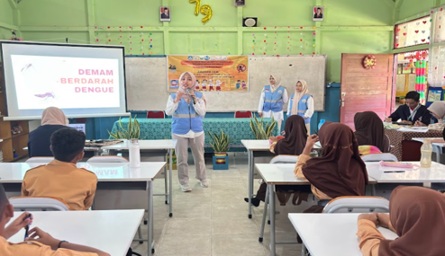
Dengue fever (DF) remains a major health problem in Indonesia, including in the Kubu Raya District, West Kalimantan. Student involvement as young volunteers of the Larva Monitoring Project (Jumantik Cilik) is expected to be an effective prevention strategy. This Jumantik Cilik training aims to improve students’ knowledge about DF and the Dengue Vector Control (PSN). The program involved 50 fifth- and sixth-grade students from Elementary School 09 Kubu Raya through lectures, audiovisual presentations, and hands-on practice. Knowledge was assessed using pretest and posttest questionnaires. The average pretest score was 6.46 (95% CI: 6.10–6.81), and the posttest average score was 9.06 (95% CI: 8.83–9.28). The Shapiro-Wilk test confirmed a normal distribution (p>0.05), and the Paired t-Test showed significant differences between the pretest and posttest scores (p<0.001). These findings show that Jumantik Cilik training effectively increased students’ knowledge of DF and PSN. This strategy is applicable as an educational approach to support sustainable Dengue control and can be replicated in other schools.
Downloads
Article Details

This work is licensed under a Creative Commons Attribution-ShareAlike 4.0 International License.
Authors who publish with this journal agree to the following terms:
- Any article on the copyright is retained by the author(s).
- Author grant the journal, right of first publication with the work simultaneously licensed under a Creative Commons Attribution License that allows others to share work with acknowledgment of the work authors and initial publications in this journal.
- Authors are able to enter into a separate, additional contractual arrangements for non-exclusive distribution of published articles of work (eg, post-institutional repository) or publish it in a book, with acknowledgment of its initial publication in this journal.
- Authors are permitted and encouraged to post their work online (e.g., in institutional repositories or on their websites) prior to and during the submission process, as can lead to productive exchanges, as well as earlier and greater citation of published work.
- The article and any associated published material is distributed under the Creative Commons Attribution-ShareAlike 4.0 International License
References
Ahmadi L, M.Y., Majid, R. and Bahar, H., 2022. Peran Kader Jumantik Terhadap Perilaku Keluarga Dalam Pencegahan DBD Di Desa Amoito Jaya Kecamatan Wolasi Kabupaten Konawe Selatan. Jurnal Kesehatan Lingkungan Universitas Halu Oleo, 3(1). https://doi.org/10.37887/jkl-uho.v3i1.27415.
Askar, N.F., Syaraji, M., Salim, M.F., Santoso, D.B. and Pramono, A.E., 2021. Pemberdayaan Kader Jumantik Cilik Sebagai Upaya Pencegahan Penyakit DBD di SDN 2 Samigaluh Desa Sidoharjo Kecamatan Samigaluh. Jurnal Pengabdian dan Pengembangan Masyarakat, 3(2), p.465. https://doi.org/10.22146/jp2m.51200.
Dinas Kesehatan Provinsi Kalimantan Barat, 2024. Profil Kesehatan Kalimantan Barat Tahun 2024. https://datacloud.kalbarprov.go.id/index.php/s/Kr5QHDR7sG3aE6b#pdfviewer.
Fathariq, G.R., Permatasari, H., Widyatuti and Rahmadiyah, D.C., 2025. Efektivitas Edukasi Berbasis Video terhadap Pengetahuan, Sikap, dan Pencegahan Demam Berdarah pada Anak Sekolah: Tinjauan Sistematik. Jurnal kesehatan komunitas (Journal of community health), 11(3), pp.639–649. https://doi.org/10.25311/keskom.Vol11.Iss3.2382.
Haider, N., Hasan, M.N., Onyango, J. and Asaduzzaman, M., 2024. Global landmark: 2023 marks the worst year for dengue cases with millions infected and thousands of deaths reported. IJID Regions, 13, p.100459. https://doi.org/10.1016/j.ijregi.2024.100459.
Haider, N., Hasan, M.N., Onyango, J., Billah, M., Khan, S., Papakonstantinou, D., Paudyal, P. and Asaduzzaman, M., 2025. Global dengue epidemic worsens with record 14 million cases and 9000 deaths reported in 2024. International Journal of Infectious Diseases, 158, p.107940. https://doi.org/10.1016/j.ijid.2025.107940.
Heyrani, A., Pourjalil, F., Hosseini, Z., Shahabi, N. and Asadipour, E., 2024. A comprehensive scoping review of global educational strategies and outcomes in aedes-borne disease control. Archives of Public Health, 82(1), p.176. https://doi.org/10.1186/s13690-024-01412-3.
Kemenkes RI, 2023. Survei Kesehatan Indonesia (SKI) Tahun 2023. https://www.badankebijakan.kemkes.go.id/laporan-hasil-survei/.
Moallemi, S., Lloyd, A.R. and Rodrigo, C., 2023. Early biomarkers for prediction of severe manifestations of dengue fever: a systematic review and a meta-analysis. Scientific Reports, 13(1), p.17485. https://doi.org/10.1038/s41598-023-44559-9.
Muhammad Rasyid Ridha, Liestiana Indriyati, Juhairiyah, Budi Hairani, Jusniar Ariati and Kusumaningtyas, H., 2022. Implementasi Model Juru Pemantau Jentik (Jumantik) dalam Pengendalian Vektor Demam Dengue pada Masyarakat Heterogen. Penerbit BRIN. https://doi.org/10.55981/brin.451.
National Institutes of Health Islamabad, 2019. Advisory for the Prevention and Control of Dengue Fever . https://www.nih.org.pk/wp-content/uploads/2019/05/Advisory-for-Dengue-Fever-May-2019.pdf.
Nurachman, A. and Sansuwito, T., 2024. The Effectiveness of an Automated Audio System for Health Education Tool on Dengue Fever Prevention Knowledge Using the ‘3M+’ Strategy. Malaysian Journal of Nursing, 16(01), pp.41–46. https://doi.org/10.31674/mjn.2024.v16i01.005.
Taufik, O., Budiyono, B. and Purnami, C.T., 2025. The Role of Elementary Schools in Dengue Fever Control: A Scoping Review. Indonesian Journal of Global Health Research, 7(2), pp.329–340. https://doi.org/10.37287/ijghr.v7i2.5479.
Tayal, A., Kabra, S.K. and Lodha, R., 2023. Management of Dengue: An Updated Review. Indian Journal of Pediatrics, 90(2), pp.168–177. https://doi.org/10.1007/s12098-022-04394-8.
Thach, T.Q., Eisa, H.G., Hmeda, A. Ben, Faraj, H., Thuan, T.M., Abdelrahman, M.M., Awadallah, M.G., Ha, N.X., Noeske, M., Abdul Aziz, J.M., Nam, N.H., Nile, M. El, Dumre, S.P., Huy, N.T. and Hirayama, K., 2021. Predictive markers for the early prognosis of dengue severity: A systematic review and meta-analysis. PLOS Neglected Tropical Diseases, 15(10), p.e0009808. https://doi.org/10.1371/journal.pntd.0009808.
World Health Organization, 2024. Disease Outbreak News; Dengue – Global Situation. [online] https://www.who.int/emergencies/disease-outbreak-news/item/2023-DON518. Available at: https://www.who.int/emergencies/disease-outbreak-news/item/2023-DON518.
Xu, C., Xu, J. and Wang, L., 2024. Long-term effects of climate factors on dengue fever over a 40-year period. BMC Public Health, 24(1), p.1451. https://doi.org/10.1186/s12889-024-18869-0.
Yuan, K., Chen, Y., Zhong, M., Lin, Y. and Liu, L., 2022. Risk and predictive factors for severe dengue infection: A systematic review and meta-analysis. PLOS One, 17(4), p.e0267186. https://doi.org/10.1371/journal.pone.0267186