Pemberdayaan PKK Sukabakti Curug melalui Pelatihan Produksi Opak Tempe sebagai Diversifikasi Pangan Lokal Empowering the PKK Community of Sukabakti, Curug through Tempeh Opak Production Training as a Local Food Diversification Strategy
Article Sidebar
Main Article Content
Abstract
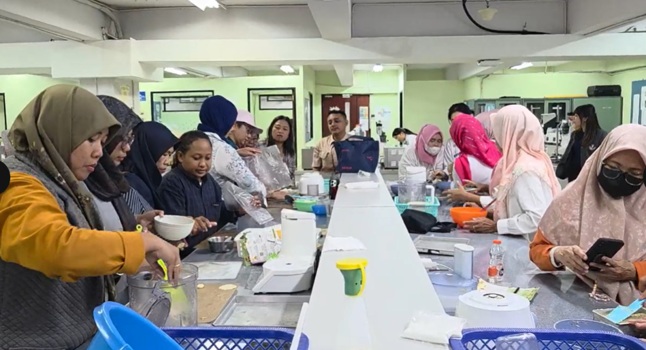
Tempeh is an Indonesian functional food rich in protein and bioactive compounds; however, its relatively short shelf life may lead to economic losses for producers. This issue is also experienced by the PKK community in Sukabakti Village, Curug, where many members are home-scale tempeh producers. This community service program aimed to enhance participants’ knowledge and skills in processing unsold tempeh into value-added products by producing opak tempe (tempeh crackers). The program was implemented through several stages, including formulation preparation, educational sessions, hands-on practice in producing opak tempe, and evaluation through questionnaires. The activity was conducted at the Food Processing Laboratory of Universitas Pelita Harapan and involved 23 participants. Evaluation results showed that 100% of participants perceived the activity as beneficial and expressed interest in participating in similar programs in the future, while 92% were willing to recommend opak tempe to others. These findings indicate that training in tempeh product diversification has the potential to increase product value and contribute to community economic empowerment.
Downloads
Article Details

This work is licensed under a Creative Commons Attribution-ShareAlike 4.0 International License.
Authors who publish with this journal agree to the following terms:
- Any article on the copyright is retained by the author(s).
- Author grant the journal, right of first publication with the work simultaneously licensed under a Creative Commons Attribution License that allows others to share work with acknowledgment of the work authors and initial publications in this journal.
- Authors are able to enter into a separate, additional contractual arrangements for non-exclusive distribution of published articles of work (eg, post-institutional repository) or publish it in a book, with acknowledgment of its initial publication in this journal.
- Authors are permitted and encouraged to post their work online (e.g., in institutional repositories or on their websites) prior to and during the submission process, as can lead to productive exchanges, as well as earlier and greater citation of published work.
- The article and any associated published material is distributed under the Creative Commons Attribution-ShareAlike 4.0 International License
References
REFERENSI
Ellent, S. S. C., Dewi, L., & Tapilouw, M. C. (2022). Karakteristik mutu tempe kedelai (Glycine max L.) yang dikemas dengan klobot. AGRITEKNO: Jurnal Teknologi Pertanian, 11(1), 32–40. https://doi.org/10.30598/jagritekno.2022.11.1.32
Ilmi, I. M. B., Sofianita, N. I., Arini, F. A., & Anwar, K. (2023). Diversifikasi keripik tempe Pondok Pesantren Sirajussaadah Depok. Jurnal Bakti Masyarakat Indonesia, 6(3), 578–584. https://doi.org/10.24912/jbmi.v6i3.26587
Ismiyati, S., Ayu, I. W., Wijayanti, N., Yani, A., & Syafruddin. (2025). Analisis kualitatif dinamika pertumbuhan home industry tempe berdasarkan faktor internal dan eksternal di Kecamatan Sumbawa. JRAM: Jurnal Riset Agribisnis dan Manajemen, 1(1), 38–56.
Komala, K., Dewanti-Hariyadi, R., & Wulandari, N. (2024). Ketersediaan tempe yang menerapkan cara produksi pangan yang baik di Jabodetabek serta pengetahuan konsumen untuk membelinya. Jurnal Mutu Pangan: Indonesian Journal of Food Quality, 11(1), 1–10. https://doi.org/10.29244/jmpi.2024.11.1.1
Muchtar, F., Hastian, & Ruksanan. (2023). Analisis kadar air, kadar protein, dan karakteristik organoleptik kerupuk stik dengan penambahan konsentrasi ikan layang yang berbeda. AGRITEKH (Jurnal Agribisnis dan Teknologi Pangan), 3(2), 94–105. https://doi.org/10.32627/agritekh.v3i2.630
Nugraha, A. (2024). Identifikasi kadar air pada keripik talas. Journal of Food Security and Agroindustry (JFSA), 2(3), 74–79. https://doi.org/10.58184/jfsa.v2i3.477
Nurdjanah, S., Putri, A., Susilawati, Nurbaiti, & Larassati, D. P. (2025). Kajian ketebalan dan lama pengeringan terhadap sifat kimia, sensoris, dan fisik opak tepung ubi kayu (Manihot esculenta C.). Agrointek, 19(4), 908–915. https://doi.org/10.21107/agrointek.v19i4.22711
Nuriyah, A. S., Nisa, K., Sangrila, K., & Muniroh, A. (2025). Tempe sebagai sumber isoflavon alami: Review article. Jurnal Life Science, 7(1), 19–24. https://doi.org/10.31980/lsciences.v7i1.2285
Parhusip, A. J. N., & Gandhy, A. (2023). Pangan fungsional dan ekonomi sirkular maggot. Penerbit Lakeisha.
Pemilia, A., Handito, D., & Sulastri, Y. (2019). Pengaruh konsentrasi tepung tempe terhadap nutrisi dan mutu sensori opak singkong dari Lombok Utara. Pro Food: Jurnal Ilmu dan Teknologi Pangan, 5(2), 459–468. https://doi.org/10.29303/profood.v5i2.99
Pramaningsih, V., Wahyuni, M., & Suryawan, S. H. (2022). Peningkatan kualitas kemasan tempe menggunakan mesin continuous sealer. PengabdianMu: Jurnal Ilmiah Pengabdian kepada Masyarakat, 7(Special Issue 1), 187–192. https://doi.org/10.33084/pengabdianmu.v7iSpecial-1.2448
Purwanto, Y. A., & Weliana. (2018). Kualitas tempe kedelai pada berbagai suhu penyimpanan. Warta Industri Hasil Pertanian, 35(2), 106–112. https://doi.org/10.32765/wartaihp.v35i2.4297
Putra, D. A., Zaini, M. A., & Handito, D. (2018). Pengaruh tepung tempe dan virgin coconut oil (VCO) terhadap mutu nutrisi dan sensoris keripik jagung-tempe. Pro Food: Jurnal Ilmu dan Teknologi Pangan, 4(2), 351–362. https://doi.org/10.29303/profood.v4i2.81
Rahman, S., & Dwiani, A. (2021). Pengaruh substitusi tepung tapioka dan tepung terigu serta lama waktu pengukusan terhadap mutu kerupuk sape. Jurnal Triton, 12(1), 45–57. https://doi.org/10.47687/jt.v12i1.156
Saefudin, S., Pujianto, M. E., Puspita, N., & Rohman, T. (2026). Diversifikasi produk tempe melalui penerapan teknologi tepat guna untuk industri rumah tangga. PengabdianMu: Jurnal Ilmiah Pengabdian kepada Masyarakat, 11(1), 289–295. https://doi.org/10.33084/pengabdianmu.v11i1.10848
Safitry, A., Pramadani, M., Febriani, W., Achyar, A., & Fevria, R. (2021). Uji organoleptik tempe dari kacang kedelai (Glycine max) dan kacang merah (Phaseolus vulgaris). Prosiding SEMNAS BIO: Inovasi Riset Biologi dalam Pendidikan dan Pengembangan Sumber Daya Lokal, 358–368. https://doi.org/10.24036/prosemnasbio/vol1/352
Widhiantari, I. A., Puspitasari, I., Khalil, I. F., Fuadi, M., Saputra, O., Zulfikar, W., Ningsih, S. M., & Aen, N. (2024). Aplikasi efek rumah kaca pada pengeringan jaje opak sebagai bentuk peningkatan kualitas dan higienitas produk di Desa Sigerongan, Kecamatan Lingsar, Kabupaten Lombok Barat. Jurnal Pengabdian Magister Pendidikan IPA, 7(3), 1116–1122. https://doi.org/10.29303/jpmpi.v7i3.8793