Peningkatan Kapasitas Masyarakat dalam Produksi Hair Oil dan Hand Gel Alami Berbasis Sereh dan Lidah Buaya pada Masyarakat Mitra Gerakan Ekonomi Kaum Ibu (GEMI) Yogyakarta Enhancing Community Capacity in the Production of Lemongrass and Aloe Vera-Based Natural Hair Oil and Hand Gel for the Gerakan Ekonomi Kaum Ibu (GEMI) Partner Community in Yogyakarta
Article Sidebar
Main Article Content
Abstract
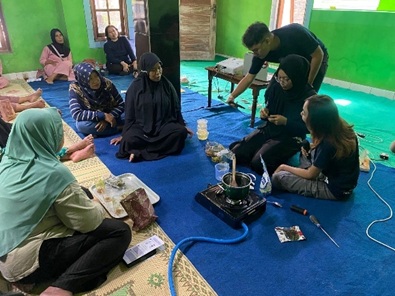
The utilization of local plants as natural ingredients for personal care products has significant potential to enhance community economic value. However, the use of plants such as lemongrass (Cymbopogon citratus) and aloe vera (Aloe vera) among communities is generally limited to basic household purposes, resulting in underutilized economic potential. This community engagement program aimed to improve the knowledge and skills of members of the Gerakan Ekonomi Kaum Ibu (GEMI) group in processing natural materials into personal care products, specifically hair oil and hand gel. The program applied the Asset Based Community Development (ABCD) approach through several stages, including planning, socialization, practical training, evaluation, and the preparation of simple guidelines to support program sustainability. The training method involved demonstrations and hands-on practice using locally available materials. Program evaluation was conducted using pre-test and post-test instruments to measure participants’ knowledge improvement. The results showed a significant increase in participants’ average scores by 21.82%, from 47.27% in the pre-test to 69.09% in the post-test. These findings indicate that the training effectively enhanced community understanding of natural ingredients for personal care products. The resulting products use easily accessible materials, involve simple production processes, and have potential for development as home-based economic activities.
Downloads
Article Details

This work is licensed under a Creative Commons Attribution-ShareAlike 4.0 International License.
Authors who publish with this journal agree to the following terms:
- Any article on the copyright is retained by the author(s).
- Author grant the journal, right of first publication with the work simultaneously licensed under a Creative Commons Attribution License that allows others to share work with acknowledgment of the work authors and initial publications in this journal.
- Authors are able to enter into a separate, additional contractual arrangements for non-exclusive distribution of published articles of work (eg, post-institutional repository) or publish it in a book, with acknowledgment of its initial publication in this journal.
- Authors are permitted and encouraged to post their work online (e.g., in institutional repositories or on their websites) prior to and during the submission process, as can lead to productive exchanges, as well as earlier and greater citation of published work.
- The article and any associated published material is distributed under the Creative Commons Attribution-ShareAlike 4.0 International License
References
Bakkali, F., Averbeck, S., Averbeck, D., & Idaomar, M. (2008). Biological effects of essential oils. Food and Chemical Toxicology, 46(2), 446–475. https://doi.org/10.1016/j.fct.2007.09.106.
Baser, K. H. C., & Buchbauer, G. (2015). Handbook of Essential oils: Science, Technology, and Applications. CRC Press. https://www.taylorfrancis.com/books/mono/10.1201/b19393/handbook-essential-oils-husnu-baser-gerhard-buchbauer
Boyce, J. M., & Pittet, D. (2002). Guideline for hand hygiene in health-care settings. Morbidity and Mortality Weekly Report, 51(RR-16), 1–45. https://www.cdc.gov/mmwr/PDF/rr/rr5116.pdf
Draelos, Z. D. (2015). Cosmetic Dermatology: Products and Procedures. Wiley Blackwell.
Eshun, K., & He, Q. (2004). Aloe vera : A valuable ingredient for the food, pharmaceutical and cosmetic industries. Critical Reviews in Food Science and Nutrition, 44(2), 91–96. https://doi.org/10.1080/10408690490424694.
Kolb, D. A. (2015). Experiential Learning: Experience as the Source of Learning and Development. Pearson Education.
Lin, T. K., Zhong, L., & Santiago, J. L. (2017). Anti-inflammatory and skin barrier repair effects of topical oils. International Journal of Molecular Sciences, 18(12), 2489. https://doi.org/10.3390/ijms19010070.
Lina, E. C., Fithri, P., & Ningsih, V. S. (2021). Pemanfaatan limbah sereh wangi menjadi insektisida botani di Kota Solok. Jurnal Hilirisasi IPTEKS, 4(2), 110–118. https://doi.org/10.25077/jhi.v4i2.512
Muzaki, H., Susanto, G., Widyartono, D., Aksani, I., & Panich, P. (2024). Development of Online Indonesian Language Teaching Materials for Foreign Speakers for level 1 learners. Indonesian Languange Education and Literature, 9(2), 252-256. https://doi.org/10.24235/ileal.v9i2.14287
Najamudin, F., & Al Fajar, A. H. (2024). Pemberdayaan masyarakat berbasis sumber daya lokal melalui pendekatan ABCD untuk mencapai SDG 1: Tanpa kemiskinan. Focus: Jurnal Pekerjaan Sosial, 7(2), 142–158. https://doi.org/10.24198/focus.v7i2.58936
Nurfadilah, A. F., & Moektiwardoyo, M. (2020). Potensi tumbuhan sebagai repellent Aedes aegypti vektor demam berdarah dengue. Farmaka, 17(3), 84–90. https://doi.org/10.24198/jf.v17i3.22034.g12484
Nurmawati, A., Puspitawati, I. N., Anggraeni, I. F., Raditya, D. W., Pradana, N. S., & Saputro, E. A. (2022). Pengenalan pemanfaatan ekstrak serai wangi sebagai pestisida organik di Desa Bocek Karangploso Malang. ABSYARA: Jurnal Pengabdian Pada Masyarakat, 3(1), 110–116. https://doi.org/10.29408/ab.v3i1.5844
Nurlia, R., Zulfiani, E., & Duriyah, F. (2025). Pemberdayaan masyarakat melalui edukasi makanan pendamping ASI (MPASI) berbasis regulasi hukum kesehatan dalam pencegahan stunting. Jurnal Pengabdian Masyarakat Aufa, 7(2), 1–5. https://doi.org/10.51933/jpma.v7i2.2100
I H N Bassolé 1, A Lamien-Meda, B Bayala, L C Obame, A J Ilboudo, C Franz, J Novak, R C Nebié, M H Dicko (2011). Chemical composition and antimicrobial activity of Cymbopogon citratus and Cymbopogon giganteus essential oils alone and in combination. Phytomedicine, 18(12):1070-4. https://doi.org/10.1016/j.phymed.2011.05.009
Putri, D. F. A., & Agustikawati, N. (2025). Pemberdayaan masyarakat desa dalam pembuatan anti nyamuk cair Serute (serai dan jeruk monte). Jurnal Pengabdian Masyarakat Nusantara, 7(1), 14–19. https://doi.org/10.57214/pengabmas.v7i1.740
Qadafi, D. M., Hastutiek, P., Maslachah, L., Suprihati, E., & Hambal, M. (2021). Repellent effectiveness of permot leaf ethanol extract (Passiflora foetida Linn.) against Aedes aegypti adult mosquitoes. Journal of Parasite Science, 5(1), 25–30. https://doi.org/10.20473/jops.v5i1.29962
Rahmawati, S., Fatmawati, A., & Gunawan, A. (2025). Formulasi dan uji SPF sediaan lip cream kombinasi ekstrak bunga telang dan minyak lemon. Jurnal Farmasi Klinik dan Sains, 5(1), 59–70. https://doi.org/10.26753/jfks.v5i1.1696
Sari, G. N. F., Rejeki, E. S., Rahayu, M. P., Harmastuti, N., Turahman, T., & Supriyadi. (2021). Pelatihan pembuatan minyak telon antinyamuk sebagai upaya perawatan kesehatan anak dan perintisan home industri di Surakarta. Journal of Dedicators Community, 5(1), 59–65. https://doi.org/10.34001/jdc.v5i1.1192
Shah, G., Shri, R., Panchal, V., Sharma, N., Singh, B., & Mann, A. (2011). Scientific basis for the therapeutic use of Cymbopogon citratus. Journal of Advanced Pharmaceutical Technology & Research, 2(1), 3–8. https://doi.org/10.4103/2231-4040.79796
Shiroja, M., Baru, C. R., Sriya, J., Kumar, M. S., Uddin, T. S., & Nehal, M. M. U. (2025). Preparation and evaluation of hair oil enriched with Aloe vera. International Journal of Pharmaceutical Research and Applications, 10(4), 224–230. https://doi.org/10.35629/4494-1004224230
Siskayanti, R., Kosim, M. E., & Saputra, D. A. (2021). Analisis konsentrasi minyak atsiri dari sereh sebagai aditif dalam pembuatan lotion anti nyamuk. Jurnal Redoks, 6(1), 26–34. https://doi.org/10.31851/redoks.v6i1.5564
Sofiani, V., & Pratiwi, R. (2017). Pemanfaatan minyak atsiri pada tanaman sebagai aromaterapi dalam sediaan farmasi. Farmaka, 15(2), 119–131. https://doi.org/10.24198/jf.v15i2.12907
Surjushe, A., Vasani, R., & Saple, D. (2008). Aloe vera : A short review. Indian Journal of Dermatology, 53(4), 163–166. https://doi.org/10.4103/0019-5154.44785