Edukasi Literasi Digital Partisipatif melalui Storytelling dalam Meningkatkan Keamanan dan Komunikasi Orang Tua-Anak di Ruang Digital Participatory Digital Literacy Education through Storytelling to Improve Digital Safety and Parent–Child Communication in Digital Spaces
Article Sidebar
Main Article Content
Abstract
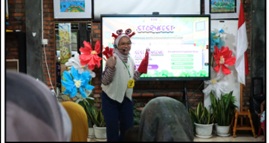
This community service activity aims to improve digital literacy, digital security awareness, and the quality of communication between parents and children in the digital space. The activity was carried out at the Alang-Alang Foundation in Ciawi, Bogor, using a participatory approach based on experiential learning that integrates digital security education, dialogic communication through "Digital Talk - Mom & Me," and storytelling training as an alternative non-gadget literacy activity. The methods used included education, direct practice, and interactive discussions involving parents, children, and the foundation. Evaluation was carried out through observation and a reflective questionnaire completed by 16 respondents. The results of the activity showed that the majority of participants gave positive responses, with the categories strongly agree and agree dominating across indicators of digital literacy understanding, data security, communication, and self-confidence. In addition, this activity produced digital educational content that can be utilized more widely by the community. These findings indicate that the integration of digital literacy and participatory storytelling can be an effective approach to building family communication and increasing awareness of the wise use of technology. This program also has the potential to be developed sustainably in the context of community-based digital literacy.
Downloads
Article Details

This work is licensed under a Creative Commons Attribution-ShareAlike 4.0 International License.
Authors who publish with this journal agree to the following terms:
- Any article on the copyright is retained by the author(s).
- Author grant the journal, right of first publication with the work simultaneously licensed under a Creative Commons Attribution License that allows others to share work with acknowledgment of the work authors and initial publications in this journal.
- Authors are able to enter into a separate, additional contractual arrangements for non-exclusive distribution of published articles of work (eg, post-institutional repository) or publish it in a book, with acknowledgment of its initial publication in this journal.
- Authors are permitted and encouraged to post their work online (e.g., in institutional repositories or on their websites) prior to and during the submission process, as can lead to productive exchanges, as well as earlier and greater citation of published work.
- The article and any associated published material is distributed under the Creative Commons Attribution-ShareAlike 4.0 International License
References
Badan Pusat Statistik. (2024). Statistik telekomunikasi Indonesia 2023. https://www.bps.go.id/id/publication/2024/08/30/f4b846f397ea452bdc2178b3/statistik-telekomunikasi-indonesia-2023.html
Buckingham, D. (2015). Defining digital literacy: What do young people need to know about digital media? Nordic Journal of Digital Literacy, 10, 21–35. https://doi.org/10.18261/ISSN1891-943X-2015-Jubileumsnummer-03
Gee, J. P. (2015). Social linguistics and literacies: Ideology in discourses (5th ed.). Routledge.
Hobbs, R. (2017). Create to learn: Introduction to digital literacy. Wiley Blackwell.
Isbell, R., Sobol, J., Lindauer, L., & Lowrance, A. (2004). The effects of storytelling and story reading on the oral language complexity and story comprehension of young children. Early Childhood Education Journal, 32(3), 157–163. https://doi.org/10.1023/B:ECEJ.0000048967.94189.a3
Katadata Insight Center. (2023). Indeks literasi digital Indonesia 2022: Ringkasan eksekutif.
Kementerian Komunikasi dan Informatika Republik Indonesia. (2022). Laporan survei literasi digital nasional 2022.
Kurnia, N., & Astuti, S. I. (2017). Peta gerakan literasi digital di Indonesia: Studi tentang pelaku, ragam kegiatan, kelompok sasaran, dan mitra yang dilakukan oleh Japelidi. Informasi, 47(2), 149–166. https://doi.org/10.21831/informasi.v47i2.16079
Livingstone, S., & Byrne, J. (2018). Parenting in the digital age: The challenges of parental responsibility in comparative perspective. In G. Mascheroni, C. Ponte, & A. Jorge (Eds.), Digital parenting: The challenges for families in the digital age (pp. 19–30). Nordicom. https://norden.diva-portal.org/smash/get/diva2:1535895/FULLTEXT01.pdf
Livingstone, S., Stoilova, M., & Nandagiri, R. (2019). Children’s data and privacy online: Growing up in a digital age—An evidence review. London School of Economics and Political Science. https://www.lse.ac.uk/my-privacy-uk/Assets/Documents/Childrens-data-and-privacy-online-report-for-web.pdf
Nasrullah, R., Aditya, W., Satya, T. I., Nento, M. N., Hanifah, N., Miftahussururi, & Akbari, Q. S. (2017). Materi pendukung literasi digital. Kementerian Pendidikan dan Kebudayaan.
Nicolopoulou, A., Cortina, K. S., Ilgaz, H., Cates, C. B., & de Sá, A. B. (2015). Using a narrative- and play-based activity to promote low-income preschoolers’ oral language, emergent literacy, and social competence. Early Childhood Research Quarterly, 31, 147–162. https://doi.org/10.1016/j.ecresq.2015.01.006
OECD. (2021). 21st-century readers: Developing literacy skills in a digital world. OECD Publishing. https://doi.org/10.1787/a83d84cb-en
UNICEF. (2017). The state of the world’s children 2017: Children in a digital world. https://www.unicef.org/reports/state-worlds-children-2017