Pengenalan Profesi Pawang Gajah menggunakan Media Komik untuk Siswa SMP Introduction to the Elephant Tamer Profession using Comic Media for Middle School Student
Article Sidebar
Main Article Content
Abstract
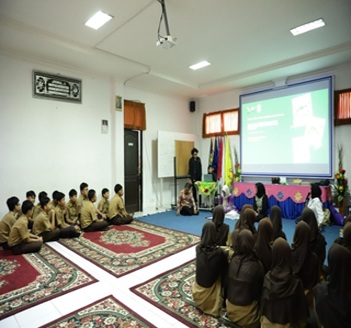
This community service program is motivated by the limited understanding among middle school students of conservation-related professions, particularly elephant tamers (mahouts), and by the lack of engaging, contextual learning media. The program aims to introduce the mahout profession through an educational comic based on local potential at Way Kambas National Park. A collaborative approach using design thinking and participatory methods was applied, consisting of preparation, media development, implementation, and evaluation stages. The main output was an educational comic titled “Mahout Si Penjaga Gajah,” designed to suit adolescent characteristics. The implementation included collective reading activities, discussions, and educational sessions supported by pretest and posttest assessments. The results indicate an improvement in students’ understanding, with the average score increasing from 6.33 to 6.87, and notable gains in previously weak knowledge areas. Additionally, students’ interest in the topic was relatively high, with an average score of 77%. These findings suggest that comic-based media is an effective alternative educational tool for introducing conservation professions and can serve as contextual teaching material for educators. Therefore, story-based visual media has the potential to enhance both students' understanding and interest in environmental and conservation-related careers.
Downloads
Article Details

This work is licensed under a Creative Commons Attribution-ShareAlike 4.0 International License.
Authors who publish with this journal agree to the following terms:
- Any article on the copyright is retained by the author(s).
- Author grant the journal, right of first publication with the work simultaneously licensed under a Creative Commons Attribution License that allows others to share work with acknowledgment of the work authors and initial publications in this journal.
- Authors are able to enter into a separate, additional contractual arrangements for non-exclusive distribution of published articles of work (eg, post-institutional repository) or publish it in a book, with acknowledgment of its initial publication in this journal.
- Authors are permitted and encouraged to post their work online (e.g., in institutional repositories or on their websites) prior to and during the submission process, as can lead to productive exchanges, as well as earlier and greater citation of published work.
- The article and any associated published material is distributed under the Creative Commons Attribution-ShareAlike 4.0 International License
References
Alfaruqy, D., & Setyawan, H. (2026). Analisis Variasi Lanskap Linguistik di Taman Nasional Way Kambas (TNWK) sebagai Daya Tarik Wisata. TOBA: Journal of Tourism, Hospitality, and Destination, 5(1), 97-103. https://doi.org/10.55123/toba.v5i1.7143
A. T. Awaliah, B. S. Dewi, and G. D. Winarno. 2018. Palatabilitas Badak Sumatera (Dicerorhinus sumatrensis) di Suaka Rhino Sumatera. Jurnal Sylva Lestari. 6 (3): 64–72. https://doi.org/10.23960/jsl3664-72
A. Khoiron. 2017. Mahout Sebagai Pemandu Wisata Pada Pusat Latihan Gajah di Minas Siak Riau. JOM Fisip. 4(1): 1–15. https://jom.unri.ac.id/index.php/JOMFSIP/article/view/13727
Ariswandy, D. (2021). Pelatihan dan Kompensasi Pawang/Mahout Gajah Jinak (Captive) Terhadap Kinerja di Balai Besar Taman Nasional Bukit Barisan Selatan. Jurnal Ilmu Manajemen Saburai (JIMS), 7(2), 101-114. https://doi.org/10.24967/jmb.v7i2.1381
E. Ghozali. 2020. Panduan Mengilustrasi dan Mendesain Cerita Anak untuk Profesional. Jakarta: Pusat Pembinaan Bahasa dan Sastra. https://doi.org/10.32815/jeskovsia.v8i02.1006
L. E. Tressler. 2015. Increasing career exploratory behavior through message framing. Psychology and Behavioral Sciences. https://digitalcommons.latech.edu/dissertations/227/
L. Purwanuriski et al. 2022. Analisis Mitigasi Konflik Gajah Sumatera di Balai Besar TN Bukit Barisan Selatan. Jurnal Belantara. 5 (2): 178–190. https://doi.org/10.29303/jbl.v5i1.865
Khairunnisa, H., Prasetyo, J. S., Jehane, P. T., & Asyianita, R. A. (2019). Kajian pengembangan wisata edukasi berbasis konservasi di Taman Hutan Raya KGPAA Mangkunegoro I Karanganyar. Bio Educatio, 4(2), 378998. https://dx.doi.org/10.31949/be.v4i2.1590
Miftahudin, M., Winarno, G. D., Santoso, T., & Darmawan, A. (2021). Analisis Obyek Daya Tarik Wisata (ODTW) dan interpretasi jalur ekowisata Elephant Tour di pusat Latihan Gajah Taman Nasional Way Kambas. Jurnal Hutan Tropis, 9(2), 270-281. https://ppjp.ulm.ac.id/journal/index.php/jht/article/view/11275/7250
Muniroh, L., & Harianto, S. P. (2018). Penggunaan bahasa pawang dan teknik pelatihan gajah sumatera untuk menunjang ekowisata di pusat latihan gajah taman nasional way kambas (TNWK). Jurnal Hutan Tropis, 6(3), 292-301. https://dx.doi.org/10.20527/jht.v6i3.6010
Noverita, A., Darliana, E., & Darsih, T. K. (2023). Pengembangan media pembelajaran komik berbasis kearifan lokal untuk meningkatkan literasi lingkungan siswa SMP. Jurnal Bionatural, 10(2). https://doi.org/10.61290/bio.v10i2.730
Rahayu, K. P., & Utami, W. S. (2018). Pengembangan Potensi Wisata Edukasi di Kawasan Wisata Trawas Kabupaten Mojokerto. Swara Bhumi, 5(7). https://ejournal.unesa.ac.id/index.php/swara-bhumi/article/view/24876
Rahman, A. (2026). Peran Edukasi Lingkungan Dalam Meningkatkan Kesadaran Konservasi Pada Siswa. Jurnal Pendidikan Ilmu Pengetahuan Alam, 1(2), 43-49. https://pendidikan.samudrailmu.com/index.php/jpipa/article/view/74
Riba’i, A. Setiawan, and A. Darmawan. 2013. Perilaku Makan Gajah Sumatera di Pusat Konservasi Gajah TNWK. Media Konservasi. 18 (2): 89–95. https://doi.org/10.29243/medkon.18.2.%p
Soenarno, S. M. (2024). Pendidikan konservasi alam merupakan sebuah pendidikan karakter. EduBiologia: Biological Science and Education Journal, 4(1), 8-12. http://dx.doi.org/10.30998/edubiologia.v4i1.22150
Priyansah, S., & Kurnia, F. (2022). Edukasi Konservasi Lingkungan Pada Generasi Muda Desa Batu Beriga. Jurnal Abdimas PHB, 5(4). https://doi.org/10.30591/JAPHB.V5I4.3641