Sosialisasi Budaya Sekolah Aman dan Nyaman di SMA Negeri 4 Palangka Raya Socializing Safe and Comfortable School Culture at SMA Negeri 4 Palangka Raya
Article Sidebar
Main Article Content
Abstract
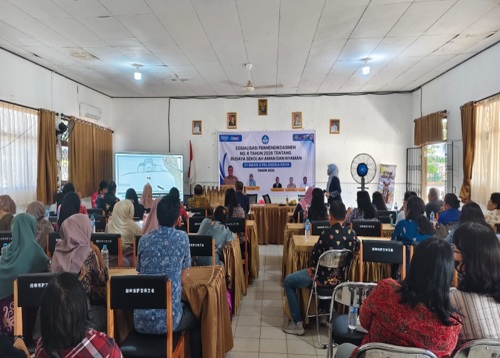
This community service program aimed to strengthen school stakeholders’ understanding, implementation readiness, and follow-up direction regarding the Regulation of the Minister of Primary and Secondary Education Number 6 of 2026 on Safe and Comfortable School Culture at SMA Negeri 4 Palangka Raya. The program was carried out through an educative and participatory socialization model integrated with pretest and posttest questionnaires, a participant satisfaction survey, open-ended responses, activity observation, and documentation. Quantitative data were analyzed descriptively using means, while qualitative data were examined thematically to interpret school-level implementation needs. A total of 53 participants completed the pretest, 44 completed the posttest, and 21 completed the satisfaction survey. The mean pretest score was 4.71, and the mean posttest score was 4.72 on a 1-5 scale, indicating that participants already had a good initial understanding, while the program mainly strengthened more operational aspects, including the four BSAN pillars, the distinction between non-criminal case handling and cross-sector referrals, student participation, and digital safety. The mean satisfaction score reached 4.75. Qualitative findings suggest the need to translate the policy into school rules, standard operating procedures, reporting channels, case-handling simulations, digital literacy efforts, and stronger partnerships with parents and the school committee. The program confirms that policy socialization can effectively serve as an initial stage in strengthening school culture when accompanied by needs assessment and concrete follow-up planning.
Downloads
Article Details

This work is licensed under a Creative Commons Attribution-ShareAlike 4.0 International License.
Authors who publish with this journal agree to the following terms:
- Any article on the copyright is retained by the author(s).
- Author grant the journal, right of first publication with the work simultaneously licensed under a Creative Commons Attribution License that allows others to share work with acknowledgment of the work authors and initial publications in this journal.
- Authors are able to enter into a separate, additional contractual arrangements for non-exclusive distribution of published articles of work (eg, post-institutional repository) or publish it in a book, with acknowledgment of its initial publication in this journal.
- Authors are permitted and encouraged to post their work online (e.g., in institutional repositories or on their websites) prior to and during the submission process, as can lead to productive exchanges, as well as earlier and greater citation of published work.
- The article and any associated published material is distributed under the Creative Commons Attribution-ShareAlike 4.0 International License
References
Aldridge, J. M., & McChesney, K. (2018). The relationships between school climate and adolescent mental health and wellbeing: A systematic literature review. International Journal of Educational Research, 88, 121–145. https://doi.org/10.1016/j.ijer.2018.01.012
Chen, Q., Wang, H., Li, T., & Wang, Y. (2024). The role of school climate on student disclosure of private information and cyberbullying: A comparison of regular and vocational school students in China. Frontiers in Public Health, 12, Article 1336617. https://doi.org/10.3389/fpubh.2024.1336617
Cohen, J., McCabe, E. M., Michelli, N. M., & Pickeral, T. (2009). School climate: Research, policy, teacher education and practice. Teachers College Record, 111(1), 180–213. https://doi.org/10.1177/016146810911100108
Hansen, K. G., & Barene, S. (2025). Exploring the associations between school climate and mental wellbeing: Insights from the MOVE12 pilot study in Norwegian secondary schools. European Journal of Investigation in Health, Psychology and Education, 15(4), Article 46. https://doi.org/10.3390/ejihpe15040046
Kementerian Pendidikan Dasar dan Menengah Republik Indonesia. (2026a). Peraturan Menteri Pendidikan Dasar dan Menengah Republik Indonesia Nomor 6 Tahun 2026 tentang budaya sekolah aman dan nyaman.
Kementerian Pendidikan Dasar dan Menengah Republik Indonesia. (2026b). Keputusan Menteri Pendidikan Dasar dan Menengah Republik Indonesia Nomor 17 Tahun 2026 tentang pedoman penyelenggaraan budaya sekolah aman dan nyaman.
Nonsihai, N., Sendayu, F. S., Romiaty, R., Feronika, N., Pasaribu, A. B. V., Lanira, N. P., Putra, M. C., & Mulyanto, S. (2025). Self-care guru BK: Pelatihan teknik butterfly hug pada guru BK di Kabupaten Katingan. PengabdianMu: Jurnal Ilmiah Pengabdian kepada Masyarakat, 10(12), 2780–2786. https://doi.org/10.33084/pengabdianmu.v10i12.10762
Pertiwi, E. W., & Wilantika, R. (2024). Hubungan antara iklim sekolah dengan school well-being pada siswa SMK X. Psikologi Prima, 7(2), 165–179. https://doi.org/10.34012/psychoprima.v7i2.5498
Sa’diyah, H., & Nurhayati, S. (2023). Analysis of child-friendly school strategies to prevent bullying at elementary schools. Al-Ishlah: Jurnal Pendidikan, 15(3), 3867–3879. https://doi.org/10.35445/alishlah.v15i3.3320
Sendayu, F. S., Romadoni, M., & Dhani, E. R. (2026). Development of Android-based LIBRA (Layanan Dasar Klasikal Berbasis Android) at State Junior High School 3 Palangka Raya. G-Couns: Jurnal Bimbingan dan Konseling, 10(1), 737–753. https://doi.org/10.31316/g-couns.v10i01.6974
Sendayu, F. S., Romiaty, R., Nonsihai, N., Feronika, N., & Ginting, H. F. B. (2025). Pelatihan implementasi konseling karier model KIPAS bagi guru BK se-Kota Palangka Raya. PengabdianMu: Jurnal Ilmiah Pengabdian kepada Masyarakat, 10(7), 1686–1697. https://doi.org/10.33084/pengabdianmu.v10i7.9041
Siska, B., Pangestie, E. P., & Sendayu, F. S. (2026). Peran guru bimbingan dan konseling dalam mengatasi bullying di sekolah: Pelaksanaan layanan responsif melalui pendekatan kualitatif. Anterior Jurnal, 25(2), 52–59. https://doi.org/10.33084/anterior.v25i2.10078
Thapa, A., Cohen, J., Guffey, S., & Higgins-D’Alessandro, A. (2013). A review of school climate research. Review of Educational Research, 83(3), 357–385. https://doi.org/10.3102/0034654313483907
Urke, H. B., Haugan, G., & Samdal, O. (2025). Perceptions of a caring school climate and mental well-being: A random-intercept cross-lagged panel analysis. Journal of School Violence, 24(1), 1–18. https://doi.org/10.1080/15388220.2023.2275574
Yang, C., Sharkey, J. D., Reed, L. A., & Dowdy, E. (2020). Cyberbullying victimization and student engagement among adolescents: Does school climate matter? School Psychology, 35(2), 158–169. https://doi.org/10.1037/spq0000352