Capacity Building for Special Education Teachers in Developing Assessment Instruments for Students with Special Needs at Special School X
Article Sidebar
Main Article Content
Abstract
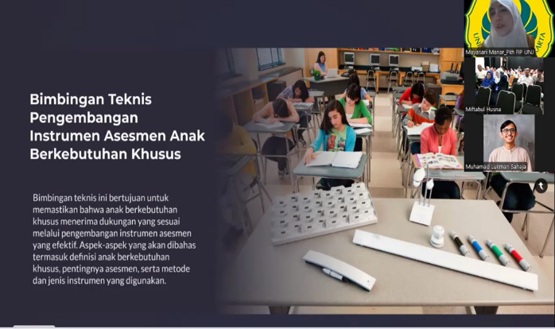
This community service program aims to enhance teachers' understanding and awareness at Special School X of the importance of developing assessment instruments tailored to the characteristics of students with special needs. Based on a needs analysis conducted at the school, most teachers still relied on generic assessments that failed to accommodate students' individual needs. The main challenges faced by teachers include limited comprehension of the principles of individualized assessment and insufficient skills in designing adaptive instruments that address diverse learning barriers. Through a series of technical guidance sessions, the community engagement team provided conceptual reinforcement of the principles of special education assessment, the types of assessments, and the fundamental steps in designing adaptive instruments. The program emphasized interactive delivery of materials, collaborative discussions, and reflective sessions to cultivate teachers’ awareness of the urgency of inclusive, learner-centered assessment practices. The results indicate an improvement in teachers’ conceptual understanding of fair and equitable assessment for students with special needs, alongside a strengthened commitment to developing simple, contextually relevant assessment instruments in their respective classrooms.
Downloads
Article Details

This work is licensed under a Creative Commons Attribution-ShareAlike 4.0 International License.
Authors who publish with this journal agree to the following terms:
- Any article on the copyright is retained by the author(s).
- Author grant the journal, right of first publication with the work simultaneously licensed under a Creative Commons Attribution License that allows others to share work with acknowledgment of the work authors and initial publications in this journal.
- Authors are able to enter into a separate, additional contractual arrangements for non-exclusive distribution of published articles of work (eg, post-institutional repository) or publish it in a book, with acknowledgment of its initial publication in this journal.
- Authors are permitted and encouraged to post their work online (e.g., in institutional repositories or on their websites) prior to and during the submission process, as can lead to productive exchanges, as well as earlier and greater citation of published work.
- The article and any associated published material is distributed under the Creative Commons Attribution-ShareAlike 4.0 International License
References
Alhassan, K. Y., & Verma, S. (2024). Assessment and evaluation in special education: Innovative approaches and tools. International Journal of Social Impact, 9(1). https://doi.org/10.25215/2455/0901001
Angeloska-Galevska, N., & Pesic, M. (2018). Assessing children with special educational needs in inclusive classrooms [Conference paper]. ResearchGate. https://www.researchgate.net/publication/328875846
Brookhart, S. M., & Long, B. A. (2008). Formative assessment that empowers. Educational Leadership, 66(3), 52–57.
Budianto, R. (2023). Inclusive learning strategies for students with disabilities in higher education. Journal of Inclusive Education, 11(2), 45–58.
Dimas, M., Milsan, H., Azahra, I. Z., & Anjani, R. (2025). Asesmen anak berkebutuhan khusus: Fondasi pendidikan yang inklusif dan berkeadilan. Early Childhood Journal, 5(1), 9–17. https://doi.org/10.30872/ecj.v5i1.4571
Friend, M., & Bursuck, W. D. (2021). Including students with special needs: A practical guide for classroom teachers. Pearson.
Fullan, M., Bertani, A., & Quinn, J. (2004). New lessons for districtwide reform. Educational Leadership, 61(7), 42–46.
Gatlin-Nash, B., Hwang, J. K., Tani, N. E., Zargar, E., Wood, T. S., Yang, D., Powell, K. B., & Connor, C. M. (2021). Using assessment to improve the accuracy of teachers’ perceptions of students’ academic competence. The Elementary School Journal, 121(4), 609–634. https://doi.org/10.1086/714083
Haikal, R. M., Darmiany, & Husniati. (2022). Problematika guru dalam mengajar peserta didik berkebutuhan khusus di SLB Azahra. Jurnal Ilmiah Profesi Pendidikan, 7(2b), 643–648. https://doi.org/10.29303/jipp.v7i2b.622
Hallahan, D. P., Kauffman, J. M., & Pullen, P. C. (2022). Exceptional learners: An introduction to special education (15th ed.). Pearson.
Hartini, J., Matasari, O., Andirani, O., & Fathiyanabila, N. (2023). Manfaat asesmen dalam pembelajaran anak berkebutuhan khusus. Jurnal Pendidikan Vokasi dan Seni, 2(1). https://doi.org/10.52060/jpvs.v2i1.1749
Hidayat, A. (2021). Capacity building dalam pengembangan kompetensi guru pendidikan khusus. Jurnal Pendidikan Luar Biasa Indonesia, 8(1), 12–21.
Kristiana, I. F. (2018). Teachers’ self-efficacy in the implementation of inclusive education: Literature review. Journal of Educational, Health and Community Psychology, 7(2), 139–152. https://doi.org/10.12928/jehcp.v7i2.8569
Maulana, E. S., Holidah, S. D., Rochyadi, E., Aprilia, I. D., & Susetyo, B. (2024). Identifikasi dan asesmen anak berkebutuhan khusus di sekolah reguler. Jurnal Pendidikan: Kajian dan Implementasi, 6(2). https://journalversa.com/s/index.php/jpki/article/view/2683
Nitko, A. J., & Brookhart, S. M. (2011). Educational assessment of students (6th ed.). Pearson.
Oo, T. Z., Habók, A., & Józsa, K. (2023). Empowering educators to sustain reflective teaching practices: The validation of instruments. Sustainability, 15(9), Article 7640. https://doi.org/10.3390/su15097640
Pierangelo, R., & Giuliani, G. A. (2018). Assessment in special education: A practical approach. Pearson.
Putra, R., Renaldo, N., Purnama, I., Putri, N. Y., & Suhardjo, S. (2024). Enhancing teacher performance through capacity building: A comprehensive analysis of professional development, mentoring, and organizational support. Reflection: Education and Pedagogical Insights, 2(1), 1–8. https://doi.org/10.61230/reflection.v2i1.84
Rahmi, F. N., & Wijayanti, S. (2025). Improving the quality of inclusive education through the assessment process of students with special needs. Transformasi: Jurnal Pengabdian Masyarakat, 21(1), 172–185. https://doi.org/10.20414/transformasi.v21i1.12810
Roig, G., & Rivera, A. (2013). Teacher reflectivity in a community of practice focusing on classroom research to improve learning with understanding in students. Education Journal, 2(4), 155–162. https://doi.org/10.11648/j.edu.20130204.18
Salleh, R. (2024). Kepentingan komuniti pembelajaran profesional: Peningkatan kualiti pengajaran dan pembelajaran serta amalan inklusif guru. Perspektif: Jurnal Sains Sosial dan Kemanusiaan, 16(1), 80–95. https://doi.org/10.37134/perspektif.vol16.1.7.2024
Salvia, J., Ysseldyke, J. E., & Witmer, S. (2004). Assessment in special and inclusive education. Houghton Mifflin.
Sari, D., & Rahman, T. (2022). Analisis kebutuhan guru dalam pengembangan asesmen individual di sekolah luar biasa. Jurnal Pendidikan Khusus, 10(3), 34–46.
Sari, I., & Nugroho, B. (2023). Collaborative capacity building for inclusive teachers: Strengthening teacher agency in special schools. Jurnal Pendidikan Khusus Indonesia, 10(1), 12–25.
UNESCO. (2020). Inclusive education: Ensuring access for all learners. UNESCO.
Yan, Z., Xiao, Y., Sin, K. F., Yang, L., & Guo, W. Y. (2021). Formative assessment practices in special school classrooms with the support of e-books: A case study. Frontiers in Education, 6, Article 674869. https://doi.org/10.3389/feduc.2021.674869