Edukasi Tata Ruang Sehat melalui Visualisasi Desain Interior untuk Meningkatkan Kenyamanan Psikologis Pasien di Rumah Singgah Kanker Kota Samarinda Healthy Space Planning Education through Interior Design Visualization to Enhance Patients' Psychological Comfort at Samarinda City Cancer Halfway House
Article Sidebar
Main Article Content
Abstract
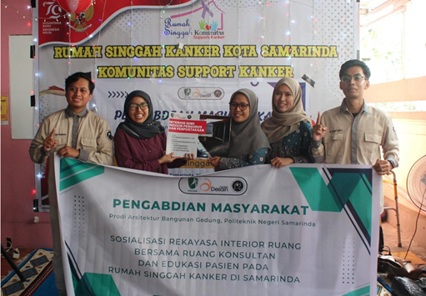
Cancer imposes a severe physical and psychological burden on patients and their families. In Samarinda, the Cancer Halfway House serves as a crucial facility for out-of-town patients; however, its building conditions are often not specifically designed for recovery needs. This community service program aims to educate the management on healthy spatial layouts through interior design engineering in the Communal Room, Consultation Room, and Educational Room. The method applied is participatory design, involving the foundation's management and patients from problem identification through the design process. The outputs of this program include Detailed Engineering Design (DED) documents and interior visualizations that utilize a healing-environment approach. The use of cream and mustard color palettes, along with optimizing natural lighting, has been theoretically shown to enhance patients' psychological comfort and positive energy. Furthermore, interior design visualization acts as an effective educational tool for laypeople to comprehend healthy space standards. In conclusion, this program demonstrates that appropriate interior engineering can transform the perception of a halfway house environment from rigid to restorative, thereby supporting the healing process holistically.
Downloads
Article Details

This work is licensed under a Creative Commons Attribution-ShareAlike 4.0 International License.
Authors who publish with this journal agree to the following terms:
- Any article on the copyright is retained by the author(s).
- Author grant the journal, right of first publication with the work simultaneously licensed under a Creative Commons Attribution License that allows others to share work with acknowledgment of the work authors and initial publications in this journal.
- Authors are able to enter into a separate, additional contractual arrangements for non-exclusive distribution of published articles of work (eg, post-institutional repository) or publish it in a book, with acknowledgment of its initial publication in this journal.
- Authors are permitted and encouraged to post their work online (e.g., in institutional repositories or on their websites) prior to and during the submission process, as can lead to productive exchanges, as well as earlier and greater citation of published work.
- The article and any associated published material is distributed under the Creative Commons Attribution-ShareAlike 4.0 International License
References
Aryanto, A. B., & Satya, Y. (2023). Healing Treatment Sebagai Media Terapi dan Bermain Pada Rumah Singgah Kanker Anak. Prosiding Temu Ilmiah, 11(1), C141–C144. https://doi.org/10.32315/ti.11.c141
Ayu Asvitasari, Nur Husniah Thamrin, & Bhanu Rizfa Hakim. (2024a). Redesain Tata Ruang Dalam pada Rumah Singgah Kanker di Samarinda. Jurnal Pengabdian UntukMu NegeRI, 8(3), 620–626. https://doi.org/10.37859/jpumri.v8i3.7826
Ayu Asvitasari, Nur Husniah Thamrin, & Bhanu Rizfa Hakim. (2024b). Redesain Tata Ruang Dalam pada Rumah Singgah Kanker di Samarinda. Jurnal Pengabdian UntukMu NegeRI, 8(3), 620–626. https://doi.org/10.37859/jpumri.v8i3.7826
Aziz, A., Srihandayani, S., Halimatusadiyah, H., & Desriyati, W. (2026). Pelatihan Pembuatan Gambar Teknis pada Proyek Konstruksi Sederhana pada Siswa Jurusan Desain Permodelan dan Informasi Bangunan di SMK Negeri 2 Dumai: Technical Drawing Making Training on Simple Construction Projects for Students of Department of Building Modeling and Information Design at SMK Negeri 2 Dumai. PengabdianMu: Jurnal Ilmiah Pengabdian Kepada Masyarakat, 11(Suppl-1), S145–S150. https://doi.org/10.33084/pengabdianmu.v11iSuppl-1.10008
Bhanu Rizfa Hakim, Musthafa A.P, H., Hidayati, Z., & Thamrin, N. H. (2021). Pelatihan Autodesk Revit Bagi Komunitas Samarinda Young Architect Forum. Jurnal Pengabdian UntukMu NegeRI, 5(1), 5–11. https://doi.org/10.37859/jpumri.v5i1.2265
Clarissa, N. C., & Defiana, I. (2019). Rumah Singgah untuk Penderita Kanker dengan Konsep Healing Environment. Jurnal Sains Dan Seni ITS, 7(2), 250–255. https://doi.org/10.12962/j23373520.v7i2.35295
Fadhilah, W., Aditya, B., & Nursiswati, N. (2025). Spiritual Interventions in Patients with Non-Communicable Diseases (NCDs): A Narrative. 8(2). https://doi.org/10.32524/jksp.v8i2.1486
Hansen, F., & Herlambang, S. (2021). Rumah Singgah Kanker Anak Dengan Terapi Paliatif. Jurnal Sains, Teknologi, Urban, Perancangan, Arsitektur (Stupa), 3(1), 1163. https://doi.org/10.24912/stupa.v3i1.10706
Hidayati, Z., Putra, H. M. A., Noviana, M., Latief, O. D., Rahman, M. H., & Abdurrokhman, A. (2025). Redesain Interior Ruang Inap untuk Kenyamanan Pasien di Rumah Singgah Kanker Samarinda: Redesigning Temporary Stay Room Interiors to Enhance Patient Comfort at the Samarinda Cancer Shelter. PengabdianMu: Jurnal Ilmiah Pengabdian Kepada Masyarakat, 10(5), 1151–1159. https://doi.org/10.33084/pengabdianmu.v10i5.9138
Krisantia, I., Besila, Q. A., Yuslim, S., Kusumadewi, R. A., Mangunsong, N. I., Seanders, O., & Fauzi, R. (2023). Model Desain Healing Garden pada Ruang Publik dan Penataannya pada Halaman Rumah Tinggal bagi Peningkatan Kualitas Hidup di Perumahan Bumi Telukjambe, Karawang: Healing Garden Design Model in Public Spaces and Its Arrangements on the Household Page for Increasing the Quality of Life in Bumi Telukjambe Housing, Karawang. PengabdianMu: Jurnal Ilmiah Pengabdian Kepada Masyarakat, 8(1), 112–119. https://doi.org/10.33084/pengabdianmu.v8i1.3019
Laswandi, H., Setiawan, M. N., Andanwerti, N., Wiyoso, A., Marizar, E. S., Mutiara, M. W., Purnomo, S. S., Ismanto, A., Sulistyawati, D., Fivanda, Kusuma, H. B., Mariana, Ferdinand, Gani, A. C., Andraini, N. I., & Augustina Ika Widyani. (2025). Transformasi Ruang Desain Interior yang Mendukung Tujuan Pembangunan Berkelanjutan. LPPI UNTAR (UNTAR Press) Lembaga Penelitian dan Publikasi Ilmiah Universitas Tarumanagara. https://untar.ac.id/2025/12/03/transformasi-ruang-desain-interior-yang-mendukung-tujuan-pembangunan-berkelanjutan/
Marsya, I. H., & Anggraita, A. W. (2016). Studi Pengaruh Warna pada Interior Terhadap Psikologis Penggunanya, Studi Kasus pada Unit Transfusi Darah Kota X. Jurnal Desain Interior, 1(1), 41. https://doi.org/10.12962/j12345678.v1i1.1461
Millenia, M., De Yong, S., & Frans, S. M. (2022). Penerapan Healing environment Pada Interior Rumah Sakit Ibu dan Anak Ferina Surabaya. Lintas Ruang: Jurnal Pengetahuan Dan Perancangan Desain Interior, 10(2), 73–85. https://doi.org/10.24821/lintas.v10i2.7198
Monica, A., & Darmayanti, T. E. (2022). Peran Warna Desain Interior terhadap Perasaan Tenang Pengunjung SPA Martha Tilaar: The role of colors psychology in interior design towards Spa’s Visitors : Study case of Martha Tilaar. Waca Cipta Ruang, 8(2), 87–91. https://doi.org/10.34010/wcr.v8i2.6114
Ningsih, T. R., Putra, H. M. A., Hidayanto, A. F., Waluyo, P., Oktaviatuzzaroh, J., & Ratnasari, M. (2026). Pembuatan Gambar Redesain Kantor Kelurahan Masjid untuk Peningkatan Pelayanan Publik dan Penguatan Identitas Lokal. Jurnal Pengabdian UntukMu NegeRI, 10(1), 57–65. https://doi.org/10.37859/jpumri.v10i1.11151
Ohly, H., White, M. P., Wheeler, B. W., Bethel, A., Ukoumunne, O. C., Nikolaou, V., & Garside, R. (2016). Attention Restoration Theory: A systematic review of the attention restoration potential of exposure to natural environments. Journal of Toxicology and Environmental Health, Part B, 19(7), 305–343. https://doi.org/10.1080/10937404.2016.1196155
Pati, D., & Nanda, U. (2011). Influence of Positive Distractions on Children in Two Clinic Waiting Areas. HERD: Health Environments Research & Design Journal, 4(3), 124–140. https://doi.org/10.1177/193758671100400310
Pramesti, I. P., Raharja, I. G. M., & Darmastuti, P. A. (2023). Redesain Ruang Rawat Inap Siloam Hospitals Bali Di Kuta, Bali. Jurnal Vastukara: Jurnal Desain Interior, Budaya, Dan Lingkungan Terbangun, 3(1), 44–57. https://doi.org/10.59997/vastukara.v3i1.2303