Pemberdayaan Masyarakat Desa Tlogowero melalui Pemanfaatan Limbah Ampas Kopi menjadi Lilin Aromaterapi Empowering Tlogowero Village Communities by Transforming Coffee Waste into Aromatherapy Candles
Article Sidebar
Main Article Content
Abstract
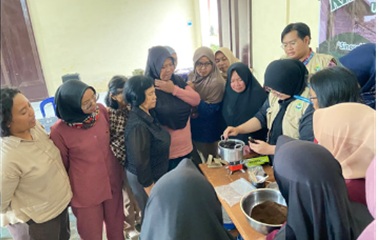
The massive increase in coffee consumption has led to the accumulation of spent coffee grounds that are not yet optimally utilized, particularly in coffee-producing areas such as Temanggung Regency. This community service program aims to empower women in the PKK group in Tlogowero Village through training in processing coffee waste into economically valuable aromatherapy candles. The novelty of this program lies in the integration of three key aspects: the use of local waste, the creation of marketable aromatherapy products, and the Asset-Based Community Development (ABCD) approach, which emphasizes existing community strengths. The implementation method includes local asset identification, program design, participatory training based on a learning-by-doing approach, and evaluation using structured questionnaires distributed to 20 participants. The evaluation results indicate that 85% of participants showed improved understanding of waste management, 80% acquired technical skills in candle-making, 70% became aware of the economic potential of waste, and 65% expressed interest in developing small-scale businesses. From an economic perspective, the per-unit profit margin ranges from 131% to 208%, with the potential to generate an additional IDR 425,000–675,000 per household per month. This program contributes to achieving the Sustainable Development Goals (SDGs), particularly SDGs 5, 8, and 12. Further assistance and the establishment of micro-cooperatives are recommended to ensure the program's sustainability.
Downloads
Article Details

This work is licensed under a Creative Commons Attribution-ShareAlike 4.0 International License.
Authors who publish with this journal agree to the following terms:
- Any article on the copyright is retained by the author(s).
- Author grant the journal, right of first publication with the work simultaneously licensed under a Creative Commons Attribution License that allows others to share work with acknowledgment of the work authors and initial publications in this journal.
- Authors are able to enter into a separate, additional contractual arrangements for non-exclusive distribution of published articles of work (eg, post-institutional repository) or publish it in a book, with acknowledgment of its initial publication in this journal.
- Authors are permitted and encouraged to post their work online (e.g., in institutional repositories or on their websites) prior to and during the submission process, as can lead to productive exchanges, as well as earlier and greater citation of published work.
- The article and any associated published material is distributed under the Creative Commons Attribution-ShareAlike 4.0 International License
References
To be published