Integrasi Skrining Penyakit Tidak Menular dan Edukasi Sanitasi Berbasis Sekolah di SMA Negeri 13 Makassar Integration of Non-Communicable Disease Screening and School-Based Sanitation Education at SMA Negeri 13 Makassar
Article Sidebar
Main Article Content
Abstract
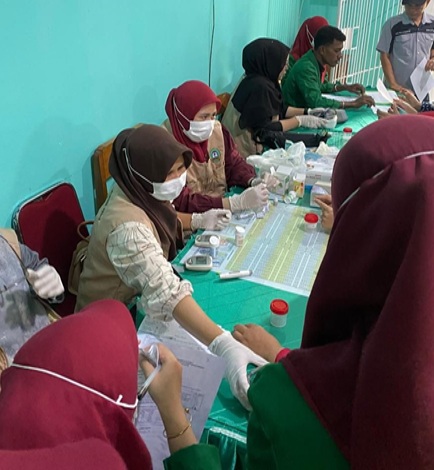
Non-communicable diseases (NCDs) and sanitation-related problems remain important public health concerns that require early prevention through promotive and preventive approaches, including within school communities. This community service activity aimed to screen teachers for risk factors associated with NCDs and to improve students’ knowledge of sanitation and clean and healthy living practices at SMA Negeri 13 Makassar. The activity employed a pre-experimental one-group pretest–posttest design involving 22 teachers and 29 students. Health screening among teachers included measurements of blood pressure, random blood glucose, total cholesterol, and uric acid levels, and urinalysis assessing urinary protein, pH, and specific gravity. Sanitation education for students was delivered through a rotating curriculum comprising three sessions: chemistry and nutrition; microbiology and parasitology; and physiology and urinalysis. Students’ knowledge was evaluated using pretests and posttests. Based on the categorization of examination results, 7 teachers (32%) had elevated blood pressure, 8 (36%) had high blood pressure, 3 (14%) had elevated random blood glucose levels, 15 (68%) had total cholesterol levels above the normal reference range, and 8 (36%) had uric acid levels above the normal reference range. In addition, 7 teachers (32%) had urinary specific gravity values outside the normal range. The sanitation education intervention produced a moderate improvement in students’ knowledge (N-gain = 0.54) regarding the importance of personal hygiene, environmental sanitation, and disease prevention through healthy behaviors. These findings indicate that integrating health screening and sanitation education within the school environment is a relevant strategy, as the screening successfully identified several NCD risk factors among teachers.
Downloads
Article Details

This work is licensed under a Creative Commons Attribution-ShareAlike 4.0 International License.
Authors who publish with this journal agree to the following terms:
- Any article on the copyright is retained by the author(s).
- Author grant the journal, right of first publication with the work simultaneously licensed under a Creative Commons Attribution License that allows others to share work with acknowledgment of the work authors and initial publications in this journal.
- Authors are able to enter into a separate, additional contractual arrangements for non-exclusive distribution of published articles of work (eg, post-institutional repository) or publish it in a book, with acknowledgment of its initial publication in this journal.
- Authors are permitted and encouraged to post their work online (e.g., in institutional repositories or on their websites) prior to and during the submission process, as can lead to productive exchanges, as well as earlier and greater citation of published work.
- The article and any associated published material is distributed under the Creative Commons Attribution-ShareAlike 4.0 International License
References
Arifa mustika, Yetti Hernaningsih, Puspa Wardhani, Siti Khaerunnisa, Natasya Nunki, Baiq Nasya Islaeli, Uli Masuliyah Indarwati, Musholli Himmatun Nabila, Teguh Satrio, Alfini Validita Sidiq, Fita Triastuti, Mochammad Reza Desianto, Agil Saputra, Novi Ersanto, Widaninggar Rahma Putri, Desty Indah sari. 2024. Correlation glucose, uric acid, and cholesterol levels towards health conditions in the highlands : poct approach. Indonesian Journal Of Clinical Pathology and Medical Laboratory, 30(3),2024.
Beatriz Sequeira-Antunes and Hugo Alexandre Ferreira. 2023. Urinary biomarkers and point-of-care urinalysis device for diagnosis and monitoring of disease. Biomedicine, 11(4). https://doi.org/10.3390/biomedicines11041051
Delfino LD, Tebar WR, Tebar FCSG, de Souza JM, Romanzini M, Fernandes RA, Christofaro DGD. 2020. Association between sedentary behavior, obesity and hypertension in public school teachers. Industrial Health. 58(4): 345–353. https://doi.org/10.2486/indhealth.2019-0170
Foundation For Innovative New Diagnostics. 2023. Point-of-care device for testing of cardiometabolic diseases. https://www.sciencedirect.com/science/article/pii/S2214180425000133
Hasan N, Hadju V, Jafar N, Thaha RM. 2019. Prevalence of metabolic syndrome (MetS) and determinants among obese teachers in Makassar, Indonesia. IIUM Medical Journal Malaysia. 18(2). https://doi.org/10.31436/imjm.v18i2.100
Ismail SR, Radzi R, Megat Kamaruddin PSN, Lokman EF, Lim HY, Abdul Rahim N, Yow HY, Arumugam D, Ngu A, Low ACY, Wong EH, Patil S, et al. 2024. The effects of school-based hygiene intervention programme: Systematic review and meta-analysis. PLOS ONE. 19(10): e0308390. https://doi.org/10.1371/journal.pone.0308390
Jhons Fatriyadi, Fitria Saftarina, Reni Zuraida, Betta Kurniawan, Juspeni Kartika. 2025. Peningkatan pemahaman implementasi program pencegahan dan pengendalian penyakit tidak menular pada guru dan tenaga kependidikan di Sekolah Alam Lampung sebagai upaya pengenalan deteksi dini penyakit tidak menular. JMP Ruwa Jurai, 10(1), Juni 2025. https://www.semanticscholar.org/paper/PENINGKATAN-PEMAHAMAN-IMPLEMENTASI-PROGRAM-DAN-PADA-Suwandi-Saftarina/77895f1ea1546cbb84f9e6e18e490759acafc786
Kementerian Kesehatan Republik Indonesia. 2019. Laporan nasional riset kesehatan dasar (riskesdas) 2018. Badan Penelitian dan Pengembangan Kesehatan. https://www.badankebijakan.kemkes.go.id/repositori/id/eprint/3514/
Kementerian Kesehatan Republik Indonesia. 2023. Mengenal penyakit tidak menular. Direktorat Jenderal Kesehatan Lanjutan. https://keslan.kemkes.go.id/view_artikel/2501/mengenal-penyakit-tidak-menular
McMichael C. 2019. Water, sanitation and hygiene (WASH) in schools in low-income countries: A review of evidence of impact. International Journal of Environmental Research and Public Health. 16(3): 359. https://doi.org/10.3390/ijerph16030359
Michael C Larkins, Muhammad Zubair, Aparna Thombare. 2025. Point-of-care testing. National Library of Medicine. https://pubmed.ncbi.nlm.nih.gov/37276307/
Ni Ketut Elmiyati, Freny R Mbaloto, Diah Fitri Purwaningsih. Penyuluhan kesehatan pencegahan penyakit kecacingan di Sdn 12Limran. Jurnal Abidas, 3(3). (2022) : June, Pages 355-611. https://doi.org/10.31004/abdidas.v3i3.595
Pérez-Jorge D, Rodríguez-Jiménez MDC, Ariño-Mateo E, Barragán-Medero F. 2021. Educational programs for the promotion of health at school: A systematic review. International Journal of Environmental Research and Public Health. 18(20): 10818. https://doi.org/10.3390/ijerph182010818
Trisnaini I, Etrawati F. 2023. Media teater boneka tangan dalam upaya meningkatkan perilaku stop buang sampah sembarangan pada anak sekolah dasar. Panrita Abdi: Jurnal Pengabdian pada Masyarakat. 7(4). https://doi.org/10.20956/pa.v7i4.21461
World Health Organization. 2019. Who guidelines on hand hygiene in health care: first global patient safety challenge.WHO Press. https://pubmed.ncbi.nlm.nih.gov/23805438/
World Health Organization. 2021. WHO guideline on school health services. WHO Press
World Health Organization, United Nations Educational, Scientific and Cultural Organization. 2021. Making every school a health-promoting school: Global standards and indicators. Geneva: World Health Organization. https://www.who.int/publications/i/item/9789240025059
World Health Organization. 2023. Noncommunicable diseases progress monitor 2022. WHO Press.
World Health Organization. 2023. Global report on hypertension: the race against a a silent killer. WHO Press
World Health Organization-UNICEF Joint Monitoring Programme. 2024. Progress on drinking water, sanitation and hygiene In Schools 2000 -2023: special focus on menstrual health. WH-UNICEF JMP. https://www.unicef.org/pacificislands/press-releases/fact-sheet-five-million-people-pacific-still-lack-access-basic-drinking-water
World Health Organization-UNICEF Joint Monitoring Programme. 2024. WASH in schools data update. WHO Press
World Health Organization. 2025. Noncommunicable diseases. Geneva: World Health Organization