Permainan Edukasi Ular Tangga Kesehatan untuk Pendidikan Anak Dalam Hidup Sehat di Kedudukan Islam Snakes and Ladders Educational Game for Health Education of Children in Islamic Countries
Article Sidebar
Main Article Content
Abstract
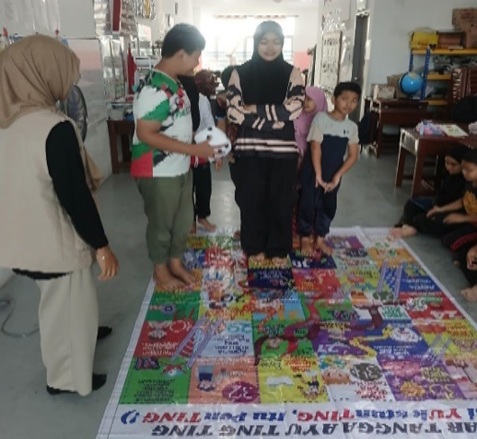
In several developing countries, including Southeast Asian countries such as Indonesia, stunting remains a major nutritional problem and a primary concern. Health education from an early age can be delivered in an engaging and interactive way. This activity is part of the International Community Service Program conducted by Malaysian students. The aim of this PkM is to increase children’s understanding of the importance of healthy living behaviors and stunting prevention through an educational game called AYU TING TING (Let’s Overcome Stunting, It’s Important), which is a health-themed snakes and ladders game. The active learning methods used include educational games, health counseling, and knowledge evaluation before and after the activity. The results of the activity showed that 12 primary school children in Pahang, Malaysia, had a good understanding of healthy behaviors, personal hygiene, and the importance of consuming nutritious food. In addition, integrating Islamic values into health education helps participants understand that maintaining good health is an important part of religious teachings. This study demonstrates that educational games can serve as an effective tool for enhancing children’s health knowledge and supporting early efforts to prevent stunting.
Downloads
Article Details

This work is licensed under a Creative Commons Attribution-ShareAlike 4.0 International License.
Authors who publish with this journal agree to the following terms:
- Any article on the copyright is retained by the author(s).
- Author grant the journal, right of first publication with the work simultaneously licensed under a Creative Commons Attribution License that allows others to share work with acknowledgment of the work authors and initial publications in this journal.
- Authors are able to enter into a separate, additional contractual arrangements for non-exclusive distribution of published articles of work (eg, post-institutional repository) or publish it in a book, with acknowledgment of its initial publication in this journal.
- Authors are permitted and encouraged to post their work online (e.g., in institutional repositories or on their websites) prior to and during the submission process, as can lead to productive exchanges, as well as earlier and greater citation of published work.
- The article and any associated published material is distributed under the Creative Commons Attribution-ShareAlike 4.0 International License
References
Ariyani, H., Anshari, M., Khofifah, R. M., Setiawan, S. N., & Azwa, S. (2022). Edukasi pencegahan stunting dan praktik pembuatan sirup kelakai sebagai booster gizi masyarakat. Borneo Community Development Journal, 1(2), 45–52.
Ariyani, H., Anshari, M., Nurhanifah, D., Saad, Z., & Chaniago, Z. (2022). Nutrition-aware family program through personal and environmental hygiene. Borneo Community Development Journal, 2(1), 15–22.
Ariyani, H., Saad, Z., Chaniago, Z., Nurhanifah, D., & Anshari, M. (2023). Edukasi pemahaman dan tindakan pencegahan stunting melalui permainan ular tangga AYU TING TING. Jurnal Pengabdian Masyarakat Bangsa, 2(3), 112–119.
Black, R. E., Victora, C. G., Walker, S. P., Bhutta, Z. A., Christian, P., de Onis, M., Ezzati, M., Grantham-McGregor, S., Katz, J., Martorell, R., & Uauy, R. (2013). Maternal and child undernutrition and overweight in low-income and middle-income countries. The Lancet, 382(9890), 427–451. https://doi.org/10.1016/S0140-6736(13)60937-X
Dewey, K. G., & Begum, K. (2011). Long-term consequences of stunting in early life. Maternal & Child Nutrition, 7(Suppl. 3), 5–18. https://doi.org/10.1111/j.1740-8709.2011.00349.x
Kementerian Kesehatan Republik Indonesia. (2021). Strategi nasional percepatan pencegahan stunting.
Niesa, Y., & Ariyani, H. (2021). Dissemination of malnutrition among infants and toddlers. Bamara Journal, 1(1), 15–20.
Noraini, I., & Ariyani, H. (2021). Socialization of good and correct handwashing for elementary school children. Bamara Journal, 1(2), 21–27.
Notoatmodjo, S. (2018). Promosi kesehatan dan perilaku kesehatan. Rineka Cipta.
Permatasari, T. A. E. (2021). The effect of nutrition and health education on improving knowledge and attitudes related to stunting prevention among adolescents. International Journal of Public Health Science, 10(4), 857–864. https://doi.org/10.11591/ijphs.v10i4.20915
United Nations Children’s Fund. (2013). Improving child nutrition: The achievable imperative for global progress.
United Nations Children’s Fund, World Health Organization, & World Bank Group. (2023). Levels and trends in child malnutrition: UNICEF/WHO/World Bank Group joint child malnutrition estimates—Key findings of the 2023 edition.
Victora, C. G., Adair, L., Fall, C., Hallal, P. C., Martorell, R., Richter, L., & Sachdev, H. S. (2008). Maternal and child undernutrition: Consequences for adult health and human capital. The Lancet, 371(9609), 340–357. https://doi.org/10.1016/S0140-6736(07)61692-4
World Health Organization. (2014). Global nutrition targets 2025: Stunting policy brief.
World Health Organization. (2023). WHO guideline for complementary feeding of infants and young children 6–23 months of age.
Yuliana, E., Suryani, D., & Kurniawati, R. (2022). Pengaruh media permainan edukatif terhadap peningkatan pengetahuan kesehatan pada anak usia sekolah. Jurnal Promosi Kesehatan Indonesia, 17(2), 85–93