Upaya Peningkatan Nilai Ekonomi Buah Kelapa di Kalimantan Utara melalui Pemberdayaan Kelompok Masyarakat dalam Pengolahan VCO Improvement Efforts the Economic Value of Coconut in North Kalimantan through Empowering Community Groups in Processing VCO
Article Sidebar
Main Article Content
Abstract
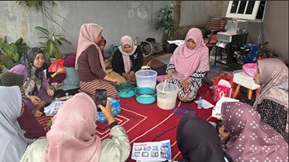
The processing of coconuts is not yet available in Tarakan City. Coconut production is quite high, but low demand poses a threat to the sustainability of the coconut plantation industry. Therefore, it is necessary to process coconut into products with high benefits and selling value, such as VCO (Virgin Coconut Oil). The processing of coconuts into VCO is relatively simple, making it a straightforward task. Therefore, this activity was carried out in collaboration with the partners of the Nurul Hikmah prayer group, a recitation group consisting of women in RT 5 Juata Kerikil Village, Tarakan, North Kalimantan. In addition to VCO production facilities, partners also need to be equipped with business management, business result analysis, and training related to marketing strategies so that production and sales activities can continue to be carried out continuously after the mentoring activities end. Community group empowerment activities are carried out in several stages, including socialisation, technology application, training, mentoring, and evaluation of activities. The target output of this activity is that partners will be able to apply the proper processing and packaging methods for VCO made from coconut. In addition, partners are also expected to conduct business analysis and effective marketing management. Through the training and mentoring activities conducted, results were obtained in the form of an increase in the understanding and skills of partners in processing and packaging coconuts into VCO. As well as improving the knowledge and ability of partners in conducting business analysis and marketing management needed in VCO's business processes.
Downloads
Article Details

This work is licensed under a Creative Commons Attribution-ShareAlike 4.0 International License.
Authors who publish with this journal agree to the following terms:
- Any article on the copyright is retained by the author(s).
- Author grant the journal, right of first publication with the work simultaneously licensed under a Creative Commons Attribution License that allows others to share work with acknowledgment of the work authors and initial publications in this journal.
- Authors are able to enter into a separate, additional contractual arrangements for non-exclusive distribution of published articles of work (eg, post-institutional repository) or publish it in a book, with acknowledgment of its initial publication in this journal.
- Authors are permitted and encouraged to post their work online (e.g., in institutional repositories or on their websites) prior to and during the submission process, as can lead to productive exchanges, as well as earlier and greater citation of published work.
- The article and any associated published material is distributed under the Creative Commons Attribution-ShareAlike 4.0 International License
References
Badan Pusat Statistik Indonesia. Kalimantan Utara dalam Angka. 2023. https://kaltara.bps.go.id/id/publication/2023/02/28/0eb3913ae2fe973d100fa04e/provinsi-kalimantan-utara-dalam-angka-2023.html
Ishak, Aji, A., & Israwati. (2015). Pengaruh Waktu Fermentasi Dan Berat Bonggol Nanas Pada Pembuatan Virgin Coconut Oil (VCO). Jurnal Teknologi Kimia Unimal, 66-77. https://ojs.unimal.ac.id/jtk/article/view/80/66
Badan Standarisasi Nasional. SNI 7381:2008 (Minyak Kelapa Virgin). https://www.scribd.com/doc/189216092/SNI-7381-2008-Minyak-Kelapa-Virgin-VCO
Fitriani, D., Widiyati, E., Triawan, D.A., Aplikasi penggunaan ekstrak nanas dan ragi roti sebagai biokatalisator pembuatan VCO (Virgin Coconut Oil) serta pemurniannya dengan menggunakan zeolit alam bengkulu dan abu sekam padi. Dalton: Jurnal Pendidikan Kimia dan Ilmu Kimia. 2021:4 (1):8-19. https://doi.org/10.31602/dl.v4i1.4872
Nurjannah, Kartina, Novitasari, F.T. Sila, Titik I. 2023. Evisiensi Pembuatan VCO (Virgin Coconut Oil) secara Enzimatis menggunakan Nanas dan Pepaya Lokal Kalimantan Utara. https://doi.org/10.52643/jir.v14i2.3409
Winarti, S. Proses Pembuatan VCO (Virgin Coconut Oil) secara enzimatis menggunakan papain kasar, Jurnal Teknologi Pangan. 2007:8: 136-14. https://doi.org/10.21776/ub.industria.2019.008.03.8
Winarno, F. G. Kimia Pangan dan Gizi. Jakarta: PT.Gramedia; 1997.Aniuranti, A., Tsani, M. H. N., & Wulandari, Y. (2021). Pelatihan penyusunan Ice Breaking untuk penguatan kompetensi calon guru. ABSYARA: Jurnal Pengabdian Pada Masyarakat, 2(1), 85–93. https://doi.org/10.29408/ab.v2i1.3578