Pelatihan Pengolahan Limbah Ampas Kelapa menjadi Tepung Kelapa sebagai Alternatif Pengganti Tepung Terigu dalam Pembuatan Kue di Desa Utaurano Kabupaten Kepulauan Sangihe Training on Processing Coconut Waste into Coconut Flour as an Alternative to Substitute Wheat Flour in Making Cookies in Utaurano Village, Sangihe Islands Regency
Article Sidebar
Main Article Content
Abstract
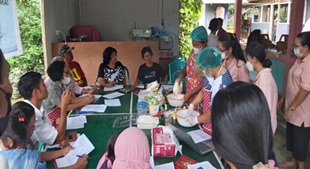
Coconut flour is obtained from the processing of coconut waste and can be used as a substitute for wheat flour or as additional flour in making bread and cakes. Coconut flour has the advantages of a fairly high protein content, being gluten-free, low digestible carbohydrate content, and higher fiber (cellulose) content compared to other types of flour. Hence, it is very suitable for people who are hypersensitive to gluten or for those who are on a diet. This activity aimed to train the community on processing coconut pulp into coconut flour and its use in making cookies. Utaurano Village in Sangihe Islands Regency is known as one of the centers for making coconut oil. Coconut waste has so far only been thrown away or used as a mixture of animal feed. Community service activities by lecturers and students of the Pharmacy Department of the Manado Ministry of Health Polytechnic include training in processing coconut pulp into coconut flour and its use for making cookies. The implementation of the activity was carried out in several stages, namely preparation, implementation, and evaluation. The results showed that in Utaurano village in Sangihe Islands Regency, coconut waste was produced from the VCO manufacturing process by local UMKM. The waste can be processed into coconut flour and used as a substitute for wheat flour for making cookies. The evaluation results show that counseling and training activities can increase knowledge and skills to utilize coconut waste into products with economic value.
Downloads
Article Details

This work is licensed under a Creative Commons Attribution-ShareAlike 4.0 International License.
Authors who publish with this journal agree to the following terms:
- Any article on the copyright is retained by the author(s).
- Author grant the journal, right of first publication with the work simultaneously licensed under a Creative Commons Attribution License that allows others to share work with acknowledgment of the work authors and initial publications in this journal.
- Authors are able to enter into a separate, additional contractual arrangements for non-exclusive distribution of published articles of work (eg, post-institutional repository) or publish it in a book, with acknowledgment of its initial publication in this journal.
- Authors are permitted and encouraged to post their work online (e.g., in institutional repositories or on their websites) prior to and during the submission process, as can lead to productive exchanges, as well as earlier and greater citation of published work.
- The article and any associated published material is distributed under the Creative Commons Attribution-ShareAlike 4.0 International License
References
Afriyanti, F., Raswen F, Yusmarni. (2016). Pemanfaatan Pati Sagu Dan Tepung Kelapa Dalam pembuatan Kue Bangkit. Jurnal Teknologi Pertanian Universitas Riau. 3(2): 1-16. https://media.neliti.com/media/publications/201868-pemafaatan-pati-sagu-dan-tepung-kelapa-d.pdf
Asrawaty, If’all, Ratnawati. (2015). IbM Kelompok Usaha Tepung Kelapa Di Desa Labuan Kungguma Kab. Donggala Provinsi Sulawesi Tengah. Majalah Aplikasi Ipteks NGAYAH. 6(1): 32-39. https://media.neliti.com/media/publications/154060-ID-ibm-kelompok-usaha-tepung-kelapa-di-desa.pdf
Banne, Y., Kalonio, DE., Rindengan, E. (2013). Potensi Pemanfaatan Tepung Kelapa Produksi Sulawesi Utara Sebagai Desintegrator Dalam Formulasi Tablet. Infokes Jurnal Ilmu Kesehatan. 8(1): 53-59. https://ejurnal.poltekkes-manado.ac.id/index.php/infokes/article/view/226
Banne, Y., Ulaen, SPJ., Rindengan, E. (2014). Optimasi Penggunaan Tepung Kelapa Sebagai Desintegrator Dalam Forulasi Tablet CTM Menggunakan Metode Cetak Langsung, Laporan Hasil Penelitian. Poltekkes Kemenkes Manado. https://ejurnal.poltekkes-manado.ac.id/index.php/infokes/article/download/226/199
Departemen Pertanian. (2007). Prospek dan Arah Pengembangan Agrobisnis Kelapa, Edisi II, Badan Penelitian dan Pengembangan Pertanian, Jakarta. https://kikp-pertanian.id/bpsipjateng/opac/detail-opac?id=423
Kecipir.com. (2018). Mengenal Tepung Kelapa (Coconut Flour) dan Manfaatnya Untuk Kesehatan. Diakses pada 28 Oktober 2024. https://kecipir.com/blog/info/mengenal-tepung-kelapa-coconut-flour-manfaatna-untuk-kesehatan/
Kumolontang, N. (2014). Tepung Kelapa Sebagai Substituen Parsial Dalam Pembuatan White Bread. Jurnal Penelitian Teknologi Industri. 6(2): 63-70. https://doi.org/10.33749/jpti.v6i2.3196
Mutiar, S., Anggia, M., Khofifah. (2024). Karakteristik Tepung Ampas Kelapa Pada Berbagai Suhu Pengeringan. Menara Ilmu : Jurnal Penelitian dan Kajian Ilmiah. 18(1): 1-8. https://doi.org/10.31869/mi.v18i1.5779
Ningtyas, K.R., Sarono, Analianasari, Agassi, T.N., Putri, P.G., Perdiansyah, M.H., Supriyanto. (2022). Pemanfaatan Limbah Sabut Kelapa Sebagai Produk Unggulan Lokal. Jurnal Pengabdian Nasional. 3(1): 1-6. https://jurnal.polinela.ac.id/JPN/article/view/2440
Panjaitan, D. (2021). Potensi Pemanfaatan Limbah Ampas Kelapa Sebagai Sumber Pangan Atau Bahan Substitusi Makanan Kesehatan. Jurnal Riset Teknologi Pangan dan Hasil Pertanian (RETIPA). 1(2): 63-68. https://doi.org/10.54367/retipa.v1i2.1209
Purnamasari, I., Zamhari, M., Putri, S. (2021). Pembuatan Tepung Serat Tinggi Dari Ampas Kelapa (Cocos Nucifera) Dengan Metode Pengeringan Beku Vakum, Jurnal Kinetika. 12(1). https://jurnal.polsri.ac.id/index.php/kimia/article/view/3126
Rosimah, S., Kamil, I., Rohmana. (2024). Pemanfaatan Limbah Kelapa Muda Untuk Nilai Tambah Ekonomi Bagi Pedagang Es Kelapa Muda Di Area Gbla, Bandung. Communnity Development Journal. 5(4): 7966-7972. https://doi.org/10.31004/cdj.v5i4.33454
Saparuddin, Alimuddin, Tojang, D., Arham, Z., Ismaun, Irwan, Fadilah, A., Nurhijayanti. (2025). Pemberdayaan Masyarakat Desa Watunohu Kabupaten Kolaka Utara dalam Pengolahan Biji Kakao menjadi Usaha Tepung Terstandar dan Tersertifikasi Halal. PengabdianMu: Jurnal Ilmiah Pengabdian kepada Masyarakat. Vol. x, Special Issue 1: 656–664. https://doi.org/10.33084/pengabdianmu.v10iSuppl-1.8284
Wardani, EN., Sugitha, IM., Pratiwi, IDPK. (2016). Pemanfaatan Ampas Kelapa Sebagai Bahan Pangan Sumber Serat Dalam Pembuatan Cookies Ubi Jalar Ungu (Utilization of Coconut Pulp as fiber source in Purple Sweet Potato Cookies). Itepa: Jurnal Ilmu dan Teknologi Pangan. 5(2): 162-170. https://ojs.unud.ac.id/index.php/itepa/article/view/27563
Yulvianti, M, Ernayati, W, Tarsono, R. Alfian, M. (2015). Pemanfaatan Ampas Kelapa Sebagai Bahan Baku Tepung Kelapa Tinggi Serat Dengan Metode Freeze Drying. Jurnal Integrasi Proses. 5(2): 101-107. https://dx.doi.org/10.36055/jip.v5i2.246