Pelatihan Tazkiyatun Nafs pada Karyawan Rumah Bersalin Cuma-Cuma Bandung Tazkiyatun Nafs Training For Staff in the Maternity Hospital Cuma-Cuma, City of Bandung
Article Sidebar
Main Article Content
Abstract
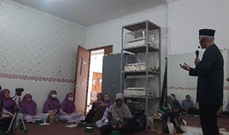
Length of service, shift work, psychosocial problems included in the workload, and physical activity significantly influence how employees cope with fatigue and provide services. Handling these issues can be done with a holistic approach that does not separate spirituality from its implementation. Tazkiyatun nafs training aims to exercise self-control through tazkiyyatun nafs to increase employees' Islamic Religious Coping. The method of activities is a tazkiyatun nafs workshop that invites religious experts (experts in Islamic aqidah philosophy, Qur'an interpretation, and hadith interpretation). The training was conducted four times in one month and was equipped with a study of muhasabah verses and daily worship practices with 21 participants, but only 13 people completed the form. At the end of the session, an evaluation was conducted using the Islamic Religious Coping Short Form Positive instrument. Participants' Religious Coping showed a significant average increase from an average of 182.08 to 182.31. This training is expected to increase religiosity or good spirituality and face problems calmly, not labile and easily anxious, because religious coping born from spiritual strength can arouse a sense of confidence and optimism.
Downloads
Article Details

This work is licensed under a Creative Commons Attribution-ShareAlike 4.0 International License.
Authors who publish with this journal agree to the following terms:
- Any article on the copyright is retained by the author(s).
- Author grant the journal, right of first publication with the work simultaneously licensed under a Creative Commons Attribution License that allows others to share work with acknowledgment of the work authors and initial publications in this journal.
- Authors are able to enter into a separate, additional contractual arrangements for non-exclusive distribution of published articles of work (eg, post-institutional repository) or publish it in a book, with acknowledgment of its initial publication in this journal.
- Authors are permitted and encouraged to post their work online (e.g., in institutional repositories or on their websites) prior to and during the submission process, as can lead to productive exchanges, as well as earlier and greater citation of published work.
- The article and any associated published material is distributed under the Creative Commons Attribution-ShareAlike 4.0 International License
References
S. Andrianti, I. Ikhsan, N. Nurlaili, and S. Sardaniah, Hubungan Beban Kerja Dengan Stres Kerja Pada Perawat Di Rumah Sakit Raflesia Kota Bengkulu, J. Vokasi Keperawatan, vol. 2, no. 2, pp. 87–101, 2020, https://doi.org/10.33369/jvk.v2i2.10687.
J. Thomas and M. Barbato, Positive religious coping and mental health among Christians and Muslims in response to the COVID-19 pandemic, Religions, 11(10), 498, 2020. http://dx.doi.org/10.3390/rel11100498
H. E. Sen, L. Colucci, and D. T. Browne, Keeping the faith: Religion, positive coping, and mental health of caregivers during COVID-19, Front. Psychol., 12, 805019, 2022. https://doi.org/10.3389/fpsyg.2021.805019
R. Dewi, S. Letchmi Panduragan, N. Syazana Umar, F. Melinda, and J. Budhiana, The effect of religion, self-care, and coping mechanisms on quality of life in diabetes mellitus patients, 2022. https://doi.org/10.24198/jkp.v10i1.1971
N. Rohmah, A. Anugerah, E. Pujiastuti, and A. Herosandiana, Pelaksanaan Pelatihan Tazkiyyatunnafs terhadap Islamic Religious Coping Mahasantri Pesma Unisa Bandung, J. Keperawatan Silampari, 6(2), 1197–1204, 2023. https://doi.org/10.31539/jks.v6i2.5078
M. Demir, Stress Experienced by Female Employees at Workplace; Symptoms, Sources of Stress, Ways to Deal with These Sources of Stress., Turkish Online J. Educ. Technol., 23(3), 73–82, 2024. https://files.eric.ed.gov/fulltext/EJ1434131.pdf
Nurdaningsih, I. Tabroni, D. Putri, and W. Luthfikha, Method of Lecture and Discussion: Increasing Islamic Understanding, Int. J. Sci. Multidiscip. Res., 1(2), 97–106, 2023. https://doi.org/10.55927/ijsmr.v1i2.3358
J. G. Cromley, Metacognition, cognitive strategy instruction, and reading in adult literacy, in Review of Adult Learning and Literacy, Volume 5, Routledge, 2023, 187–204. https://www.ncsall.net/fileadmin/resources/ann_rev/rall_v5_ch7_supp.pdf
M. R. Rifat, T. Toriq, and S. I. Ahmed, Religion and sustainability: Lessons of sustainable computing from Islamic religious communities, Proc. ACM Human-Computer Interact., 4, no. CSCW2, 1–32, 2020. https://doi.org/10.35445/alishlah.v17i1.6645
L. Mollart, V. M. Skinner, C. Newing, and M. Foureur, Factors that may influence midwives work-related stress and burnout, Women and birth, 26(1), 26–32, 2013. https://doi.org/10.1016/j.wombi.2011.08.002
N. Ghorbani, P. J. Watson, S. Tahbaz, and Z. J. Chen, Religious and psychological implications of positive and negative religious coping in Iran, J. Relig. Health, 56, 477–492, 2017. https://doi.org/10.1007/s10943-016-0228-5
M. de Abreu Costa and A. Moreira-Almeida, Religion-adapted cognitive behavioral therapy: A review and description of techniques, J. Relig. Health, 61(1), pp. 443–466, 2022, https://doi.org/10.1007/s10943-021-01345-z.
M. Hollander, E. de Miranda, F. Vandenbussche, J. van Dillen, and L. Holten, Addressing a need. Holistic midwifery in the Netherlands: A qualitative analysis, PLoS One, vol. 14, no. 7, p. e0220489, 2019, doi: https://doi.org/10.1371/journal.pone.0220489.