Peningkatan Literasi Budaya Anak-anak Panti Asuhan Amanda melalui Fabel Populer Dayak Maanyan Enhancing the Cultural Literacy of Amanda Orphanage Children through Popular Dayak Maanyan Fables
Article Sidebar
Main Article Content
Abstract
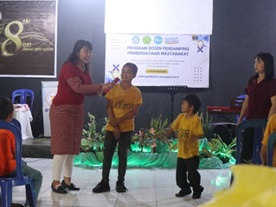
This activity aims to introduce and preserve the Dayak Maanyan's local culture by reading popular fables to children at the Amanda Orphanage in Palangka Raya City, Central Kalimantan. The fable reading serves as a means to enhance cultural literacy among the children. This community service method involves interactive storytelling of Dayak Maanyan fables, designed to teach cultural values and foster children's imagination and critical thinking skills. Success indicators include the number of active participants, their understanding of local culture, increased creativity and expression, and feedback from the participants and orphanage administrators. Through this activity, orphanage children are expected to gain a deeper understanding of and appreciation for the Dayak Maanyan cultural heritage, contributing to its preservation.
Downloads
Article Details

This work is licensed under a Creative Commons Attribution-ShareAlike 4.0 International License.
Authors who publish with this journal agree to the following terms:
- Any article on the copyright is retained by the author(s).
- Author grant the journal, right of first publication with the work simultaneously licensed under a Creative Commons Attribution License that allows others to share work with acknowledgment of the work authors and initial publications in this journal.
- Authors are able to enter into a separate, additional contractual arrangements for non-exclusive distribution of published articles of work (eg, post-institutional repository) or publish it in a book, with acknowledgment of its initial publication in this journal.
- Authors are permitted and encouraged to post their work online (e.g., in institutional repositories or on their websites) prior to and during the submission process, as can lead to productive exchanges, as well as earlier and greater citation of published work.
- The article and any associated published material is distributed under the Creative Commons Attribution-ShareAlike 4.0 International License
References
Desyandri, D., Zuryanty, Z., & Mansurdin, M. (2020). Pelatihan Pembelajaran Seni Musik sebagai Sarana Literasi Budaya untuk Guru Sekolah Dasar: Music Arts Learning Training as a Means of Culture Literation for Elementary School Teachers. PengabdianMu: Jurnal Ilmiah Pengabdian Kepada Masyarakat, 5(2), 119–126. https://doi.org/10.33084/pengabdianmu.v5i2.1022
Diman, P. (2020). Nyanyian Adat Masyarakat Dayak Maanyan: Suatu Pendekatan Hermeneutika. Enggang: Jurnal Pendidikan, Bahasa, Sastra, Seni, Dan Budaya, 1(1), 40–56. https://doi.org/10.37304/enggang.v1i1.2461
Effrata, E. (2022). Fenomologi Sosial Suku Dayak Maanyan. Jurnal Sociopolitico, 4(1), 13-22. https://doi.org/10.54683/sociopolitico.v4i1.55
Juanda, J. (2018). Eksplorasi nilai fabel sebagai sarana alternatif edukasi siswa. Jurnal Pendidikan Bahasa dan Sastra, 18(2), 294-303. https://doi.org/10.17509/bs_jpbsp.v18i2.15517
Junaini, E., Agustina, E., & Canrhas, A. (2017). Analisis Nilai Pendidikan Karakter Dalam Cerita Rakyat Seluma. Jurnal Ilmiah KORPUS, 1(1), 39–43. https://doi.org/10.33369/jik.v1i1.3202
Lazarus Linarto, Petrus Poerwadi, Indra Perdana, Nirena Ade Christy, Septi Apriliani, & Siska Natalis Harapani. (2024). Interpretasi Nilai Karakter Dalam Cerita Fabel Dayak Maanyan Kabupaten Barito Timur. ENGGANG: Jurnal Pendidikan, Bahasa, Sastra, Seni, Dan Budaya, 4(2), 354–370. https://doi.org/10.37304/enggang.v4i2.14525
Muhammad Arif Fadhilah, Joko Hariadi, Rizkei Kurniawan, Yoki Afriandi Rangkuti, Muhajir Syahputra, & Dodi Irwansyah. (2022). Membumikan Kembali Olahraha Dan Permainan Tradisional Di Era Digital Melalui Literasi Budaya Di Wilayah Pesisir Aceh Timur. Jurnal Bina Pengabdian Kepada Masyarakat, 3(1), 40-46. https://doi.org/10.55081/jbpkm.v3i1.760
Septiana, D., Santosa, R., & Sumarlam, S. (2019). Riak in Dayak Maanyan ritual tradition (An ethnolinguistics study). Langkawi: Journal of The Association for Arabic and English, 5(2), 79-90. http://dx.doi.org/10.31332/lkw.v5i2.1378
Tarigan, H. Guntur. (2011). Prinsip-prinsip Dasar Sastra. Bandung: Penerbit Angkasa
Wahyuni, D. (2016). Kreativitas Berbahasa Dalam Sastra Anak Indonesia. Madah: Jurnal Bahasa dan Sastra, 7(2), 127–146. https://doi.org/10.31503/madah.v7i2.44