Sosialisasi dan Pelatihan Pemanfaatan Limbah Kulit Kopi sebagai Sumber Energi Alternatif bagi Gabungan Kelompok Tani di Kecamatan Silo, Kabupaten Jember Socialization and Training on Utilizing Coffee Husk Waste as an Alternative Energy Source for Farmer Groups in Silo Subdistrict, Jember District
Article Sidebar
Main Article Content
Abstract
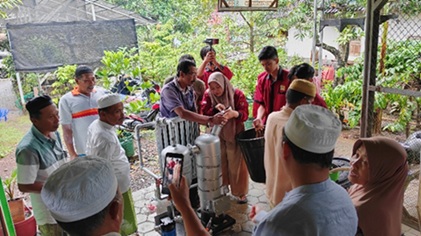
The Silo subdistrict is one of the coffee-producing villages, with a production amounting to more than 40% of the total coffee production in Jember Regency. The coffee processing produces coffee husk waste, which is often discarded into the environment and potentially causes pollution. Coffee husk waste has a high calorific value and is suitable for use as biomass fuel to produce syngas through gasification methods. The partner for this community service is GAPOKTAN Suka Maju, located in Pace Village, Silo Subdistrict, Jember Regency. GAPOKTAN Suka Maju is led by Mr. Zainal Arifin, who has 30 members. This community service aims to provide knowledge to GAPOKTAN Suka Maju members about the environmental impact of coffee husk waste disposal and the utilization of coffee husk waste as an energy source through gasification methods. The community service method consists of pre-activities, activity implementation, and evaluation. The pre-activities include designing the gasification equipment, making the gasification equipment, and drying the coffee husk waste. The implementation consists of socializing the environmental impact of coffee husk waste disposal, the energy potential of coffee husk waste, and training in gasification equipment. The results show a significant increase in the participants' understanding of the environmental impact of coffee husk waste disposal, the energy potential of coffee husk waste, and the gasification method and equipment to convert coffee husk waste into fuel.
Downloads
Article Details

This work is licensed under a Creative Commons Attribution-ShareAlike 4.0 International License.
Authors who publish with this journal agree to the following terms:
- Any article on the copyright is retained by the author(s).
- Author grant the journal, right of first publication with the work simultaneously licensed under a Creative Commons Attribution License that allows others to share work with acknowledgment of the work authors and initial publications in this journal.
- Authors are able to enter into a separate, additional contractual arrangements for non-exclusive distribution of published articles of work (eg, post-institutional repository) or publish it in a book, with acknowledgment of its initial publication in this journal.
- Authors are permitted and encouraged to post their work online (e.g., in institutional repositories or on their websites) prior to and during the submission process, as can lead to productive exchanges, as well as earlier and greater citation of published work.
- The article and any associated published material is distributed under the Creative Commons Attribution-ShareAlike 4.0 International License
References
BPS Indonesia. (2023). Statistik Kopi Indonesia 2022 (Vol. 7). BPS Indonesia.
BPS Kabupaten Jember. (2024). Kabupaten Jember dalam Angka 2024. BPS Kabupaten Jember.
BPS Provinsi Jawa Timur. (2024). Provinsi Jawa Timur dalam Angka 2024 (Vol. 47). BPS Provinsi Jawa Timur.
Briones-Hidrovo, A., Copa, J., Tarelho, L. A. C., Gonçalves, C., Pacheco Da Costa, T., & Dias, A. C. (2021). Environmental and energy performance of residual forest biomass for electricity generation: Gasification vs. combustion. Journal of Cleaner Production, 289, 125680. https://doi.org/10.1016/j.jclepro.2020.125680
De Oliveira, J. L., Da Silva, J. N., Martins, M. A., Pereira, E. G., & Da Conceição Trindade Bezerra E Oliveira, M. (2018). Gasification of waste from coffee and eucalyptus production as an alternative source of bioenergy in Brazil. Sustainable Energy Technologies and Assessments, 27, 159–166. https://doi.org/10.1016/j.seta.2018.04.005
Direktorat Jenderal Perkebunan Kementerian Pertanian Republik Indonesia. (2023). Statik Perkebunan Unggulan Nasional 2020-2022. Direktorat Jenderal Perkebunan Kementerian Pertanian Republik Indonesia.
Kibret, H. A., Kuo, Y.-L., Ke, T.-Y., & Tseng, Y.-H. (2021). Gasification of spent coffee grounds in a semi-fluidized bed reactor using steam and CO2 gasification medium. Journal of the Taiwan Institute of Chemical Engineers, 119, 115–127. https://doi.org/10.1016/j.jtice.2021.01.029
Latief, M., Heriyanti, H., Tarigan, I. L., Bemis, R., & Puspitasari, R. D. (2024). Pengembangan Ekonomi Kreatif Masyarakat melalui Pengolahan Limbah Kulit Kopi Liberika di Desa Jatimulyo: The Development of Economy Creative through Liberica Coffee Waste Processing in Jatimulyo Village. PengabdianMu: Jurnal Ilmiah Pengabdian kepada Masyarakat, 9(3), 409–413. https://doi.org/10.33084/pengabdianmu.v9i3.5562
Mishra, S., & Upadhyay, R. K. (2021). Review on biomass gasification: Gasifiers, gasifying mediums, and operational parameters. Materials Science for Energy Technologies, 4, 329–340. https://doi.org/10.1016/j.mset.2021.08.009
Mussatto, S. I., Machado, E. M. S., Martins, S., & Teixeira, J. A. (2011). Production, Composition, and Application of Coffee and Its Industrial Residues. Food and Bioprocess Technology, 4(5), 661–672. https://doi.org/10.1007/s11947-011-0565-z
Pio, D. T., Ruivo, L. C. M., Tarelho, L. A. C., Frade, J. R., Kantarelis, E., & Engvall, K. (2021). Tar formation during eucalyptus gasification in a bubbling fluidized bed reactor: Effect of feedstock and reactor bed composition. Energy Conversion and Management, 229, 113749. https://doi.org/10.1016/j.enconman.2020.113749
Rodrigues, J. P., Ghesti, G. F., Silveira, E. A., Lamas, G. C., Ferreira, R., & Costa, M. (2022). Waste-to-hydrogen via CO2/steam-enhanced gasification of spent coffee ground. Cleaner Chemical Engineering, 4, 100082. https://doi.org/10.1016/j.clce.2022.100082
Ruesgas-Ramón, M., Figueroa-Espinoza, M. C., Durand, E., Suárez-Quiroz, M. L., González-Ríos, O., Rocher, A., Reversat, G., Vercauteren, J., Oger, C., Galano, J.-M., Durand, T., & Vigor, C. (2019). Identification and quantification of phytoprostanes and phytofurans of coffee and cocoa by- and co-products. Food & Function, 10(10), 6882–6891. https://doi.org/10.1039/C9FO01528K
Septianingtyas Purwandhini, A., Wahyu Pudjiastutik, E., & Exwin Suhaeriyah, N. (2023). Analisis Perwilayahan Komoditas Kopi. Jurnal Sosial Ekonomi Pertanian, 19(2), 167–178. https://doi.org/10.20956/jsep.v19i2.25124
serayunusantara.com. (2023, July 8). Petik Kopi Merah, Bupati Jember Kenalkan Varietas Kopi Milo Robusta—Serayu Nusantara. https://serayunusantara.com/petik-kopi-merah-bupati-jember-kenalkan-varietas-kopi-milo-robusta/
Von Berg, L., Pongratz, G., Pilatov, A., Almuina-Villar, H., Hochenauer, C., Scharler, R., & Anca-Couce, A. (2021). Correlations between tar content and permanent gases as well as reactor temperature in a lab-scale fluidized bed biomass gasifier applying different feedstock and operating conditions. Fuel, 305, 121531. https://doi.org/10.1016/j.fuel.2021.121531
Zhang, X., Wang, W., Yang, W., Su, P., Ge, Y., Jiang, K., & Huang, J. (2023). Optimized carbonization of coffee shell via response surface methodology: A circular economy approach for environmental remediation. Environmental Pollution, 123018. https://doi.org/10.1016/j.envpol.2023.123018