Aplikasi Eco-Enzyme sebagai Bahan Pembuatan Sabun Antiseptik Cair yang Ramah Lingkungan Application of Eco-Enzyme as an Ingredient for Making Environmentally Friendly Liquid Antiseptic Soap
Article Sidebar
Main Article Content
Abstract
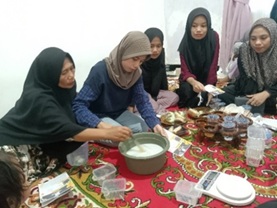
Household waste tends to end up in landfills as waste and can damage the environment, but with good management, it can be processed into materials with economic value. Waste materials such as vegetable waste or fruit peels can be processed into a multipurpose eco-enzyme liquid. Eco-enzyme is an organic compound in the form of a complex solution produced from the fermentation process of waste materials in the form of fruit and vegetable peels. How to make it is very easy and can be done by anyone. Because of its content, eco enzyme has many ways to help the natural cycle such as cleaning polluted water. This eco-enzyme can be used as an ingredient in making liquid antiseptic soap. This liquid antiseptic soap is the right solution to reduce water pollution in the environment. This community service activity was carried out to provide insight to mothers on increasing the utility value of organic waste through the application of eco-enzyme as a raw material for making antiseptic soap. Based on the results of organoleptic tests, the antiseptic soap produced has an aroma, color, moisture, viscosity, smoothness, and amount of foam that is liked by the community. This is proven by the organoleptic test, where the average percentage of very like and like was 100%.
Downloads
Article Details

This work is licensed under a Creative Commons Attribution-ShareAlike 4.0 International License.
Authors who publish with this journal agree to the following terms:
- Any article on the copyright is retained by the author(s).
- Author grant the journal, right of first publication with the work simultaneously licensed under a Creative Commons Attribution License that allows others to share work with acknowledgment of the work authors and initial publications in this journal.
- Authors are able to enter into a separate, additional contractual arrangements for non-exclusive distribution of published articles of work (eg, post-institutional repository) or publish it in a book, with acknowledgment of its initial publication in this journal.
- Authors are permitted and encouraged to post their work online (e.g., in institutional repositories or on their websites) prior to and during the submission process, as can lead to productive exchanges, as well as earlier and greater citation of published work.
- The article and any associated published material is distributed under the Creative Commons Attribution-ShareAlike 4.0 International License
References
Ehilen OE, obadoni BO, Imade FN, Eseigbe D, & Mensah JK. (2017). The effect of detergents on the germination and growth of Amaranthus hybridus L. and Solanum lycopersicon L. Nigerian Annals of Natural Sciences. January, 100–108.
Eliningsih, E. (2021). Peningkatan Kemampuan Guru Dalam Manajemen Pengelolaan Kelas Di Masa Pandemi Covid-19 Melalui Supervisi Klinis Pengawas Di SDN 15 Perawang. Nuansa Akademik: Jurnal Pembangunan Masyarakat, 6(1), 25–36.
Endah Kusumawati, D., & Nindya Putri, C. (2022). Pelatihan Pembuatan Sabun Ecoenzyme Berbahan Limbah Organik Rumah Tangga di Kelompok Ibu-Ibu PKK Desa Batursari Demak. Nuansa Akademik: Jurnal Pembangunan Masyarakat, 7(1), 13–22. https://jurnal.ucy.ac.id/index.php/nuansaakademik/article/view/1081
Ghofur, Abdul, Muhammad Alvis Syarifuddin, Abdul Majid Toyyibi, D., & Kurnianingsih, R. (2021). Strategi Lembaga Keuangan Syariah Menghadapi Pembiayaan Bermasalah Di Masa Pandemi Covid-19. Ulumuddin: Jurnal Ilmu-Ilmu Keislaman, 11(2), 129–142.
Hidayat et al. (2021). Penanganan Kesehatan Pasien Reaktif COVID-19 Melalui Terapi Zikir Dan Lingkungan Wawasan Pengalaman Subyektif. Ulumuddin : Jurnal Ilmu-Ilmu Keislaman, 11(1), 1–12.
Jadid, N., Jannah, A. L., Wicaksono Putra Handiar, B. P., Nurhidayati, T., Purwani, K. I., Ermavitalin, D., Muslihatin, W., & Navastara, A. M. (2022). Aplikasi Eco Enzyme Sebagai Bahan Pembuatan Sabun Antiseptik. Sewagati, 6(1), 69–75. https://doi.org/10.12962/j26139960.v6i1.168
Kusumaningtyas, R. D., Widjanarko, D., Cahyati, W. H., Wulansarie, R., Maksiola, M., Meysanti, D., Salsabilla, M. T., Nugraha, D. D., Najuda, M. D., & Rachmadi, M. F. (2022). Pengolahan Limbah Minyak Jelantah Menjadi Sabun Cuci Tangan sebagai Upaya Konservasi Lingkungan dan Pencegahan Penularan Virus Covid-19. Jurnal Abdimas, 26(2), 110–121. https://doi.org/10.15294/abdimas.v26i2.40053
Mananda, A. B., Nalawati, A. N., Murwanti, R., Wardhana, D. I., Setiawan, A. P., Alim, A. W., & Eryani, N. P. (2024). Pelatihan Pembuatan Sabun Cuci Piring Berbasis Eco-enzyme Sebagai Upaya Menumbuhkan Jiwa Wirausaha Siswa SMA Muhammadiyah 3 Jember. Journal of Community Development, 4(3), 243–252. https://doi.org/10.47134/comdev.v4i3.170
Mustikawati, I. S. (2017). Perilaku Cuci Tangan Pakai Sabun Studi Kualitatif pada Ibu-Ibu di Kampung Nelayan Muara Angke Jakarta Utara. Studi Kualitatif.
Nurfajriah. (2021). Pelatihan Pembuatan Eco-enzyme Sebagai Usaha Pengolahan Sampah Organik Pada Level Rumah Tangga. IKRA-ITH ABDIMAS, 4(1), Article 3.
Pandoman, A. (2020). Analisis Quietus Politik Terhadap Upaya Pemerintah Menangani Wabah Covid-19 Pasca Deklarasi Public Health Emergency Of International Concern (PHEIC). Ulumuddin : Jurnal Ilmu-Ilmu Keislaman, 10(1), 1–12. https://doi.org/10.47200/ulumuddin.v10i1.379
Purnamasari, E. N. (2014). Karakteristik Kandungan Linear Alkyl Benzene Sulfonat (LAS) pada Limbah Cair Laundry. Jurnal Media Teknik, 11(1), 32–36.
Suastuti DA, Suarsa IW, P. D. (2015). Pengolahan larutan detergen dengan biofilter tanaman kangkung (ipomoea crassicaulis) dalam sistem batch (curah) teraerasi. Jurnal Kimia FMIPA, 9(1), 98–104.
Wathoni, M., Susanto, A., Syahban, A. K. D. P. (2020). Pemanfaatan Bahan Rumah Tangga dalam Pembuatan Sabun Cair dari Sabun Batang di Masa Pandemi. Seminar Nasional Pengabdian Masyarakat LPPM Universitas Muhammadiyah Jakarta, E-ISSN, 2714–6286.
Wijana, S., Sumarjo, Harnawi, T. (2009). Studi pembuatan sabun mandi cair dari daur ulang minyak goreng bekas (Kajian pengaruh lama pengadukan dan rasio air: sabun terhadap kualitas). Jurnal Teknologi Pertanian, 10(1), 54–61