Inovasi Upaya Eliminasi Skabies di Pesantren dengan Pelatihan Pembuatan Sabun Herbal Berbasis Minyak Kelapa dan Ekstrak Buah Tin Innovation in Efforts to Eliminate Scabies in Islamic Boarding Schools through Training on Making Herbal Soap Based on Coconut Oil and Fig Fruit Extract
Article Sidebar
Main Article Content
Abstract
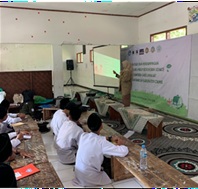
The results of a survey conducted at the Sabilunnajat Islamic Boarding School in Ciamis Regency in 2022─2023 found that scabies incidents among students ranged from around 50─60%. The partners' problems were identified as consisting of three issues: Low levels of information and implementation of Clean and Healthy Living Behaviors, High incidence of scabies, and No previous training in self-sufficiency in producing PHBS implementation products. The objective of the PKM activity is to eliminate scabies through education and support for PHBS, as well as empowering teachers and student representatives in making herbal soap as a means of self-sufficiency and empowerment in producing PHBS implementation products at the boarding school. The PKM implementation method, as a solution to the partners' third problem, consists of two stages. Stage I: Socialization, Education, and PHBS Support, and Stage II: Training and Assistance in Making Herbal Soap using Coconut Oil-Based and Fig Fruit Extracts. This serves as an effort to transfer knowledge to teachers and student representatives at the boarding school by utilizing local natural resources. Before and after the implementation of PHBS education and support, as well as the soap-making training, pre- and post-tests were conducted to assess the impact of PKM activities on participants' knowledge levels, evaluated using the Paired Samples Test analysis, with p<0.05. In conclusion, there was an increase in knowledge about PHBS after the provision of education, PHBS support, and training and assistance in making herbal soap based on coconut oil and fig fruit extract through talk shows and interactive discussions
Downloads
Article Details

This work is licensed under a Creative Commons Attribution-ShareAlike 4.0 International License.
Authors who publish with this journal agree to the following terms:
- Any article on the copyright is retained by the author(s).
- Author grant the journal, right of first publication with the work simultaneously licensed under a Creative Commons Attribution License that allows others to share work with acknowledgment of the work authors and initial publications in this journal.
- Authors are able to enter into a separate, additional contractual arrangements for non-exclusive distribution of published articles of work (eg, post-institutional repository) or publish it in a book, with acknowledgment of its initial publication in this journal.
- Authors are permitted and encouraged to post their work online (e.g., in institutional repositories or on their websites) prior to and during the submission process, as can lead to productive exchanges, as well as earlier and greater citation of published work.
- The article and any associated published material is distributed under the Creative Commons Attribution-ShareAlike 4.0 International License
References
Al-Bugha, M. D. (2007). Al-Wafi: Syarah Hadits Arbain Imam An-Nawawi. Hikmah (PT Mizan Publika).
Bismantara, H., Ahern, S., Teede, H. J., & Liew, D. (2022). Academic health science centre models across the developing countries and lessons for implementation in Indonesia: a scoping review. BMJ Open, 12(9). https://doi.org/10.1136/bmjopen-2021-051937
Darman, M. S. R. (2022). Konsep Bangsa Ideal Perspektif Al-Qur’an dan Tanakh: Studi Analisis Komparatif QS Ali ‘Imran/3: 110 dan Tanakh. AL-AQWAM: Jurnal Studi Al-Quran Dan Tafsir, 1(1), 45–54. https://ejournal.iaingorontalo.ac.id/index.php/aq/article/download/268/360/1660
Djoru, M. R. B., & Adi, R. R. (2023). PKM Pelatihan Pembuatan Dan Pengemasan Sabun Herbal Kelor, Sereh Merah Dan Kunyit Pada Siswa SMA Negeri 10 Kupang. SWARNA: Jurnal Pengabdian Kepada Masyarakat, 2(1). https://doi.org/10.55681/swarna.v2i1.151
El-Moamly, A. A. (2021). Scabies as a part of the World Health Organization roadmap for neglected tropical diseases 2021–2030: what we know and what we need to do for global control. Tropical Medicine and Health, 49(1), 64. https://doi.org/10.1186/s41182-021-00348-6
Mulqie, L., Hazar, S., Choesrina, R., Mardliyani, D., Nurzahra, A., & Latifa, N. N. (2023). Potensi Antibakteri Fraksi Ekstrak Buah Tin Domestik (Ficus carica L.) Terhadap Pseudomonas aeruginosa dan Staphylococcus aureus. Jurnal Ilmiah Farmasi Farmasyifa, 6(2). https://doi.org/10.29313/jiff.v6i2.10853
Nurhidayat, Firdaus, F. A., Nurapandi, A., & Kusumawaty, J. (2022). Analisis faktor- faktor Yang mempengaruhi terjadinya skabies pada santri di Pondok Pesantren Miftahul Amin. Healthcare Nursing Journal, 4(2). https://doi.org/10.35568/healthcare.v4i2.2267
Pratama, A. M. Y. (2024, March). 3 Daerah dengan Kebun Kelapa Terluas di Jabar, Produksi Bisa Sampai 30 Ribu Ton. Pikiran Rakyat Tasikmalaya. https://tasikmalaya.pikiran-rakyat.com/properti/pr-067813611/3-daerah-dengan-kebun-kelapa-terluas-di-jabar-produksi-bisa-sampai-30-ribu-ton
Sulaiman, E. S. (2022). Pendidikan dan Promosi Kesehatan: Teori dan Implementasi di Indonesia. UGM Press.
Sylvia, D., & Pratiwi, D. (2021). Pelatihan Pembuatan Sabun Padat Herbal di Desa Cileles Kabupaten Tangerang. Jurnal Ilmiah Pangabdhi, 7(2). https://doi.org/10.21107/pangabdhi.v7i2.11800
Triyani, Y., Hendryanny, E., Indriyanti, R. A., Purbaningsih, W., & Respati, T. (2020). Scabies and The Development of Clean and Healthy Living Behavior Tools for Islamic Boarding Schools (Pesantren). In Medical Technology and Environmental Health (pp. 149–152). CRC Press. https://doi.org/10.1201/9781003016700-26
Triyani, Y., Yuniarti, L., Tejasari, M., Purbaningsih, W., Ismawati, I., & Respati, T. (2019). A Journey to a Better Community Service in Religious Boarding School Pesantren. Proceedings of the Social and Humaniora Research Symposium (SoRes 2018), 497–499. https://doi.org/10.2991/sores-18.2019.114