Transformasi Digital dalam Pendidikan: Pelatihan Pembelajaran Berbasis Canva bagi Guru SDN 65/II Sungai Bangsat Digital Transformation in Education: Canva-Based Learning Training for Teachers of SDN 65/II Sungai Bangsat
Article Sidebar
Main Article Content
Abstract
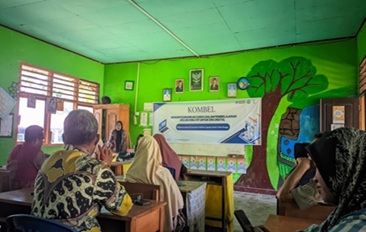
The digital transformation in education is essential for enhancing learning quality, particularly at the elementary school level. This community engagement program aims to enhance teachers' digital skills through Canva-based learning training for Teachers at SDN 65/II Sungai Bangsat, conducted on January 31–February 1, 2025. The Participatory Action Research (PAR) method was implemented, involving 18 teachers and one school principal as active participants. The training results indicate that 80% of participants were able to create digital teaching materials independently, and 90% agreed that Canva helped enhance learning engagement. Challenges included limited internet access and varying levels of digital proficiency among teachers. Thus, follow-up mentoring, technological infrastructure improvements, and periodic evaluations are necessary to ensure the sustainable use of Canva in teaching. This program enhances teachers' digital literacy and serves as a training model applicable to other elementary schools, particularly in areas with limited technological resources.
Downloads
Article Details

This work is licensed under a Creative Commons Attribution-ShareAlike 4.0 International License.
Authors who publish with this journal agree to the following terms:
- Any article on the copyright is retained by the author(s).
- Author grant the journal, right of first publication with the work simultaneously licensed under a Creative Commons Attribution License that allows others to share work with acknowledgment of the work authors and initial publications in this journal.
- Authors are able to enter into a separate, additional contractual arrangements for non-exclusive distribution of published articles of work (eg, post-institutional repository) or publish it in a book, with acknowledgment of its initial publication in this journal.
- Authors are permitted and encouraged to post their work online (e.g., in institutional repositories or on their websites) prior to and during the submission process, as can lead to productive exchanges, as well as earlier and greater citation of published work.
- The article and any associated published material is distributed under the Creative Commons Attribution-ShareAlike 4.0 International License
References
Anderson, J., & Simpson, M. (2024). Technology Integration in Primary Education: A Study on Digital Tools for Engagement. Journal of Educational Technology Research, 41(2), 112–130. https://www.researchgate.net/publication/382913688_Engaging_students_in_higher_education_with_educational_technology
Bradbury, H. (2024). Action Research in Practice: Creative Approaches to Professional Development. Routledge. https://www.researchgate.net/publication/278411678_From_Action_Research_to_Practice_Research
Greenwood, D. J., & Levin, M. (2024). Introduction to Action Research: Social Research for Social Change. SAGE Publications. https://books.google.com/books/about/Introduction_to_Action_Research.html?id=PdtFBQAAQBAJ
Hasanah, R. (2024). Transformasi Digital dalam Pendidikan: Peluang dan Tantangan di Indonesia. Jurnal Pendidikan Digital, 12(1), 32–45. https://doi.org/10.54065/jld.3.3.2023.596
Johnson, L., & Peters, K. (2024). Bridging the Digital Divide: Teacher Training for 21st Century Skills in Rural Schools. International Journal of Digital Education, 15(1), 78–95. https://doi.org/10.35608/ruraled.v41i1.576
Kemmis, S., & McTaggart, R. (2024). Participatory Action Research: Communicative Action and the Public Sphere. Routledge. https://www.researchgate.net/publication/232521456_Participatory_Action_Research_Communicative_Action_and_the_Public_Sphere
McIntyre, A. (2024). Participatory Action Research: Qualitative Research in Action. SAGE.
Mayer, R. E. (2023). Multimedia Learning: Principles and Applications in Digital Education. Cambridge University Press. https://doi.org/10.1017/9781108894333
O’Brien, R. (2024). An Overview of Participatory Action Research and Its Application in Education. Journal of Educational Innovation, 18(2), 60–75. https://files.eric.ed.gov/fulltext/EJ908178.pdf
Prasetyo, A., & Widodo, B. (2024). Pemanfaatan Canva dalam Pengembangan Media Pembelajaran Interaktif di MI Al Ahmad. Jurnal Pendidikan Islam, 10(1), 25–35. https://doi.org/10.3059/insis.v0i0.22895
Rahayu, S., & Setiawan, D. (2024). Kesiapan Guru dalam Mengadopsi Teknologi Digital dalam Pembelajaran Sekolah Dasar. Jurnal Inovasi Pendidikan, 18(2), 10–30. https://www.researchgate.net/publication/380376378_INOVASI_PEMBELAJARAN_DAN_PENDIDIKAN_TEKNOLOGI_UNTUK_PENINGKATAN_KUALITAS_PENDIDIKAN
Santoso, H., & Lestari, M. (2024). Pendampingan Pasca-Pelatihan sebagai Faktor Keberhasilan Adopsi Teknologi dalam Pembelajaran. Jurnal Ilmu Pendidikan, 19(3), 35–45. https://journal.iapa.or.id/proceedings/article/download/1082/479/
Stringer, E. T. (2024). Action Research in Education: A Practical Guide. Pearson.
Suryani, T. (2024). Efektivitas Pelatihan Canva dalam Meningkatkan Literasi Digital Guru Sekolah Dasar. Jurnal Teknologi Pendidikan, 14(3), 40–50. https://doi.org/10.37985/pmsdu.v1i2.65
Sugiyono. (2022). Metode Penelitian Kualitatif, Kuantitatif, dan R&D. Alfabeta.
UNESCO. (2024). Digital Transformation in Education: Global Trends and Best Practices. United Nations Educational, Scientific and Cultural Organization. https://www.unesco.org/en/digital-education
Wijayanti, L. (2024). Pengaruh Media Pembelajaran Digital terhadap Motivasi Siswa dalam Pembelajaran Sekolah Dasar. Jurnal Riset Pendidikan, 22(1), 50–60. https://journal.unpas.ac.id/index.php/pendas/article/view/23991/12611