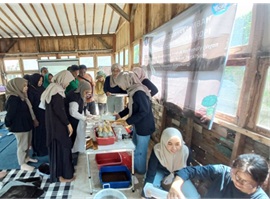
Training on Bioconversion of Coffee Pulp Waste into Vegan Leather Raw Material in Dusun Krajan, Tegalharjo, Glenmore, Kabupaten Banyuwangi
Article Sidebar
Main Article Content
Abstract
Banyuwangi is the largest coffee plantation centre in East Java, with robusta and arabica coffee production reaching 10,518 tonnes per year. Coffee plantation waste, which is abundant, is known as coffee pulp. Coffee pulps can be converted into organic compost/fertilizer, animal feed, and eco-friendly products such as cellulose-based nata/membrane. The abundant availability of coffee pulp waste in Banyuwangi Regency has not been correctly handled or processed to prevent environmental impact. Converting coffee pulp waste into eco-friendly products will benefit the surrounding community and increase the added value of the waste. To overcome these problems, it is necessary to engage in activities involving the local community, local government, and agro-tourism actors through counseling and training on processing coffee pulp waste/bioconversion into eco-friendly products, thereby benefiting the community in Banyuwangi Regency, especially in the Glenmore area. Training participants were given a questionnaire for assessment. Based on the results of the questionnaire analysis, it is known that the participants' understanding before the activity is: 40% of participants were very poorly understood, 13% were poorly understood, 20% were quite understood, 13% understood, and 13% were very familiar with the material of processing coffee pulp waste. After receiving training, 27% of participants achieved an excellent understanding, 33% had a moderate understanding, and 33% had a somewhat understanding. Additionally, there were still participants who did not understand as much as 7%. Based on the participants' assessment, 67% felt that the benefits of this activity were excellent and should be carried out on an ongoing basis.
Downloads
Article Details

This work is licensed under a Creative Commons Attribution-ShareAlike 4.0 International License.
Authors who publish with this journal agree to the following terms:
- Any article on the copyright is retained by the author(s).
- Author grant the journal, right of first publication with the work simultaneously licensed under a Creative Commons Attribution License that allows others to share work with acknowledgment of the work authors and initial publications in this journal.
- Authors are able to enter into a separate, additional contractual arrangements for non-exclusive distribution of published articles of work (eg, post-institutional repository) or publish it in a book, with acknowledgment of its initial publication in this journal.
- Authors are permitted and encouraged to post their work online (e.g., in institutional repositories or on their websites) prior to and during the submission process, as can lead to productive exchanges, as well as earlier and greater citation of published work.
- The article and any associated published material is distributed under the Creative Commons Attribution-ShareAlike 4.0 International License
References
Absharina, D., Padri, M., Veres, C., & Vágvölgyi, C. (2025). Bacterial Cellulose: From Biofabrication to Applications in Sustainable Fashion and Vegan Leather. Fermentation, 11(1), 23. https://doi.org/10.3390/fermentation11010023
Aimah, S., Budiywono, E., & Al-Rosid, Moh. H. (2019). Upaya Meningkatkan Perekonomian Masyarakat Desa Tegalharjo Melalui Inovasi Pemanfaatan Pepaya Menjadi Abon. LOYALITAS, Jurnal Pengabdian Kepada Masyarakat, 2(2), 215. https://doi.org/10.30739/loyal.v2i2.493
Aswini, K., Gopal, N. O., & Uthandi, S. (2020). Optimized Culture Conditions for Bacterial Cellulose Production by Acetobacter senegalensis MA1. BMC Biotec1hnology. 20(46). https://doi.org/10.3390/fermentation10090466
Blinová, L., Sirotiak, M., Bartošová, A., & Soldán, M. (2017). Review: Utilization of waste from coffee production. Research Papers Faculty of Materials Science and Technology Slovak University of Technology, 25(40), 91–101. https://doi.org/10.1515/rput-2017-0011
Kefale, G. Y., Kebede, Z. T., & Birlie, A. A. (2023). A Systematic Review on Potential Bio Leather Substitute for Natural Leather. Hindawi, 2023(1), 1-11. https://doi.org/10.1155/2023/1629174
Geissdoerfer, M., Savaget, P., Bocken, N. M. P., & Hultink, E. J. (2017). The Circular Economy – A new sustainability paradigm?. Journal of Cleaner Production, 143, 757–768. https://doi.org/10.1016/j.jclepro.2016.12.048
Jannah, A., Aulanni`am, A., Ardyati, T., Suharjono, S., 2018. Isolation, Cellulase Activity Test and Molecular Identification of Selected Cellulolytic Bacteria Indigenous Rice Bran. Indones. J. Chem. 18, 514. https://doi.org/10.22146/ijc.26783
Jiménez-Sánchez, A., Hernández-Gil, L., Jiménez-Sánchez, Y., García Pérez, M. A., & Rodríguez-Larraburu, E. (2024). Production of Bacterial Cellulose from Kombucha Tea and Coffee Husk Infusion. Nativa, 12(3), 567-573. https://doi.org/10.31413/nativa.v12i3.17720
Machado, R. T. A., A. B. Maneguin, R. M. Sabio, D. F. Franco, S. G. Antonio, J. Gutierrez, A. Tercjak, A. A. Berretta, S. J. L. Riberio, S. C. Laurearini, W. T. Lustri & H. S. Barud. 2018. Komagataeibacter rhaeticus grown in sugarcane molassessupplemented culture medium as a strategy for enhancing bacterial cellulose production. Ind Crops Prod. 122:637-646. https://doi.org/10.1016/j.indcrop.2018.06.048
Mateo, S., Peinado, S., Morillas-Gutiérrez, F., La Rubia, M. D., & Moya, A. J. (2021). Nanocellulose from Agricultural Wastes: Products and Applications—A Review. Processes, 9(9), 1594. https://doi.org/10.3390/pr9091594
Murthy, P. S., & Madhava Naidu, M. (2012). Sustainable management of coffee industry by-products and value addition—A review. Resources, Conservation and Recycling, 66, 45–58. https://doi.org/10.1016/j.resconrec.2012.06.005
Ravindra B. Malabadi, Kiran P. Kolkar, Raju K. Chalannavar, & Himansu Baijnath. (2025). Plant-based leather production: An update. World Journal of Advanced Engineering Technology and Sciences, 14(1), 031–059. https://doi.org/10.30574/wjaets.2025.14.1.0648
Serna-Jiménez, J. A., Siles, J. A., De Los Ángeles Martín, M., & Chica, A. F. (2022). A Review on the Applications of Coffee Waste Derived from Primary Processing: Strategies for Revalorization. Processes, 10(11), 2436. https://doi.org/10.3390/pr10112436
Yasmaniar, G., Husla, R., Wastu, A. R. R., Fadliah, F., & Pramadika, H. (2023). Pelatihan Pembuatan Starch (Tepung Jagung) dari Limbah Bonggol Jagung di Lagoa, Jakarta Utara. Jurnal AKAL: Abdimas Dan Kearifan Lokal, 4(2), 141–146. https://doi.org/10.25105/akal.v4i2.13875