Intervensi melalui Psikoedukasi untuk Meningkatkan School Well-Being Siswa Kecamatan Ngaliyan Intervention through Psychoeducation to Improve School Well Being of Ngaliyan District Students
Article Sidebar
Main Article Content
Abstract
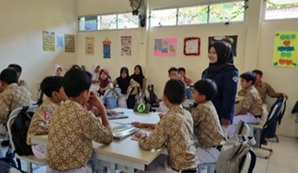
School well-being influences building a good atmosphere in the educational process in the school environment. This community service strives to ensure students achieve good school well-being. This community service uses qualitative methods with structured written and verbal interviews, and psychoeducation is also provided to students. Community Service by providing psychoeducation for students in Ngaliyan District. Namely, students are given material related to improving school well-being with psychoeducation consisting of relaxation, self-efficacy, and assertiveness. The results of this service showed an increase in school well-being in this community service with psychoeducation, which improved the welfare of elementary school students after being given psychoeducation, compared to before being given psychoeducation.
Downloads
Article Details

This work is licensed under a Creative Commons Attribution-ShareAlike 4.0 International License.
Authors who publish with this journal agree to the following terms:
- Any article on the copyright is retained by the author(s).
- Author grant the journal, right of first publication with the work simultaneously licensed under a Creative Commons Attribution License that allows others to share work with acknowledgment of the work authors and initial publications in this journal.
- Authors are able to enter into a separate, additional contractual arrangements for non-exclusive distribution of published articles of work (eg, post-institutional repository) or publish it in a book, with acknowledgment of its initial publication in this journal.
- Authors are permitted and encouraged to post their work online (e.g., in institutional repositories or on their websites) prior to and during the submission process, as can lead to productive exchanges, as well as earlier and greater citation of published work.
- The article and any associated published material is distributed under the Creative Commons Attribution-ShareAlike 4.0 International License
References
Amalia. I. 2020. Gambaran School wellbeing Siswa SMA. Jurnal Psikologi Terapan [JPT], 3(1), Juli 2020 ISSN:2597-663X.. https://doi.org/10.29103/jpt.v3i1.3637
Alwi, M. A.1, Suminar, D. R.2, Nawangsari, N. A. W. 2020. Dukungan di Sekolah dan Kesejahteraan Sekolah: Harga Diri Sebagai Mediator. Jurnal Internasional Pedagogi dan Pendidikan Guru. 4 (2) | Oktober 2020) PAPER |60 e-ISSN: 2549-8525| p-ISSN: 2597-7792
Allardt, E. (1989) An updated indicator system: having, loving, being. Department of Sociology. Working Paper 1989: 48, University of Helsinki, Helsinki. http://dx.doi.org/10.1177/10888683241263634
Anggraeni & Immanuel. 2020. Model School Well-Being Sebagai Tatanan Sekolah Sejahtera Bagi Siswa. Psikobuletin: Buletin Ilmiah Psikologi 1(3), September, 2020 (146 – 156) e-ISSN : 2720 – 8958 http://dx.doi.org/10.24014/pib.v1i3.9848
Audhild Løhrea,, Unni K Moksnesa, dan Monica Lillefjella,, Jurnal Pendidikan Kesehatan 2014, 73(1) 90–100)
Azwar, S. (2007). Metode penelitian, Cetakan VIII. Yogyakarta: Pustaka Pelajar.
Ben-Arieh, A., & Frønes, I. (2007). Indicators of children’s well being: What Should Be Measured And Why?. Social Indicators Research, 84(3), 249-250. http://dx.doi.org/10.1007/s11205-007-9183-6
Bonell, C., Humphrey, N., Fletcher, A., Moore, L., Anderson, R., & Campbell, R. (2014). Why schools should promote students health and wellbeing. http://dx.doi.org/10.1136/bmj.g3078
Bronfenbrenner, U., & Moris, P.A. (2006). The bioecological model of human development. Handbook of child psychology, https://www.childhelp.org/wp-content/uploads/2015/07/Bronfenbrenner-U.-and-P.-Morris-2006-The-Bioecological-Model-of-Human-Development.pdf
Cahill, H. (2007). Creating school environment that promote social and emotional well-being. Schools and diversity, 2. http://dx.doi.org/10.1108/HE-11-2016-0057
Candra, T. (2018). Listening to the voices of children, parents, and teachers about children’s school life: promoting children’s wellbeing in Yogyakarta, Indonesia (Doctoral dissertation). Diakses melalui http://hdl.handle.net/11343/224390
Cohen, S. (2004). Social relationships and health. American Psychologist, 59(8), 676. http://dx.doi.org/10.1037/0003-066X.59.8.676
Cohen, S., & Hoberman, H. M. (1983). Positive events and social supports as buffers of life change stress 1. Journal of Applied Social Psychology, 13(2), 99-125. https://doi.org/10.1111/J.1559-1816.1983.TB02325.X
Cohen, S., & Wills, T. A. (1985). Stress, social support, and the buffering hypothesis. Psychological Bulletin, 98(2), 310. 74 Columbo, S. A. (1986). General wellbeing in adolescents: its nature and measuremen (Doctoral dissertation, Saint Louis University). https://pubmed.ncbi.nlm.nih.gov/3901065/
Cummins, R. A., Lau, A. D., & Davern, M. T (2012). Subjective wellbeing homeostasis. Handbook of Social Indicators and Quality of Life Research, (pp. 79-98). https://doi.org/10.1007/978-94-007-2421-1_4
Dawson, J., & Singh-Dhesi, D. (2010). Educational psychology working to improve psychological well-being: an example. Emotional and Behavioural Difficulties, 15(4), 295-310. http://dx.doi.org/10.1080/13632752.2010.523213
Demir, M., & Leyendecker, B. (2018). School-related social support is associated with school engagement, self-competence and health-related quality of life (HRQoL) in turkish immigrant students. Frontier in Education, 3(83). Frontiers. http://dx.doi.org/10.3389/feduc.2018.00083
Diener, E. (2009). Subjective well-being. The science of well-being, 11-58. http://dx.doi.org/10.1007/978-90-481-2350-6
Eva Nur Rachmah. 2016. Pengaruh School Well-being terhadap Motivasi Belajar Siswa. Psikosains. 11(2), Agustus 2016, Hal. 99-108 ISSN: 1907-5235. https://doi.org/10.30587/psikosains.v11i2.640
Fauziah, M., Handarini, D. M., & Muslihati. (2018). Self-esteem, social support, personality and psychological wellbeing of junior high school student. Jurnal Pendidikan Humaniora, 6(1), 17-23. Diakses melalui http://journal.um.ac.id/index.php/jph
Faizah, F. (2020). School Well-Being Siswa Sekolah Dasar dan Siswa Sekolah Menengah Pertama Pengguna Sistem Full-Day School di Indonesia . Jurnal Kajian Bimbingan dan Konseling, 5(1). http://dx.doi.org/10.17977/um001v5i12020p034
Farah Aulia1 , Thomas Dicky Hastjarjo2 , Diana Setiyawati3 , Bhina Patria. Well-being: A Systematic Literature Review of Science Education, Universitas Negeri. Padang Universitas Gadjah Mada Submitted 24 January 2019 Accepted 20 March 2019 Published 22 June 2020). http://dx.doi.org/10.22146/buletinpsikologi.42979
Gottlieb, B.H. (1983). Social Support Strategie: Guideliness for Mental Helth Practice. London: Sage Publication. https://kikp-pertanian.id/bbpmkp/opac/detail-opac?id=17967
Graham, A., & Fitzgerald, R. (2011). Supporting children's social and emotional wellbeing: does Having a Say matter?. Children & Society, 25 (6), 447-457. http://dx.doi.org/10.1111/j.1099- 0860-2010.00295.x
Hegney, D. G., Buikstra, E., Baker, P., Rogers-Clark, C., Pearce, S., Ross, H., ... & WatsonLuke, A. (2007). Individual resilience in rural people: a Queensland study, Australia. Rural and remote health, 7(4), 1-13. https://pubmed.ncbi.nlm.nih.gov/17961001/
Hidayah, N., Pali, M., Ramli, M., & Hanurawan, F. (2016). Students’ well-being assessment at school. Journal of Educational, Health, and Community Psychology, 5(1). https://doi.org/10.30596/bibliocouns.v3i1.4804
Hobfoll, S.E. (1986). Stress, social support and women: the series in clinical and community psychology. New York: Herpe & Row. https://api.pageplace.de/preview/DT0400.9781317770602_A23905338/preview-9781317770602_A23905338.pdf
Imam Setyawan, Endah Kumala Dewi. 2014. Efektivitas Pelatihan PEDE” (Pemaafan, Efikasi Diri dan Empati Untuk Meningkatkan School WellBeing Siswa. Jurnal Psikologi 18(2) Oktober 2019, 218-229 218. https://doi.org/10.14710/jp.18.2.218-229
Izzah, L., Kurniawan, W., Damra, H. R., Putri, U. H., Putri, L. A., & Susilawati, D. (2020). Pengaruh Intervensi Pendidikan Kesehatan Mental Dalam Meningkatkan School Well-Being Pada Remaja Di MA Muhammadiyah Pekanbaru. Nathiqiyyah, 3(1), 68-85. https://doi.org/10.46781/nathiqiyyah.v3i1.307
Jarvela, S., & Jarvenoja, H. (2011). Socially constructed self-regulated learning and motivation regulation in collaborative learning groups. Teachers College Record, 113(2), 350- 374. https://doi.org/10.1177/016146811111300205
Khatimah, H. (2015). Gambaran school well-being pada peserta didik program kelas akselerasi di SMA Negeri 8 Yogyakarta. Psikopedagogia, 4(1), 20-30. 75. http://dx.doi.org/10.12928/psikopedagogia.v4i1.4485
Konu, A., Alanen, E., Lintonen, T., & Rimpelä, M. (2002). Factor structure of the school well- being model. Health Education Research, 17(6), 732-742. https://doi.org/10.1093/her/17.6.732
Konu, A., & Lintonen, T., (2006). School well-being in Grades 4–12. Health Education Research, 21(5), 633–642. https://doi.org/10.1093/her/cyl032
Konu, A., & Rimpelä, M. (2002). Well-being in schools: A conceptual model. Health Promotion International, 17(1), 79-87. http://dx.doi.org/10.1093/heapro/17.1.79.
Liu, W., Tian, L., Huebner, E. S., Zheng, X., & Li, Z. (2014). Preliminary development of the elementary school students subjective well-being in school scale. Social Indicators Research, 120 (3), 917-937. http://dx.doi.org/10.1007/s11205-014-0614-x
Leipold, B., & Greve, W. (2009). Resilience: A conceptual bridge between coping and development. European Psychologist, 14(1), 40-50. https://doi.org/10.1027/1016-9040.14.1.40
Løhre, A., Lydersen, S., & Vatten, L. (2010). School wellbeing among children in grades 1–10. BMC Public Health, 10(1), 1-7. https://doi.org/10.1186/1471-2458-10-526
Løhrea. A Unni K Moksnesa. U & Lillefjell. M. (2014). Gender differences in predictors of school wellbeing? Health Education Journal, 73(1) 90–100. http://dx.doi.org/10.1177/0017896912470822
Masten, A. S. (2001). Ordinary magic: Resilience processes in development. American psychologist, 56(3). https://doi.org/10.1037//0003-066x.56.3.227
Misbah, I. (2018). Kajian wellbeing dalam perencanaan kebijakan pendidikan Indonesia (A discussion about wellbeing in education policy in Indonesia). Kilas Pendidikan, 16. Pusat Pendidikan dan Kebijakan Indonesia. https://pspk.id/wp-content/uploads/2020/09/Kilas-Pendidikan-Edisi-16_Kajian-Wellbeing-dalam-Perencanaan-Kebijakan-Pendidikan.pdf
Prasetyo, Y. S.2010. Evaluation of School Well-being with The School Well-being Model Approach in SMP 24 Malang. Evaluation of School Well-being with The School Well- being Model Approach in SMP 24 Malang. Mutiara Medika 10(1):37-43 Januari 2010
Rabbani, M. (2019). Hubungan antara stress akademik dan school wellbeing pada siswa SMA di Yogyakarta (Doctoral dissertation, Universitas Islam Indonesia). https://dspace.uii.ac.id/handle/123456789/18466;jsessionid=C7B44A3AC84EC355057AFD87BD6A42B6
Santrock, J.W. (2011). Life span development 13th edition. New York: McGrawHill. https://books.google.co.id/books/about/Life_span_Development.html?id=LLfgQQAACAAJ&redir_esc=y
Suldo, S., & Huebner, E.S. (2004). Does life satisfaction moderate the effects of stressful life events on psychopathological behavior in adolescence? School Psychology Quarterly, 19(2), 93. http://dx.doi.org/10.1521/scpq.19.2.93.33313
Saraswati, L., Tiatri, S., & Sahrani, R. (2017). Peran self-esteem dan school wellbeing pada resiliensi siswa SMK Pariwisata A. Jurnal Muara Ilmu Sosial, Humaniora, dan Seni, 1(2), 511-518. http://dx.doi.org/10.24912/jmishumsen.v1i2.1472
Setyawan, I., & Dewi, E. K. (2019). Efektivitas pelatihan PEDE (pemaafan, efikasi diri, dan empati) untuk meningkatkan school well-being siswa. Jurnal Psikologi, 18(2), 218. https://doi.org/10.14710/jp.18.2.218-229
Sthepvanny Herlof A. I. Laure1 , Yeni Damayanti2 , Juliana Marlyn Y Benu3 , Luh Putu Ruliati. 2020. Kesejahteraan Sekolah dan Kenakalan Remaja Siswa Sekolah Menengah Kejuruan. Journal of Health and Behavioral Science 2(2), June 2020, pp. 88~104. https://doi.org/10.35508/jhbs.v2i2.2192
Tribunnews. (2020). Kasus bunuh diri siswi smp di ciracas, pemerhati sebut sebagai bagian dari dosa lingkungan. Diakses melalui https://www.tribunnews.com/lifestyle/2020/01/23/kasus-bunuh-diri-siswismp-di-ciracas-pemerhati-sebut-sebagai-bagian-dari-dosa-lingkungan
Ville Puonti, Rikka Hirvonen & Noona Kiuru. 2021. Development and Aging Associations of temperament types and gender of early adolescents and teachers with adolescents’ school well-being. Scandinavian Journal of Psychology, 2021 https://doi.org/10.1111/sjop.12729
Wijayanti, P.A.K.,& Sulistiobudi, R.A. (2017). School management as one of key factors to develop elementary school students' well-being. Proceeding Book of The 6th Asian Psychological Association Convention (p. 162-172). Malang: Fakultas Pendidikan Psikologi Universitas Negeri Malang. https://scholar.google.com/citations?user=5L3yOU4AAAAJ&hl=en
Wijayanti, P., & Sulistiobudi, R. (2018). Peer relation sebagai prediktor utama school well- being siswa sekolah dasar. Jurnal Psikologi, 17(1), 56-67, https://doi.org/10.14710/jp.17.1.56-67.
https://www.hotcourses.co.id/study-abroad-info/student-life/ini-pentingnya-kesehatan-mental- mahasiswa-dan/
https://sehatnegeriku.kemkes.go.id/baca/rilismedia/20211007/1338675/kemenkes-beberkan- masalah-permasalahan-kesehatan-jiwa-di-indonesia/