Community Empowerment Strategy of Pondok Agung, Kasembon Sub-district through Biogas Technology to Reduce Cattle Waste Pollution in Water
Article Sidebar
Main Article Content
Abstract
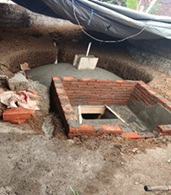
The community-based biogas project in Kasembon sub-district focuses on utilising livestock manure as a renewable energy source and organic fertiliser producer to improve community welfare and reduce negative environmental impacts. Through an Asset-Based Community Development (ABCD) approach, the project identifies local assets, such as land and manure, and empowers the local community to maintain the biogas system. The biogas production process produces environmentally friendly energy and reduces dependence on LPG. In addition, the organic fertiliser made from biogas waste can be utilised in agriculture to improve productivity and soil health. The implementation of ABCD encourages collaboration between the community, government, and university, and creates new economic opportunities by selling organic fertiliser. However, challenges such as dependence on external assistance, high initial capital requirements, and technical limitations hinder long-term sustainability.
Downloads
Article Details

This work is licensed under a Creative Commons Attribution-ShareAlike 4.0 International License.
Authors who publish with this journal agree to the following terms:
- Any article on the copyright is retained by the author(s).
- Author grant the journal, right of first publication with the work simultaneously licensed under a Creative Commons Attribution License that allows others to share work with acknowledgment of the work authors and initial publications in this journal.
- Authors are able to enter into a separate, additional contractual arrangements for non-exclusive distribution of published articles of work (eg, post-institutional repository) or publish it in a book, with acknowledgment of its initial publication in this journal.
- Authors are permitted and encouraged to post their work online (e.g., in institutional repositories or on their websites) prior to and during the submission process, as can lead to productive exchanges, as well as earlier and greater citation of published work.
- The article and any associated published material is distributed under the Creative Commons Attribution-ShareAlike 4.0 International License
References
Afandi, A., Laily, N., Wahyudi, N., Umam, M. H., Kambau, R. A., Siti Aisyah Rahman, M. S., Jamilah, Kadir, N. A., & Syahruni Junaid, Serliah Nur, Rika Dwi Ayu Parmitasari, Nurdiyanah, Jarot Wahyudi, M. W. (2022). Metodologi Pengabdian Masyarakat (J. W. Suwendi, Abd. Basir (ed.); 1st ed.). Direktorat Pendidikan Tinggi Keagamaan Islam Direktorat Jenderal Pendidikan Islam Kementerian Agama RI.
Ilma, Izana Saffana. (2023). Kajian Pencemaran Lingkungan Airtanah Akibat Limbah Perternakan Sapi Di Desa Pengkolrejo, Kecamatan Japah, Kabupaten Blora. Tesis , Universitas Gajadh Mada
Kusmiyati, K., Wijaya, D.K., & Hartono, B.J.R. (2023). Advancements in Biogas Production from Cow Dung: A Review of Present and Future Innovations. World Chemical Engineering Journal, 6(2), 50-56. http://dx.doi.org/10.1051/e3sconf/202344804005
Nel, H. (2020). Stakeholder_Engagement_Asset-Based_Community-Led_D. Social Work, 56(3), 0–3. http://dx.doi.org/10.15270/56-4-857
Oliver, M. D., & Stout, M. (2022). Examining natural resource management through a community development theoretical lens. Community Development, 53(2), 130–149. https://doi.org/10.1080/15575330.2021.1946575
Saputra, L. (2017). Pengaruh Limbah Peternakan Sapi Terhadap Kualitas. Universitas Muhammadiyah Surakarta
Ward, S. (2023). Using theory-based evaluation to understand what works in asset-based community development. Community Development Journal, 58(2), 206–224. https://doi.org/10.1093/cdj/bsab046
Werkneh, A. A. (2022). Biogas impurities: environmental and health implications, removal technologies and future perspectives. Heliyon, 8(10), e10929. https://doi.org/10.1016/j.heliyon.2022.e10929