Keterampilan Berbahasa Inggris Melalui Pengenalan Connected Speech untuk Guru-Guru SMAN 16 Batam English Language Skills Through Connected Speech Introduction for Teachers at SMAN 16 Batam
Article Sidebar
Main Article Content
Abstract
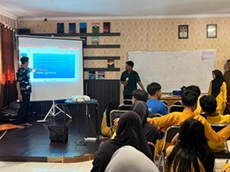
Mastering English for teachers can increase their competency in this digital era. Teachers who speak English achieve their selling point in communication, gain access to global references and the latest educational technology, and broaden their professional mindsets. This training trained the participants to understand non-native speakers of English, and speak English like non-native speakers by providing connected speech which contains linking, assimilation, elision, silent letters, and intrusive [j] dan [w] as the topic. This training, which 55 teachers attended, was held at SMAN 16 Batam on 17, 23, and 31 January 2025. This training applied a service-learning method with models of lectures, discussions, and practice. The results showed an increase in ability of 71%, when initially only two participants could pronounce them before training. The planned and sustainable programmes will provide successful English language training. Having the ability to speak English is not only useful for teachers but also for the school and the students being taught.
Downloads
Article Details

This work is licensed under a Creative Commons Attribution-ShareAlike 4.0 International License.
Authors who publish with this journal agree to the following terms:
- Any article on the copyright is retained by the author(s).
- Author grant the journal, right of first publication with the work simultaneously licensed under a Creative Commons Attribution License that allows others to share work with acknowledgment of the work authors and initial publications in this journal.
- Authors are able to enter into a separate, additional contractual arrangements for non-exclusive distribution of published articles of work (eg, post-institutional repository) or publish it in a book, with acknowledgment of its initial publication in this journal.
- Authors are permitted and encouraged to post their work online (e.g., in institutional repositories or on their websites) prior to and during the submission process, as can lead to productive exchanges, as well as earlier and greater citation of published work.
- The article and any associated published material is distributed under the Creative Commons Attribution-ShareAlike 4.0 International License
References
Abimanto, D. (2024). Hari Guru Nasional: Perlukah semua guru menguasai bahasa Inggris di era digital? Kumparan. https://kumparan.com/dhanan-abimanto/hari-guru-nasional-perlukah-semua-guru-menguasai-bahasa-inggris-di-era-digital-23ytVtbQjlg/full
Afandi, A., Laily, N., Wahyudi, N., Umam, M. H., Kambau, R. A., Rahman, S. A., Sudirman, M., Jamilah, Kadir, N. A., Junaid, S., Nur, S., Ayu, R. D., Parmitasari, Nurdiyanah, N., Wahyudi, J., & Wahid, M. (2022). Metodologi pengabdian masyarakat (S. Suwendi, A. Basir, & J. Wahyudi (eds.)). Direktorat Pendidikan Tinggi Keagamaan Islam Direktorat Jenderal Pendidikan Islam Kementerian Agama RI. https://doi.org/10.31764/jmm.v8i1.19972
Ahyani, N., Fitria, H., Lian, B., & Nugroho, H. S. (2024). Pengaruh literasi digital terhadap kinerja guru. Edusaintek, 11(3), 1296 – 1308. https://doi.org/https://doi.org/10.47668/edusaintek.v11i3.1283
Ambalegin, A., Afriana, A., & Purwanti, A. (2024). Mengembangkan keterampilan berbicara siswa/i SMA/SMK di Kota Batam melalui pelatihan public speaking. Jurnal Masyarakat Mandiri, 8(1), 312–324. https://doi.org/https://doi.org/10.31764/jmm.v8i1.19972
Ambalegin, A., Arianto, T., Handayani, N. D., & Mubarak, Z. H. (2022). An English speaking training for the dragon fruit plantation workers in Rempang island, Batam: agro-tourism base. PUAN Indonesia, 3(2). https://doi.org/DOI: https://doi.org/10.37296/jpi.v3i2.75
Ambalegin, A., Sunarga, S., & Handayani, N. D. (2023). Training on class action research proposal writing for teachers at Pondok Pesantren Manba’ul Hidayah Batam. MITRA, 7(1), 114–123. https://doi.org/https://doi.org/10.25170/mitra.v7i1.3707
Arsini, Y., Yoana, L., & Prastami, Y. (2023). Peranan guru sebagai model dalam pembentukan karakter peserta didik. MUDDABIR, 3(2), 27–35. https://doi.org/https://doi.org/10.56832/mudabbir.v3i2.368
Aryana, S., Subyantoro, S., & Pristiwati, R. (2022). Tuntutan kompetensi guru profesional Bahasa Indonesia dalam menghadapi abad 21. Semantik, 11(1), 71–86. https://doi.org/https://doi.org/10.22460/semantik.v11i1.p71-86
Aslinda, A., Fadrul, F., & Priyono, P. (2024). Studi literatur: Upaya meningkatkan kualitas guru. JICN, 1(4), 5856–5875. https://jicnusantara.com/index.php/jicn/article/view/955
Azwar, S. (2022). Sikap manusia: Teori dan pengukurannya (3rd ed.). Pustaka Pelajar.
Baharuddin, M. S., & Maunah, B. (2022). Problematika guru di sekolah. NUSRA, 3(1), 44–64. https://doi.org/https://doi.org/10.55681/nusra.v3i1.128
Dwyy, O. (2023). Peran guru bahasa Inggris dalam kehidupan sehari-hari. Indonesiana. https://www.indonesiana.id/read/166333/peran-guru-bahasa-inggris-dalam-kehidupan-sehari-hari
Fromkin, V., Rodman, R., Hyams, N., Amberber, M., Cox, F., & Thornton, R. (2018). An introduction to language (9th ed.). Cengage Learning. https://ces.wu.ac.th/news/03/n25967.pdf
Gaol, N. T. L. (2021). Faktor-faktor penyebab guru mengalami stres di sekolah. Educational Guidance and Counseling Development Jounal, 4(1), 17–28. https://doi.org/10.24014/egcdj.v4i1.11781
Harmsen, R., Helms-Lorenz, M., Maulana, R., & Veen, K. van. (2018). The relationship between beginning teachers’ stress causes,stress responses, teaching behaviour and attrition. Teachers and Teaching: Theory and PracTice, 24(6), 626–643. https://doi.org/https://doi.org/10.1080/13540602.2018.1465404
Hitipeuw, J. (2024). Kegagalan pengajaran bahasa Inggris di sekolah dan perguruan tinggi Indonesia. Kompas. https://www.kompas.com/edu/read/2024/04/04/104057171/kegagalan-pengajaran-bahasa-inggris-di-sekolah-dan-perguruan-tinggi
Jannah, A. Z., Wijaya, S. D., & Ro’ifah, R. (2022). Learning connected speech by pronouncing song lyrics: students’ perspective. Jo-ELT (Journal of English Language Teaching), 9(1), 13–28. https://doi.org/doi:https://doi.org/10.33394/jo-elt.v9i1.5156
Kamal, M. (2013). Umumnya guru Indonesia tidak jago berbahasa Inggris. Kompasiana. https://www.kompasiana.com/alchemist/552fe7026ea834fe5a8b4659/umumnya-guru-indonesia-tidak-jago-berbahasa-inggris
Kamil, M. (2012). Model pendidikan dan pelatihan. Alfabeta.
Kinas, A. A., & Nilawati, F. (2024). Tantangan guru dalam menghadapi era digital 5.0. ADAARA, 14(2), 109–117. https://doi.org/10.30863/ajmpi.v14i2.7213
Maulida, Z. P., Aprilianti, S. R., & Sari, N. N. K. (2024). Pentingnya bahasa Inggris dalam kehidupan sehari-hari. Karimah Tauhid, 3(3), 3192–3199. https://doi.org/https://doi.org/10.30997/karimahtauhid.v3i3.12600
Munawir, M., Erindha, A. N., & Sari, D. P. (2023). Memahami karakteristik guru profesional. Jurnal Ilmiah Profesi Pendidikan, 8(1), 384–390. https://doi.org/https://doi.org/10.29303/jipp.v8i1.1108
Napisah, S. S., & Rasmitadila, R. (2023). Pengaruh rendahnya kualitas tenaga pendidik terhadap peningkatan mutu pembelajaran. Karimah Tauhid, 2(5), 2154–2163. https://doi.org/https://doi.org/10.30997/karimahtauhid.v2i5.9621
Nitta, T., Deguchi, Y., & Iwasaki, S. (2018). Depression and occupational stress in Japanese school principals and vice-principals. Occupational Medicine, 69(1), 39–46. https://doi.org/https://doi.org/10.1093/occmed/kqy149
Nordquist, R. (2024). Silent letter words in English. ThoughtCo. https://www.thoughtco.com/silent-letter-pronunciation-1692097
Nugroho, A. S., Suryanti, S., & Wiryanto, W. (2022). Peningkatan kualitas guru, sebanding dengan peningkatan pendidikan? BASICEDU, 6(5), 7758–7767. https://doi.org/10.31004/basicedu.v6i5.3354
Ofita, C., & Sururi, S. (2023). Kompetensi pedagogik guru abad 21 tinjauan peran guru menghadapi generasi alpha. Jurnal Tata Kelola Pendidikan, 5(2), 101–110. https://doi.org/https://doi.org/10.17509/jtkp.v5i2.64847
Rao, P. S. (2019). The importance of speaking skills in the classroom. Alford Council of International English and Literature Journal (ACIELJ), 2(2), 1–12. https://www.acielj.com/v2i2.html
Rukhani, S. (2020). Peran guru dalam pengelolaan kelas untuk meningkatkan prestasi belajar siswa kelas VII. Al-Athfa, 1(1), 21–39. https://doi.org/https://doi.org/10.58410/al-athfal.v1i1.381
Simamora, L., Simamora, M., Sitanggang, A. A., & Turnip, H. (2022). Kompetensi guru yang membawa dampak positif terhadap tujuan pembelajaran peserta didik. Jurnal Pendidikan Sosial Dan Humaniora, 2(1), 64–73. https://publisherqu.com/index.php/pediaqu/article/view/48
Stiglbauer, B., & Zuber, J. (2018). Challenge and hindrance stress among schoolteachers. Psychology in the Schools, 55(6), 707–721. https://doi.org/https://doi.org/10.1002/pits.22135
Sulistiani, I., & Nugraheni, N. (2023). Makna guru sebagai peranan penting dalam dunia pendidikan. Jurnal Citra Pendidikan, 3(4), 1261–1268. https://doi.org/10.38048/jcp.v3i4.2222
Syamel, S. S., & Jusman, J. (2024). Peran sertifikasi guru dalam meningkatkan kualitas pendidikan di sekolah menengah kejuruan negeri 5 Makassar. NUSRA, 5(1), 1224–1232. https://doi.org/https://doi.org/10.55681/nusra.v5i3.3105
Yenti, R. F., & Darmiyanti, A. (2023). Peran kode etik guru sebagai landasan berprilaku dalam pengembangan pendidikan. Journal on Education, 5(2), 2908–2913. https://doi.org/https://doi.org/10.31004/joe.v5i2.940