Pembuatan Probiotik untuk Budidaya Ikan dari Bahan yang Mudah Ditemukan dan Ramah Lingkungan Manufacture of Probiotics for Fish Farming from Easy-to-Find and Environmentally Friendly Materials
Article Sidebar
Main Article Content
Abstract
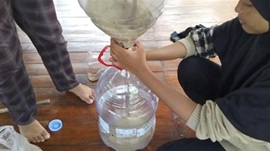
This community service activity aims to address the high cost constraints in fish farming in Tengket Village, Arosbaya, by manufacturing locally sourced, environmentally friendly probiotics. These probiotics are made from fine bran, molasses, yeast tape, and Yakult, processed to improve production efficiency, support environmental sustainability, and reduce dependence on synthetic chemicals. The implementation of activities includes socialization, training in the production of probiotics, and the distribution of products to cultivators. The results show that local probiotics have a quality close to commercial products, with the advantage of lower cost and environmental friendliness. This activity increased public awareness of the use of local materials, had a positive impact on the ecosystem, and supported the sustainability of aquaculture.
Downloads
Article Details

This work is licensed under a Creative Commons Attribution-ShareAlike 4.0 International License.
Authors who publish with this journal agree to the following terms:
- Any article on the copyright is retained by the author(s).
- Author grant the journal, right of first publication with the work simultaneously licensed under a Creative Commons Attribution License that allows others to share work with acknowledgment of the work authors and initial publications in this journal.
- Authors are able to enter into a separate, additional contractual arrangements for non-exclusive distribution of published articles of work (eg, post-institutional repository) or publish it in a book, with acknowledgment of its initial publication in this journal.
- Authors are permitted and encouraged to post their work online (e.g., in institutional repositories or on their websites) prior to and during the submission process, as can lead to productive exchanges, as well as earlier and greater citation of published work.
- The article and any associated published material is distributed under the Creative Commons Attribution-ShareAlike 4.0 International License
References
Afriansyah, Dewiyanti, I., & Hasri, I. (2016). Keragaan Nitrogen dan T-Phosfat pada PemanfaatanLimbah Budidaya Ikan Lele (Clarias gariepinus) Oleh Ikan Peres (Osteochilus kappeni) dengan Sistem Resirkulasi. Jurnal Ilmiah Mahasiswa Kelautan Dan Perikanan Unsyiah, 1(2), 252–261. https://garuda.kemdiktisaintek.go.id/documents/detail/446464
Apriyanti, M. E. (2018). Pentingnya Kemasan Terhadap Penjualan Produk Perusahaan. Journal LPPM Unindra, 10(1), 20–27. http://dx.doi.org/10.30998/sosioekons.v10i1.2223
Arsyad, R., Muharam, A., & Syamsuddin. (2015). Kajian Aplikasi Probiotik dari Bahan Baku Lokal Terhadap Pertumbuhan dan Tingkat Kelangsungan Hidup Benih Ikan Nila (Oreochromis niloticus). Ilmiah Perikanan Dan Kelautan, 3(2), 51–57. https://doi.org/10.37905/.v3i2.1293
Aryasatya, R., Lumbangaol, D., Putri, R. R., Salam Junaedi, A., Zainuri, M., Pramithasari, F. A., & Rohma, F. F. (2024). Pelatihan Budidaya Ikan Lele Sangkuriang. Qardhul Hasan; Media Pengabdian Kepada Masyarakat, 10(2), 147–152. https://doi.org/10.30997/qh.v10i2.13665
Atho, M., Dwi Fadila, M., Salam Junaedi, A., Studi Manajemen Sumberdaya Perairan, P., Ilmu Kelautan dan Perikanan, J., Trunojoyo Madura, U., Raya Telang, J., Box, P., Kamal, K., & Bangkalan, K. (2021). UJI BAKU MUTU PROBIOTIK IKAN BERBAHAN DASAR AIR LIMBAH CUCIAN BERAS, KULIT BAWANG PUTIH (Allium sativum), DAN FERMENTASI EKSTRAK DAUN KELOR (Moringa oleifera) Fish Probiotic Quality Standards Based On Rice Washing, Garlic (Allium sativum) Skin, and Fermentation Of Moringa Leaf Extract (Moringa oleifera). Indonesian Journal of Fisheries Science and Technology Available, 17(4), 240. http://ejournal.undip.ac.id/index.php/saintek
Hayati Soeprapto, Heri Ariadi, & Kharismatul Khasanah. (2022). Pelatihan Pembuatan Probiotik Herbal Bagi Kelompok Pembudidaya Ikan. J-ABDI: Jurnal Pengabdian Kepada Masyarakat, 1(8), 1929–1934. https://doi.org/10.53625/jabdi.v1i8.1015
Mansyur, A., & Tangko, A. M. (2008). Probiotik: Pemanfaatannya Untuk Pakan Ikan Berkualitas Rendah. Media Akuakultur, 3(2), 145. https://doi.org/10.15578/ma.3.2.2008.145-149
Mirna, M., & Tahir, R. (2023). Pengaruh Dosis Molase dan Probiotik Lactobacillus Sp. terhadap Laju Pertumbuhan dan Kelangsungan Hidup Benih Ikan Nila (Oreochromis niloticus). Jurnal Galung Tropika, 12(1), 9–16. https://doi.org/10.31850/jgt.v12i1.940
Noviyana Efendy, E., Olnis Syawallita, R., Zainuri, M., & Salam Junaedi, A. (2023). APLIKASI PEMBERIAN PROBIOTIK YANG BERBEDA IKAN LELE SANGKURIANG (Clarias gariepinus) DI DESA BANYUAJUH KAMAL BANGKALAN (Application of Different Probiotics In Sangkuriang Catfish (Clarias Gariepinus) In Banyuajuh Kamal Village Bangkalan). In Journal of Indonesian Tropical Fisheries JOINT-FISH 6(2). https://doi.org/10.30743/best.v7i1.8576
Pantaya, D., Wiryawan, K. G., Amirroenas, D. E., & Suryahadi, S. (2016). Detoksifikasi Mikotoksin Melalui Optimalisasi Fungsi Rumen dengan Pemberian Ragi (MYCOTOXIN DETOXIFICATION THROUGH OPTIMIZATION THE RUMEN FUNCTION BY YEAST). Jurnal Veteriner, 17(1), 143–154. https://doi.org/10.19087/jveteriner.2016.17.1.143
Surak, A. S., Ndaong, N. A., & Detha, A. I. R. (2024). Studi Literatur Bakteri Asam Laktat Yang Diisolasi Dari Susu Kuda, Susu Kambing Dan Susu Sapi. Jurnal Veteriner Nusantara, 7(30). https://doi.org/10.35508/jvn.v7i2.2421
Telaumbanua, B. V., Telaumbanua, P. H., Lase, N. K., & Dawolo, J. (2023). Penggunaan Probiotik Em4 Pada Media Budidaya Ikan: Review. TRITON: Jurnal Manajemen Sumberdaya Perairan, 19(1), 36–42. https://doi.org/10.30598/tritonvol19issue1page36-42
Zubaidah, E., Martati, E., & Resmanto, A. M. (2014). Pertumbuhan Isolat Bal Asal Bekatul dan Probiotik Komersial (Lactobacillus acidophilus dan Lactobacillus casei) Pada Media Bekatul dan Susu SKIM. Jurnal Bioteknologi & Biosains Indonesia (JBBI), 1(1), 27. https://doi.org/10.29122/jbbi.v1i1.549