Close Family Economic System: Pilah-Olah Sampah Rumah Tangga Bernilai Ekonomis di Wilayah RW 02 Kelurahan Karanganyar Gunung Kecamatan Candisari Kota Semarang Close Family Economic System: Sorting and Processing Household Waste with Economic Value in RW 02 Area, Karanganyar Gunung Village, Candisari District, Semarang City
Article Sidebar
Main Article Content
Abstract
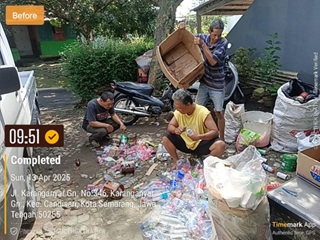
The problem of waste is not only faced by the country, but Semarang City, especially Karanganyar Gunung Village, also faces the same problem. Data shows that waste generated from household activities contributes the most to national and regional waste sources. Therefore, it is necessary to involve households in aspects of waste management. The Close Family Economic System is an approach to sorting and processing waste that generates economic value, which households can achieve. This system offers activities to sort organic and inorganic waste, allowing it to have economic value. Inorganic waste is sorted according to its characteristics to be then sold to collectors. At the same time, organic waste is processed simply into aromatherapy candles and ecoenzymes. The proceeds from the sale of waste are then managed or returned to residents to drive household economic activities.
Downloads
Article Details

This work is licensed under a Creative Commons Attribution-ShareAlike 4.0 International License.
Authors who publish with this journal agree to the following terms:
- Any article on the copyright is retained by the author(s).
- Author grant the journal, right of first publication with the work simultaneously licensed under a Creative Commons Attribution License that allows others to share work with acknowledgment of the work authors and initial publications in this journal.
- Authors are able to enter into a separate, additional contractual arrangements for non-exclusive distribution of published articles of work (eg, post-institutional repository) or publish it in a book, with acknowledgment of its initial publication in this journal.
- Authors are permitted and encouraged to post their work online (e.g., in institutional repositories or on their websites) prior to and during the submission process, as can lead to productive exchanges, as well as earlier and greater citation of published work.
- The article and any associated published material is distributed under the Creative Commons Attribution-ShareAlike 4.0 International License
References
Andriani, D., Indrawanis;, E., Nopsagiarti;, T., Seprido;, Ezward;, C., Wahyudi;, Haitami;, A., & Marlina, G. (2023). Pelatihan Pemanfaatan Sampah Organik dan Anorganik di Desa Sako Kecamatan Inuman. BERSAMA: Jurnal Pengabdian Kepada Masyarakat, 1(1), 20–26. https://doi.org/10.36355/bsm.v1i1.5
Anggreny, D. E., & Ulfah, M. (2023). Sosialisasi Pembuangan Sampah Organik Dan Anorganik. Jurnal Pengabdian Kolaborasi Dan Inovasi IPTEKS, 1(3), 217–223. https://doi.org/10.59407/jpki2.v1i3.35
Ariyanto, E. D., & Marom, A. (2021). Analisis Peran Stakeholder dalam Program Pilah Sampah di Kelurahan Mangkang Kulon, Kecamatan Tugu, Kota Semarang. Journal of Public Policy and Management Review, 10(2), 1–19. http://scioteca.caf.com/bitstream/handle/123456789/1091/RED2017-Eng-8ene.pdf?sequence=12&isAllowed=y%0Ahttp://dx.doi.org/10.1016/j.regsciurbeco.2008.06.005%0Ahttps://www.researchgate.net/publication/305320484_SISTEM_PEMBETUNGAN_TERPUSAT_STRATEGI_MELESTARI
Dewi, R. E., Setiyaningrum, N., Hapsari, A. S., & Pradana, F. G. (2022). Pemilahan Sampah dengan Cara Paksa Pilah Sampah dari Rumah. Berdikari: Jurnal Inovasi Dan Penerapan Ipteks, 10(2), 225–235. https://doi.org/10.18196/berdikari.v10i2.15729
Kusuma, Y. A., & Syahrir, I. (2022). Pemberdayaan Masyarakat Melalui Gerakan Pilah Sampah Dan Pengolahan Sampah Organik Dengan Metode Takakura. Humanism : Jurnal Pengabdian Masyarakat, 3(2), 113–123. https://doi.org/10.30651/hm.v3i2.13721
Malina, A. C., Suhasman, Muchtar, A., & Sulfahri. (2017). Kajian Lingkungan Tempat Pemilahan Sampah di Kota Makassar. Jurnal Inovasi Dan Pelayanan Publik Makassar, 1(1), 14–27. https://www.neliti.com/id/publications/290779/kajian-lingkungan-tempat-pemilahan-sampah-di-kota-makassar
Marlina, A., & dkk. (2023). Edukasi Mengenai Pentingnya Pemilahan Serta Pengolahan Sampah Untuk Mengurangi Dampak Negatif Terhadap Lingkungan. Darmabakti: Jurnal Inovasi Pengabdian Dalam Penerbangan, 4(1), 11–17. https://doi.org/10.31764/jmm.v9i3.31509
Nurwati, S., Mulyani, R. B., Romiaty, Rahmiati, Ulfah, S. M., Zulaika, T., & Sarie, F. (2023). Pelatihan Pemilahan Sampah dan Pemanfaatan Sampah Anorganik Untuk Craft Dengan Prinsip Do It Yourselft (DIY) Pada Kelompok Milenial Kota Palangka Raya. Pengabdian Kampus : Jurnal Informasi Kegiatan Pengabdian Pada Masyarakat, 10(2), 114–123. https://doi.org/10.52850/jpmupr.v10i2.9199
Prasetyo, T., Eka Putri Manurung, N., Africano, F., Desiana, L., Dewantara, B., Hermialingga, S., Burhan, A., Aji Nugraha, Y., Adha, U., Cahya, G., Nadeak, E., Kurniawan, E., & Amri Yahya, M. (2023). Penyuluhan Tentang Sampah Organik Dan Anorganik, Pemilahan Sampah, Serta Pengolahannya. Communnity Development Journal, 4(6), 13495–13500. https://doi.org/10.29303/wicara.v2i5.5556
Suci Rohyani, I., Satria Wirawan Rusady, K., Hafizzudin, M., Wayan Yusvika Yanti, N., Karina Permatasari, B., Ratna Putri, R., Safhira Avanda, L., Hardianti Sangian, F., Luh Wulan Sri Apsari, N., Kadek Sri Wulandari, N., Yuliandini, W., Sari, E., Dwi Angraeni, D., Marya Rizka, I., & Mia Rosdiana, B. (2021). under a Creative Commons Attribution (CC-BY) 4.0 license. Pelatihan Pengolahan Sampah berbasis Masyarakat sebagai Alternatif Penanganan Limbah di Desa Penimbung. Jurnal Pengabdian Magister Pendidikan IPA, 4, 412–413. https://doi.org/10.29303/jpmpi.v3i2.1174
Wahyuningsih, S., Widiati, B., Melinda, T., & Abdullah, T. (2023). Sosialisasi Pemilahan Sampah Organik dan Non-Organik Serta Pengadaan Tempat Sampah Organik dan Non-Organik. DEDIKASI SAINTEK Jurnal Pengabdian Masyarakat, 2(1), 7–15. https://doi.org/10.58545/djpm.v2i1.103