Pelatihan Strategi Pembelajaran Berbasis Pengembangan Efikasi Diri untuk Meningkatkan Kemampuan Siswa Bercapaian Rendah Training of Self-efficacy Enhancement-Based Teaching Strategy to Improve the Ability of Low Achievers
Article Sidebar
Main Article Content
Abstract
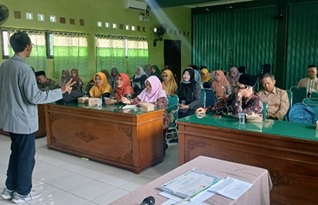
Since the implementation of the Zoning System for Student Admissions, classes in public schools have become academically heterogeneous. High achievers and low achievers are often in the same classroom. In many cases, these low achievers continue to lag because they are trapped in a vicious cycle of poor performance. Therefore, intervention is needed. One of them is by enhancing their academic self-efficacy through the implementation of a teaching strategy specifically designed to achieve this goal. This community service aims to: 1) improve teachers' understanding of the academic self-efficacy construct and its influence on learning, and 2) assist teachers in developing teaching strategies based on academic self-efficacy enhancement. This community service is divided into three stages of implementation: 1) pre-face-to-face training activities, 2) face-to-face training activities, and 3) post-face-to-face training activities. In the first stage, the community service team coordinates with the partner to prepare the necessary arrangements. In the second stage, the team provided the participants with a one-day training session. Twenty-six English teachers participated. After the self-efficacy construct was presented, participants formulated teaching strategies in groups based on the principles of self-efficacy enhancement. These strategies can then be implemented in their respective classes. The participants positively responded to the training. Follow-up activities, such as research on the strategy's impact, are necessary. Therefore, the lectures and the teachers are expected to maintain cooperation.
Downloads
Article Details

This work is licensed under a Creative Commons Attribution-ShareAlike 4.0 International License.
Authors who publish with this journal agree to the following terms:
- Any article on the copyright is retained by the author(s).
- Author grant the journal, right of first publication with the work simultaneously licensed under a Creative Commons Attribution License that allows others to share work with acknowledgment of the work authors and initial publications in this journal.
- Authors are able to enter into a separate, additional contractual arrangements for non-exclusive distribution of published articles of work (eg, post-institutional repository) or publish it in a book, with acknowledgment of its initial publication in this journal.
- Authors are permitted and encouraged to post their work online (e.g., in institutional repositories or on their websites) prior to and during the submission process, as can lead to productive exchanges, as well as earlier and greater citation of published work.
- The article and any associated published material is distributed under the Creative Commons Attribution-ShareAlike 4.0 International License
References
Abu-Hamour, B., & Al-Hmouz, H. (2013). A study of gifted high, moderate, and low achievers in their personal characteristics and attitudes toward school and teachers. International Journal of Special Education, 28(3), 5–15. https://files.eric.ed.gov/fulltext/EJ1024419.pdf
Aluvalu, R. K., Kulkarni, V., & Asif, M. (2017). Handling classrooms with students having heterogeneous learning abilities. Journal of Engineering Education Transformations, 31(2), 36–41. http://www.journaleet.org/index.php/jeet/article/view/119557/82219
Artino, A. R. (2012). Academic self-efficacy: From educational theory to instructional practice. Perspectives on Medical Education, 1, 76–85. https://doi.org/10.1007/s40037-012-0012-5
Bandura, A. (1977). Self-efficacy: Toward a unifying theory of behavioral change. Psychological Review, 84(2), 191–215. https://doi.org/10.1007/978-3-319-75361-4
Bandura, A. (1986). Social foundations of thought and action: A social cognitive theory. Prentice-Hall.
Bandura, A. (1997). Self-efficacy: The exercise of control (1st ed.). W.H. Freeman and Company.
Batita, M. S. R. (2020). A study of student admission by school zoning system in Indonesia: Problem or solution? (Issue April).
Bouton, E., Yosef, D., & Asterhan, C. S. C. (2025). Differences between low and high achievers in whole-classroom dialogue participation quality. Learning and Instruction, 96(January), 102088. https://doi.org/10.1016/j.learninstruc.2025.102088
Byrne, M., Flood, B., & Griffin, J. (2014). Measuring the academic self-efficacy of first-year Accounting students. Accounting Education: International Journal, September, 37–41. https://doi.org/10.1080/09639284.2014.931240
Fenollar, P., Roman, S., & Cuestas, P. J. (2007). University students’ academic performance: An integrative conceptual framework and empirical analysis. British Journal of Educational Psychology, 77, 873–891. https://doi.org/10.1348/000709907X189118
Hartono, H., Arjanggi, R., & Nugroho, K. Y. (2025). Indonesian tenth graders’ academic self-efficacy and English achievement admitted through zoning and achievement schemes. International Journal of Evaluation and Research in Education (IJERE), 14(4), 2500–2509. https://doi.org/10.11591/ijere.v14i4.29110
Hendral, H. N., & Sudiyatno. (2021). Impact of new student admission zoning system on academic and geographic heterogeneity in junior high school in Tegal City, Central Java. Proceedings of the 5th International Conference on Current Issues in Education (ICCIE 2021), 640(Iccie), 255–260. https://doi.org/10.2991/assehr.k.220129.046
Hidayat, S. (2014). Sacred science vs. secular: Carut marut hubungan agama dan sains. Kalam: Jurnal Studi Agama Dan Pemikiran Islam, 8(1), 87–102. https://doi.org/10.24042/klm.v8i1.169
Huang, C. (2013). Gender differences in academic self-efficacy: A meta-analysis. European Journal of Psychology of Education, 28(1), 1–35. https://doi.org/10.1007/s10212-011-0097-y
Karmila, M., Syakira, N., & Mahir, M. (2020). Analisis kebijakan pendidikan sistem zonasi dalam penerimaan peserta didik baru. Jurnal Mappesona, 3(1), 1–14. https://jurnal.iain-bone.ac.id/index.php/mappesona/article/download/827/559
Lei, W., Wang, X., Dai, D. Y., Hu, W., & Xiang, S. (2022). Academic self‐efficacy and academic performance among high school students: A moderated mediation model of academic buoyancy and social support. Psychology in the Schools, 59, 885–899. https://doi.org/10.1002/pits.22653
Luo, Q., Chen, L., Yu, D., & Zhang, K. (2023). The mediating role of learning engagement between self-efficacy and academic achievement among Chinese college students. Psychology Research and Behavior Management, 16, 1533–1543. https://doi.org/https://doi.org/10.2147/PRBM.S401145
Musa, M. (2020). Academic self-efficacy and academic performance among university undergraduate students: an antecedent to academic success. European Journal of Education Studies, 7(3), 135–148. https://doi.org/10.5281/zenodo.3756004
OECD. (2016). Low-performing students: Why they fall behind and how to help them succeed, PISA. OECD Publishing. http://dx.doi.org/10.1787/9789264250246-en
Pajares, F., & Schunk, D. H. (2001). Self-beliefs and school success: Self-efficacy, self-concept, and school achievement. In R. Riding & S. Raynes (Eds.), Perception (pp. 239–266). Ablex Publishing. https://www.researchgate.net/publication/2470953_Self-Beliefs_And_School_Success_Self-Efficacy_Self-Concept_And_School_Achievement
Sachitra, V., & Bandara, U. (2017). Measuring the academic self-efficacy of undergraduates: The role of gender and academic year experience. International Journal of Educational and Pedagogical Sciences, 11(11), 2443–2448. https://www.researchgate.net/publication/320281960_Measuring_the_Academic_Self-Efficacy_of_Undergraduates_The_Role_of_Gender_and_Academic_Year_Experience
Schunk, D. H., & DiBenedetto, M. K. (2021). Self-efficacy and human motivation. In Advances in Motivation Science (1st ed., Vol. 8, pp. 153–179). Elsevier Inc. https://doi.org/10.1016/bs.adms.2020.10.001
Schunk, D. H., & Pajares, F. (2002). The development of academic self-efficacy. In A. Wigfield & J. Eccles (Eds.), The Development of Achievement Motivation (pp. 11–28). Academic Press. https://doi.org/10.12930/0271-9517-8.1.11
Setyowati, L., Mujaddidah, A., Sukmawan, S., & El-Sulukiyyah, A. A. (2020). Comparing the high and low achiever students’ difficulties in learning writing during remote learning. Academic Journal Perspective: Education, Language, and Literature, 8(2), 107–121. https://doi.org/10.33603/perspective.v8i2.4074
Sulistyosari, Y., Wardana, A., & Dwiningrum, S. I. A. (2023). School zoning and equal education access in Indonesia. International Journal of Evaluation and Research in Indonesia (IJERE), 12(2), 586–593. https://doi.org/10.11591/ijere.v12i2.22488
Svensson, A. (2017). The challenge of teaching English in a heterogeneous classroom. Educare, 2, 56–80. https://doi.org/10.24834/educare.2017.2.3
Syathroh, I. L., Musthafa, B., & Purnawarman, P. (2019). Investigating Indonesian teachers’ strategies of teaching English in mixed ability classes. ELTIN Journal, 7(2), 60–74. https://doi.org/10.22460/eltin.v7i2.p60-74
Usher, E. L., & Pajares, F. (2008). Sources of self-efficacy in school: Critical review of the literature and future directions. Review of Educational Research, 78(4), 751–796. https://doi.org/10.3102/0034654308321456
van Dinther, M., Dochy, F., & Segers, M. (2011). Factors affecting students’ self-efficacy in higher education. Educational Research Review, 6(2), 95–108. https://doi.org/10.1016/j.edurev.2010.10.003
Wilde, N., & Hsu, A. (2019). The influence of general self-efficacy on the interpretation of vicarious experience information within online learning. International Journal of Educational Technology in Higher Education, 16(26), 1–20. https://doi.org/10.1186/s41239-019-0158-x
Wong, M. D., Quartz, K. H., Saunders, M., Meza, B. P. L., Childress, S., Seeman, T. E., & Dudovitz, R. N. (2022). Turning vicious cycles into virtuous ones: The potential for schools to improve the life course. Pediatrics, 149(5), 1–10. https://doi.org/10.1542/PEDS.2021-053509M
Yokoyama, S. (2019). Academic self-efficacy and academic performance in Online Learning: A mini review. Frontiers in Psychology, 9(JAN), 1–4. https://doi.org/10.3389/fpsyg.2018.02794