Edukasi Label Pangan dan Sadar GGL Sebagai Upaya Pencegahan Penyakit Tidak Menular pada Remaja di Perkotaan Education of Food Label and Sugar, Salt, Fat Awareness as an Effort to Prevent Non-Communicable Diseases in Urban Adolescents
Article Sidebar
Main Article Content
Abstract
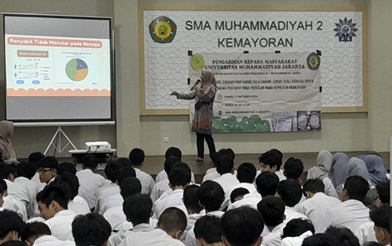
According to the 2018 Basic Health Research (Riskesdas), the prevalence of overweight and obesity was 16.0% among adolescents aged 13-15 years and 13.5% among adolescents aged 16-18 years. Three out of ten Indonesians aged 10 years or older consume more salt than the recommended limit. Four out of ten Indonesians aged 10 years and above consume more fat than the recommended limit. The purpose of this activity is to increase adolescent knowledge regarding food labels and the content of sugar, salt, and fat in packaged products. This activity was conducted on Thursday, October 17, 2024, at SMA Muhammadiyah 2 Jakarta. The community service was carried out by Lecturers of the Nutrition Study Program, Universitas Muhammadiyah Jakarta, with 162 participants. The method used in this community service activity is the lecture method, incorporating leaflets and PowerPoint presentations. The pre-test results showed that 80.1% of participants who took the pre-test had a category of poor nutritional knowledge with a pre-test score below 60. Meanwhile, the post-test results showed that most participants, specifically 46.6%, fell into the moderate category of nutritional knowledge, with a post-test score between 60 and 80 points. The average pre-test score was 40.99. Meanwhile, the average post-test score was 62.27. The results of this community service indicate an increase in target knowledge related to food labels and awareness of sugar, salt, and fat content, as measured by the pre-test and post-test, by 21.27 points. This represents one of the efforts to prevent non-communicable diseases in urban adolescents.
Downloads
Article Details

This work is licensed under a Creative Commons Attribution-ShareAlike 4.0 International License.
Authors who publish with this journal agree to the following terms:
- Any article on the copyright is retained by the author(s).
- Author grant the journal, right of first publication with the work simultaneously licensed under a Creative Commons Attribution License that allows others to share work with acknowledgment of the work authors and initial publications in this journal.
- Authors are able to enter into a separate, additional contractual arrangements for non-exclusive distribution of published articles of work (eg, post-institutional repository) or publish it in a book, with acknowledgment of its initial publication in this journal.
- Authors are permitted and encouraged to post their work online (e.g., in institutional repositories or on their websites) prior to and during the submission process, as can lead to productive exchanges, as well as earlier and greater citation of published work.
- The article and any associated published material is distributed under the Creative Commons Attribution-ShareAlike 4.0 International License
References
Alfora, D., Saori, E., & Fajriah, L. N. (2023). Pengaruh konsumsi makanan cepat saji terhadap gizi remaja. FLORONA : Jurnal Ilmiah Kesehatan, 2(1). https://doi.org/10.55904/florona.v2i1.688
Almatsier., S. (2015). Prinsip Dasar Ilmu Gizi Edisi ke-9. Jakarta: PT. Gramedia Pustaka Utama., 13(3).
Amiroh, A., Dwiyana, P., & Mardiyah, S. (2021). Edukasi Gizi Pola Konsumsi Rendah Gula, Garam, Lemak (GGL) pada Remaja. Community Empowerment, 6(4), 595–601. https://doi.org/10.31603/ce.4600
Badan Penelitian dan Pengembangan Kesehatan. (2013). Riset Kesehatan Dasar (RISKESDAS) 2013. Laporan Nasional 2013. https://repository.badankebijakan.kemkes.go.id/id/eprint/4467/1/Laporan_riskesdas_2013_final.pdf
Bany, Z. U., Sunnati, S., & Darman, Wi. (2014). Perbandingan Efektivitas Penyuluhan Metode Ceramah dan Demonstrasi terhadap Pengetahuan Kesehatan Gigi dan Mulut Siswa SD. Cakradonya Dent J, 6(1), 661–666. https://jurnal.usk.ac.id/CDJ/article/view/10408/0
Darmawati, I., & Arumiyati, S. (2017). Pengetahuan Gizi Remaja SMPN 40 Kota Bandung. Jurnal Kesehatan Poltekkes Ternate, 10(2). https://doi.org/10.32763/juke.v10i2.42
Dewi, M., & Aminah, M. (2016). Pengaruh Edukasi Gizi terhadap Feeding Practice Ibu Balita Stunting Usia 6-24 Bulan. Indonesian Journal of Human Nutrition, 3(1). https://doi.org/10.21776/ub.ijhn.2016.003.Suplemen.1
Dewi, N. T., Yunita, L., Sukanty, N. M. W., & Ariani, F. (2023). Edukasi Label Informasi Nilai Gizi Sebagai Upaya Peningkatan Pengetahuan dan Kemampuan Membaca Label Gizi Siswa di SMAN 5 Mataram. Jurnal Mandala Pengabdian Masyarakat, 4(1), 246–252. https://doi.org/10.35311/jmpm.v4i1.225
Illavina, I., & Kusumaningati, W. (2022). Pengaruh Edukasi Pembacaan Label Informasi Nilai Gizi dengan Media Slide PowerPoint terhadap Pengetahuan Siswa SMA Kota Depok. Muhammadiyah Journal of Nutrition and Food Science (MJNF), 3(1). https://doi.org/10.24853/mjnf.3.1.27-35
Kementerian Kesehatan RI. (2021). Remaja Sehat Komponen Utama Pembangunan SDM Indonesia. In Kementerian Kesehatan RI. https://kemkes.go.id/id/remaja-sehat-komponen-utama-pembangunan-sdm-indonesia
Kumala, M., Limanan, D., & Santoso, A. H. (2020). PEMERIKSAAN STATUS GIZI SEBAGAI UPAYA PREVENTIF PENYAKIT DEGENERATIF PADA SISWA SEKOLAH BM JAKARTA PUSAT. Jurnal Bakti Masyarakat Indonesia, 3(1). https://doi.org/10.24912/jbmi.v3i1.8034
Masri, E., Nasution, N. S., & Ahriyasna, R. (2022). Literasi Gizi dan Konsumsi Gula, Garam, Lemak pada Remaja di Kota Padang. Jurnal Kesehatan, 10(1). https://doi.org/10.25047/jkes.v10i1.284
Riset Kesehatan Dasar (RISKESDAS). (2019). Laporan Nasional Riskesdas 2018. In Badan Penelitian dan Pengembangan Kesehatan Riset. https://repository.badankebijakan.kemkes.go.id/id/eprint/3514/
UNICEF Indonesia. (2021). Strategi Komunikasi Perubahan Sosial dan Perilaku: Meningkatkan Gizi Remaja di Indonesia. In Unicef. https://www.unicef.org/indonesia/media/9241/file/Strategi%20Komunikasi%20Perubahan%20Sosial%20dan%20Perilaku.pdf