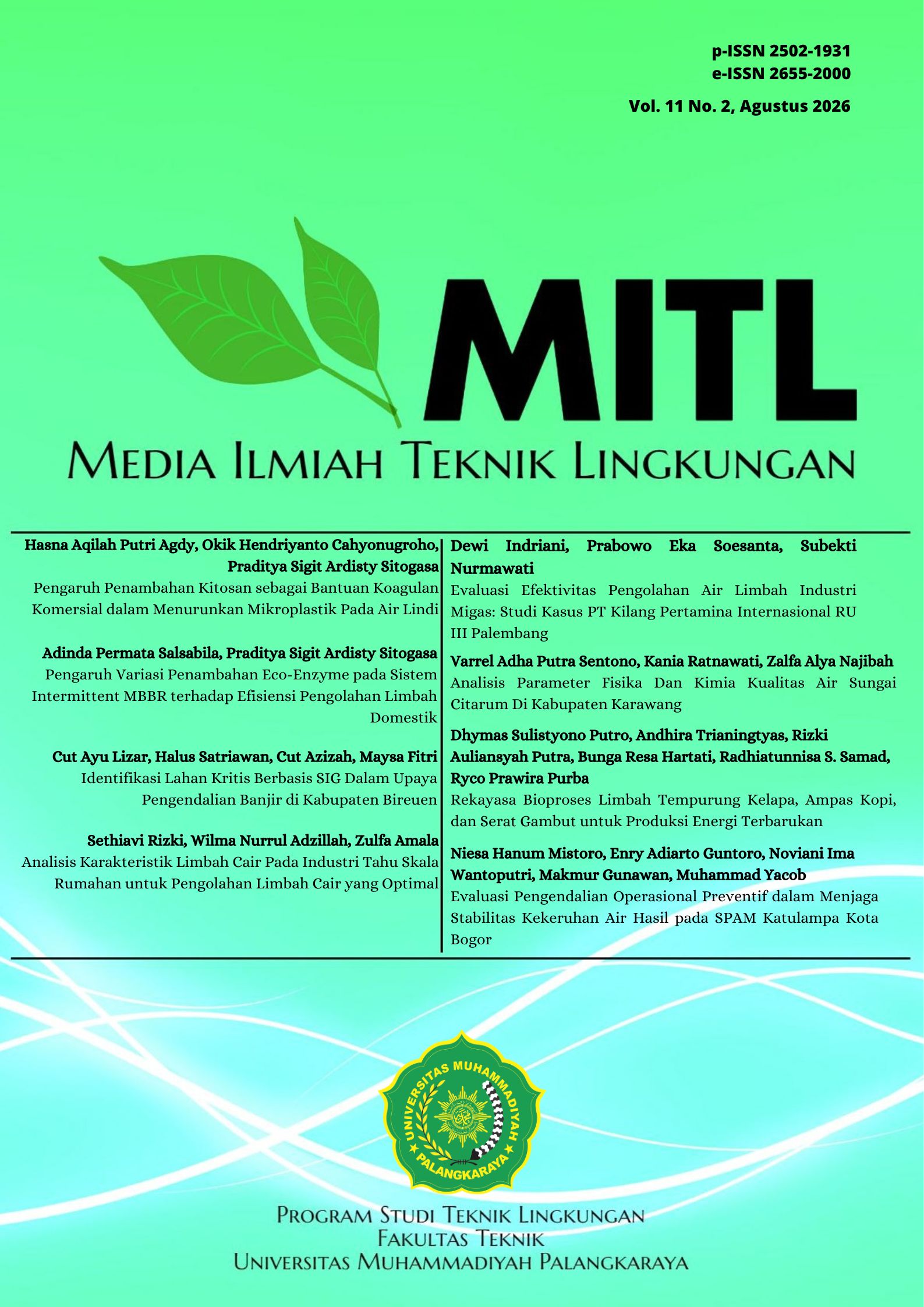
The Effect of Adding Chitosan as a Commercial Coagulant Aid in Reducing Microplastics in Leachate Pengaruh Penambahan Kitosan sebagai Bantuan Koagulan Komersial dalam Menurunkan Mikroplastik Pada Air Lindi
Article Sidebar
Main Article Content
Abstract
Leachate from the final processing site (TPA) has the potential to pollute the environment because it contains organic compounds, suspended solids, and microplastics. This study aims to analyze the effect of varying doses of polyaluminum chloride (PAC) coagulant and chitosan on the reduction of microplastics, COD, and TSS in leachate from the Randegan landfill. The method used was coagulation-flocculation with a jar test. The results showed that varying doses and combinations of coagulants affected the effectiveness of treatment. The combination of PAC and chitosan at the optimum dosage was able to reduce microplastics by 78%, COD by 86%, and TSS by 91%. The reduction in microplastics occurred through the mechanisms of charge neutralization, adsorption, and sweep flocculation. The combination of PAC and chitosan has the potential to be applied as an effective and sustainable leachate treatment method.
Downloads
Article Details

This work is licensed under a Creative Commons Attribution-ShareAlike 4.0 International License.
All rights reserved. This publication may be reproduced, stored in a retrieval system, or transmitted in any form or by any means, electronic, mechanical, photocopying, recording.
References
H. Permono, A. Mustain, M. K. Pratiwi “Pemanfaatan Air Lindi Untuk Pupuk Organik Cair,”DISTILAT: Jurnal Teknologi Separasi, vol. 10, no. 9, pp. 498–504, 2024, Link: https://doi.org/10.33795/distilat.v10i2.5225
N. L. Angrianto, J. Manusawai, and A. S. Sinery, “Analisis Kualitas Air Lindi dan Permukaan pada areal TPA Sowi Gunung dan Sekitarnya di Kabupaten Manokwari Papua Barat,” Cassowary, vol. 4, no. 2, pp. 221–233, 2021, Link: 10.30862/casssowary.cs.v4.i2.79
B. P. A. Pradiptaadi and F. Fallahian, “Analisis Kelimpahan Mikroplastik Pada Air dan Sedimen di Kawasan Hilir DAS Brantas,” Environmental Pollution Journal, vol. 2, no. 1, pp. 344–352, 2022, Link: 10.58954/epj.v2i1.39
R. Eamrat, S. Rujakom, T. Pussayanavin, A. Taweesan, C. Witthayaphirom, and T. Kamei, “Optimizing biocoagulant aid from shrimp shells (Litopenaeus vannamei) for enhancing microplastics removal from aqueous solutions,” Environmental Technology Innovation, vol. 33, no. November 2023, p. 103457, 2024, Link: https://doi.org/10.1016/j.eti.2023.103457
S. Prasetyo, C. A. Santos, A. K. Sugih, and H. Kristianto, “Utilization of chitosan as a natural coagulant for polyethylene microplastic removal,” Sustainable Chemistry for the Environment, vol. 9, 2025, Link: 10.1016/j.scenv.2025.100225
Nurhasanah, M. R. Cordova, and E. Riani, “Micro- and mesoplastics release from the Indonesian municipal solid waste landfill leachate to the aquatic environment: Case study in Galuga Landfill Area, Indonesia,” Marine Pollution Bulletin, vol. 163, 2021, Link: 10.1016/j.marpolbul.2021.11198A6
A. A. Sulianto, E. Kurniati, and C. T. Rahmawati, “Sebaran Kualitas Air Sumur Di Sekitar TPA Randegan Kota Mojokerto Berbasis Sistem Informasi Geografis,” Jurnal Sumberdaya Alam dan Lingkungan, vol. 7, no. 1, pp. 28–35, 2020, Link: https://jsal.ub.ac.id/index.php/jsal/article/view/331/1000
R. Tafaqury, “Kelimpahan dan Karakteristik Mikroplastik pada Air Lindi TPA Randegan , Kota Mojokerto,” Institut Teknologi Sepuluh Nopember, 2022. Link: http://repository.its.ac.id/id/eprint/115927
L. Li, D. Liu, K. Song, and Y. Zhou, “Performance evaluation of MBR in treating microplastics polyvinylchloride contaminated polluted surface water,” Marine Pollution Bulletin, vol. 150, no. November, pp. 1–6, 2020, Link: 10.1016/j.marpolbul.2019.110724
T. D. Somer, M. V. Melkebeke, B. Goethals, S. Gusev, P. V. Meeren, K. M. V. Geem, S. D. Meester, “Modelling and application of dissolved air flotation for efficient separation of microplastics from sludges and sediments,” Journal Environmental Chemical Engineering, vol. 12, no. 3, 2024, Link: https://doi.org/10.1016/j.jece.2024.112864
I. Lee, S. Khujaniyoz, H. Oh, H. Kim, and T. Hong, “The Removal of Microplastics from Reverse Osmosis Wastewater by Coagulation,” Journal Environmental Chemical Engineering, vol. 12, no. 4, p. 113198, 2024, Link: https://doi.org/10.1016/j.jece.2024.113198
M. P. G. Setiawan and Sudarmaji, “Implikasi Cemaran Mikroplastik terhadap Kesehatan Lingkungan pada Ekosistem Sungai : Literature Review,” Jurnal Kesehatan Tambusai, vol. 6, no. 4, pp. 16877–16886, 2025, Link: https://doi.org/10.31004/jkt.v6i4.51678
M. R. Jung, F. D. Horgen, S. V. Orski, V. Rodriguez, K. L. Beers, G. H. Balazs, T. T. Jones, T. M. Work, K. C. Brignac, S. Royer, K. D. Hyrenbach, B. A. Jensen, J. M. Lynch, “Validation of ATR FT-IR to identify polymers of plastic marine debris , including those ingested by marine organisms,” Marine Pollution Bulletin, vol. 127, no. December 2017, pp. 704–716, 2018, Link: 10.1016/j.marpolbul.2017.12.061
R. Adawiyah, E. Sunarwidhi, and D. A. Candri, “Isolation and Analysis of Microplastics in Vaname Shrimp ( Litopenaeus vannamei Boone , 1931 ) at Tanjung Luar Fish Landing Base , East Lombok Regency,” Jurnal Biologi Tropis, vol. 24, pp. 157–164, 2024, Link: http://doi.org/10.29303/jbt.v24i4.7567
X. Wu, X. Ge, D. Wang, and H. Tang, “Distinct Coagulation Mechanism and Model Between Alum and High Al 13 -PACl,” Colloids and Surfaces A: Physicochemical and Engineering Aspects, vol. 305, pp. 89–96, 2007, Link: 10.1016/j.colsurfa.2007.04.046
L. Huang, W. He, Y. Zhang, X. Wang, K. Wu, Z. Yang, J. Zhang, “Chitosan Enhances Poly Aluminum Chloride Flocculation System Removal of Microplastics: Effective, Stable, and Pollution Free,” Journal Water Process Engineering, vol. 54, no. 2, p. 103929, 2023, Link: 10.1016/j.jwpe.2023.103929
D. Anggarwati, “Efektivitas Koagulan Terhadap Penurunan Parameter Limbah Cair Industri Tahu,” RUWA JURAI: Jurnal Kesehatan Lingkungan, vol. 12, pp. 9–16, 2018, Link: https://doi.org/10.26630/rj.v12i1.2745
I. F. Purwanti, H. S. Titah, B. V. Tangahu, M. Anes, R. M. Syawlia, and H. A. Hassan, “Optimization of The Coagulation Flocculation Process of Benowo Landfill Using Poly Aluminum Chloride and Chitosan,” Ecology, Environment and Conservation Paper, vol. 26, 2020, Link: https://www.envirobiotechjournals.com/issues/article_abstract.php?aid=10473&iid=302&jid=3.
I. H. Alsohaimi, M. S. Alhumaimess, H. M. A. Hassan, M. Reda, A. M. Aldawsari, Q. Chen, M. A. Kariri, “Chitosan Polymer Functionalized-Activated Carbon/Montmorillonite Composite for the Potential Removal of Lead Ions from Wastewater,” Polymers, 2023, Link: https://doi.org/10.3390/polym15092188
F. Batool, T. A. Kurniawan, A. Mohyuddin, M. H. D. Othman, A. Anouzla, C. Meidina, H. H. Goh, K. W. Chew “Fixed-Bed Studies of Landfill Leachate Treatment Using Chitosan-Coated Carbon Composite,” Water, 2023, Link: https://doi.org/10.3390/w15122263
E. K. Tsoutsa, A. K. Tolkou, and G. Z. Kyzas, I. A. Katsoyiannis, “New Trends in Composite Coagulants for Water and Wastewater Treatment,” Macromol, pp. 509–532, 2024, Link: https://doi.org/10.3390/macromol4030030
S. F. Ramli and H. A. Aziz, “Use of Ferric Chloride and Chitosan as Coagulant to Remove Turbidity and Color from Landfill Leachate,” International Integrated Engineering Summit 2014, pp. 1163–1167, 2015, Link: https://doi.org/10.4028/www.scientific.net/AMM.773-774.1163
T. Partuti, Y. Dwiyanti, “Penentuan Kondisi Optimum Pengendapan Limbah Tailing Hasil Penambangan Emas di Daerah Cibaliung,” Journal Industrial Servicess, vol. 3, no. 1, pp. 93–97, 2017, Link: https://jurnal.untirta.ac.id/index.php/jiss/article/view/2068