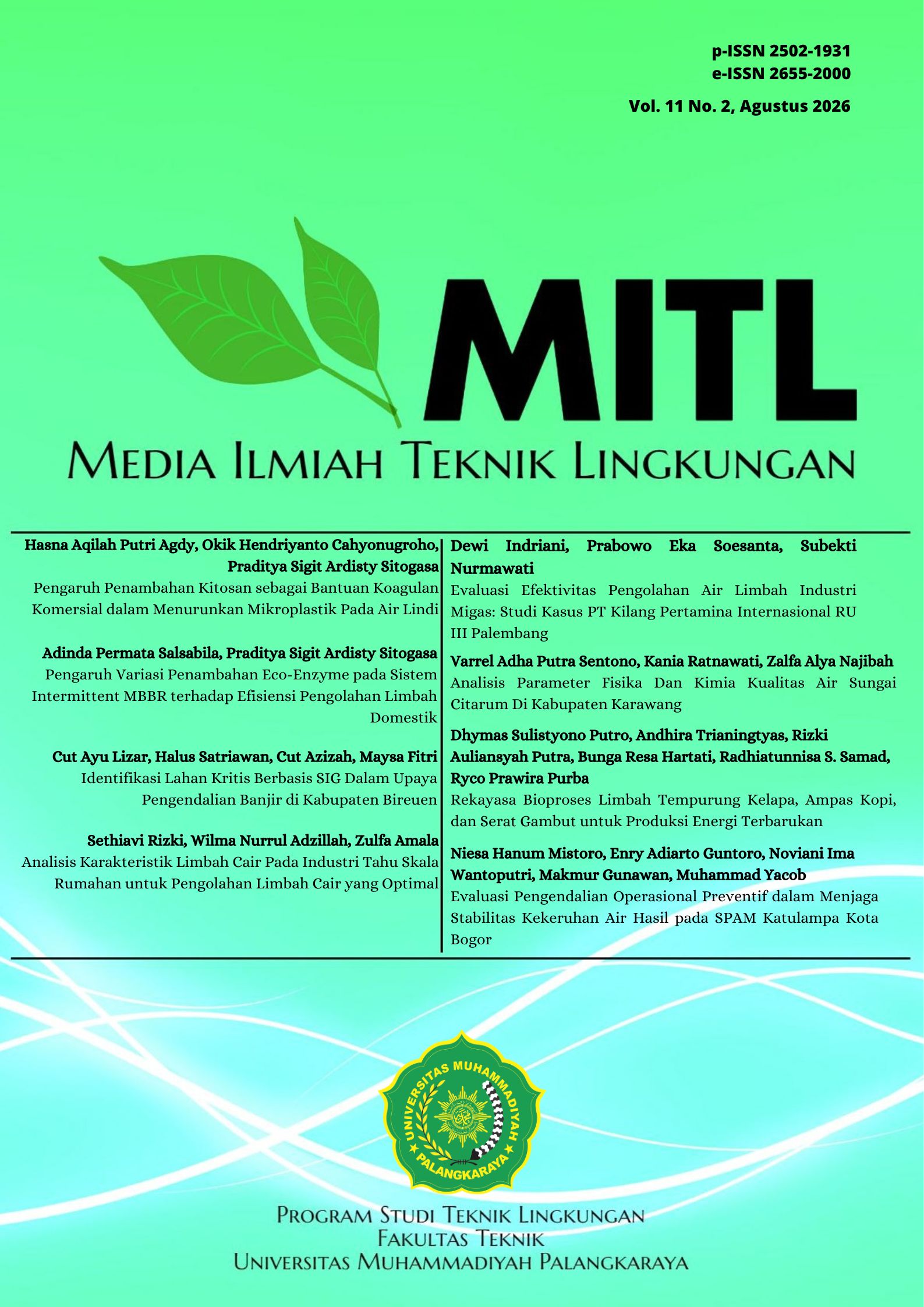
Evaluation of the Effectiveness of Oil and Gas Industrial Wastewater Treatment: A Case Study of PT Kilang Pertamina Internasional RU III Palembang Evaluasi Efektivitas Pengolahan Air Limbah Industri Migas: Studi Kasus PT Kilang Pertamina Internasional RU III Palembang
Article Sidebar
Main Article Content
Abstract
Wastewater treatment in the oil and gas industry plays an important role in meeting environmental quality standards and preventing pollution. This study aims to evaluate the effectiveness of wastewater treatment at PT Kilang Pertamina Internasional RU III Palembang through a comparison of influent and effluent quality. The parameters analyzed include ammonia, Biochemical Oxygen Demand (BOD), Chemical Oxygen Demand (COD), sulfide, pH, and oil and fat. The study used a quantitative approach with paired comparative analysis based on 12 months of operational data. The normality test using Kolmogorov–Smirnov showed that some of the data showed a normal distribution so that hypothesis testing was continued using a paired t-test at a 95% confidence level (α = 0.05). The results showed an effective reduction of 58.97% (ammonia), 28.34% (BOD), 37.51% (COD), and 56.81% (oil and fat), while sulfide was relatively low (22.02%) and pH tended to be stable (-0.81%). The results of the paired t-test showed a significant difference (p < 0.05) between influent and effluent concentrations in the main parameters, indicating that the wastewater treatment system was working effectively. However, the suboptimal effectiveness of several parameters indicated the need for optimization of the treatment process.
Downloads
Article Details

This work is licensed under a Creative Commons Attribution-ShareAlike 4.0 International License.
All rights reserved. This publication may be reproduced, stored in a retrieval system, or transmitted in any form or by any means, electronic, mechanical, photocopying, recording.
References
A. Susanto and R. Putri, “Risiko psikososial di industri minyak dan gas bumi (MIGAS): Tinjauan literatur naratif,” Jurnal Lentera Kesehatan Masyarakat, vol. 4, no. 2, pp. 124–136, 2025, Link: https://doi.org/10.69883/mgh1hq52
E. C. Kumala, M. Fjasmine, S. A. P. Rimansa, F. Amalia, H. Mulyanti, and R. M. Kusuma, “Analisis Kualitas Buangan Air Limbah Unit Pengolahan Migas (Kilang) PPSDM Migas Cepu,” Jurnal Pembangunan Berkelanjutan, vol. 7, no. 2, pp. 21–32, 2024, Link: https://doi.org/10.22437/jpb.v7i2.37417
T. A. Karini, D. R. Wijaya, and Z. F. Arranuri, “Karakteristik dan Kualitas Biological Oxygen Demand (BOD), Chemical Oxygen Demand (COD), Limbah Cair Rumah Sakit (Studi Deskriptif di Rumah Sakit X Kabupaten Jeneponto),” vol. 6, no. 2, pp. 100-107, 2020, Link: https://doi.org/10.24252/higiene.v6i2.18234
D. Tetanika, H. Hardoyo, and A. Setiajaya, “Kinerja Lagoon Digester Dalam Pengolahan Limbah Cair Industri Tapioka Sebagai Bahan Baku Biogas Di PT Tedco Agri Makmur,” Jurnal Ilmiah Research Student, vol. 3, no. 1, pp. 148–157, 2026, Link: https://ejurnal.kampusakademik.co.id/index.php/jirs/article/view/8431/7196
H. Purnata, S. Rahmat, N. A. Ilahi, N. A. Triwuri, and A. F. Pratiwi, “Pengolahan Limbah Cair Batik dengan Elektrokoagulasi dan Filtrasi-Adsorbsi untuk Keberlanjutan,” Room of Civil Society Development, vol. 4, no. 1, pp. 197–210, 2024, Link: https://doi.org/10.59110/rcsd.528
A. M. Tsani and Y. M. Yustiani, “Evaluasi Kinerja Operasional dan Pemeliharaan WWTP Industri Susu Berdasarkan Parameter Kualitas Effluent dan Manajemen Operasional (Studi Kasus: PT. CC),” Infomatek, vol. 27, no. 2, pp. 229–236, 2025, Link: https://doi.org/10.23969/infomatek.v27i2.40838
J. Jumawati, R. Ramli, Sukriati, Hamran, M. I. Ahmad, M. A. Imran, and A. R. Saleh, “Integrasi, Implementasi, dan Evaluasi Pengendalian Mutu dalam Manajemen Modern,” Sulawesi Tenggara Educational Journal, vol. 5, no. 1, pp. 225–232, 2025, Link: https://doi.org/10.54297/seduj.v5i1.1102
F. Rozi, M. Widiyanti, M. Yusuf, and M. I. Hadjri, “The influence of work motivation on employee performance: Case study at PT Pertamina International Refinery RU III Plaju,” IInternational Research Journal of Management, vol. 11, no. 6, pp. 264–271, 2024, Link: https://doi.org/10.21744/irjmis.v11n6.2480
A. Naillah, L. Y. Budiarti, and F. Heriyani, “Literature Review: Analisis Kualitas Air Sungai dengan Tinjauan Parameter pH, Suhu, BOD, COD, DO terhadap Coliform,” Homeostasis, vol. 4, no. 2, pp. 487–494, 2021, Link: https://doi.org/10.20527/ht.v4i2.4041
V. C. Yolanda and A. P. Heriyanti, “Wastewater Quality Characteristics Test in Domestic Wastewater Treatment Plant Dinas Lingkungan Hidup Kota Semarang,” Indonesian Journal of Earth and Human, vol. 1, no. 1, pp. 44–52, 2026, Link: https://journal.unnes.ac.id/journals/ijeh/article/view/2678
R. Tosepu, Analisis Kualitas Lingkungan. Uwais Inspirasi Indonesia, 2024.
T. M. Mulyasari and M. Firdaust, “The Effectiveness of the Use of ‘SM’ Wastewater Treatment Equipment on the Physical and Chemical Quality of Laundry Wastewater,” Buletin Keslingmas, vol. 44, no. 4, 281–290, 2025, Link: https://doi.org/10.31983/keslingmas.v44i4.14015
I. W. Tuye, J. Sutrisno, and D. Majid, “Potensi salvinia molesta dan pistia stratiotes dalam penurunan kadar fosfat, BOD, dan COD pada limbah cair laundry,” WAKTU: Jurnal Teknik UNIPA, vol. 21, no. 02, Jul 2023, Link: https://doi.org/10.36456/waktu.v21i02.7727
Y. Ananta, “Dinamika Pertumbuhan Bakteri Pengurai pada Biofilter Air Limbah Domestik di Bawah Variasi pH dan Suhu,” Jurnal Greenation Pertanian dan Perkebunan, vol. 3, no. 2, pp. 63–73, 2025, Link: https://doi.org/10.38035/jgpp.v3i2.583
T. Fahrianto, T. Fahrianto, and M. Naswir, “Pengaruh Waktu Aerasi terhadap peningkatan efisiensi penghilangan amonia di air lindi pada sistem ammonia stripper,” Jurnal Pembangunan Berkelanjutan, vol. 7, no. 2, pp. 91–95, 2024, Link: https://online-journal.unja.ac.id/JPB/article/view/38625
N. S. Prihatini, C. Abdi, I. Nirtha, R. Noor, B. Mu’min, and Y. Agafe, “Pengolahan Limbah Cair Bengkel Dengan Metode Fisik-Biologis Dalam Menurunkan Kandungan Minyak Dan Lemak,” Prosiding Seminar Nasional Lingkungan Lahan Basah, vol. 10, no. 1, 2025, Link: https://snllb.ulm.ac.id/prosiding/index.php/snllb-lit/article/view/1313
H. Sani, “Evaluasi Kinerja Permeable Reactive Barrier Anaerobik dalam Pengolahan Air Asam Tambang Skala Pilot: Efektivitas dan Tantangan dalam Penyisihan Mangan,” RIGGS: Journal of Artificial Intelligence and Digital Business, vol. 4, no. 3, pp. 8221–8226, 2025, Link: https://doi.org/10.31004/riggs.v4i3.3150
A. Wulandari, R. W. Nusantara, and M. S. Anwari, “Efektifitas Sistem Lahan Basah Buatan Dalam Pengolahan Limbah Cair Rumah Sakit-X (Effectiveness of Artificial Wetland System in Processing Liquid Waste of Hospital-X),” Jurnal Manusia & Lingkungan, vol. 27, no. 2, pp. 39, 2020, Link: https://doi.org/10.22146/jml.52179
G. N. Affandi, P. C. G. Berlianti, N. R. Ramadhania, R. S. A. Shawaaba, and D. O. Radianto, “Efektivitas Pengolahan Limbah Fisik (Padat Dan Cair) dengan Menggunakan Teknologi Inovatif,” JWIKAL, vol. 3, no. 1, pp. 84–98, 2024, Link: https://doi.org/10.58169/jwikal.v3i1.368