Edukasi dan Pelatihan Pemanfaatan Tanaman Obat Keluarga di Desa Dlingo Bantul sebagai Upaya Pencapaian Tujuan SDGs di Bidang Kesehatan Education and Training on the Use of Family Medicinal Plants in Dlingo Village, Bantul, as an Initiative to Support the Achievement of Health-Related SDGs
Article Sidebar
Main Article Content
Abstract
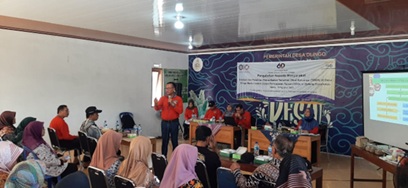
Global health issues have become increasingly urgent following the COVID-19 pandemic, which resulted in approximately 6.6 million deaths by 2022. This impact has prompted communities to revert to traditional medicines, aligning with the National Development Planning System (RPJPN) 2005-2025, which promotes a health paradigm through traditional remedies. Community service activities were carried out in partnership with the Ngudi Makmur Farmer Group (POKTAN) in Dlingo Village, Bantul Regency. The primary objective of this activity was to enhance residents’ knowledge in Dlingo Village regarding the benefits and processing of Family Medicinal Plants (TOGA). The methods employed included material development, counseling sessions, question-and-answer discussions, and direct practical training in the preparation of aromatherapy candles. Evaluation was undertaken using pretests and posttests, which demonstrated a significant increase in participants’ understanding. The average scores rose from 81.67 (pretest) to 132.5 (posttest), with a statistically significant difference (p <0.001). These findings indicate that the counseling was effective in improving knowledge about TOGA and its utilization in producing aromatherapy candles. Such activities not only enhance awareness but also reinforce community autonomy in managing traditional medicinal resources, in line with the health-related objectives of the Sustainable Development Goals (SDGs).
Downloads
Article Details

This work is licensed under a Creative Commons Attribution-ShareAlike 4.0 International License.
Authors who publish with this journal agree to the following terms:
- Any article on the copyright is retained by the author(s).
- Author grant the journal, right of first publication with the work simultaneously licensed under a Creative Commons Attribution License that allows others to share work with acknowledgment of the work authors and initial publications in this journal.
- Authors are able to enter into a separate, additional contractual arrangements for non-exclusive distribution of published articles of work (eg, post-institutional repository) or publish it in a book, with acknowledgment of its initial publication in this journal.
- Authors are permitted and encouraged to post their work online (e.g., in institutional repositories or on their websites) prior to and during the submission process, as can lead to productive exchanges, as well as earlier and greater citation of published work.
- The article and any associated published material is distributed under the Creative Commons Attribution-ShareAlike 4.0 International License
References
Anh, N. H., Kim, S. J., Long, N. P., Min, J. E., Yoon, Y. C., Lee, E. G., Kim, M., Kim, T. J., Yang, Y. Y., Son, E. Y., Yoon, S. J., Diem, N. C., Kim, H. M., & Kwon, S. W. (2020). Ginger on Human Health: A Comprehensive Systematic Review of 109 Randomized Controlled Trials. Nutrients, 12(1). https://doi.org/10.3390/nu12010157
BPS. (2022). Kecamatan Dlingo dalam Angka 2022.
Dehzad, M. J., Ghalandari, H., Amini, M. R., & Askarpour, M. (2023). Effects of curcumin/turmeric supplementation on liver function in adults: A GRADE-assessed systematic review and dose–response meta-analysis of randomized controlled trials. Complementary Therapies in Medicine, 74, 102952. https://doi.org/https://doi.org/10.1016/j.ctim.2023.102952
Khairullah, A. R., Solikhah, T. I., Ansori, A. N. M., Hanisia, R. H., Puspitarani, G. A., Fadholly, A., & Ramandinianto, S. C. (2021). Medicinal importance of Kaempferia galanga L. (Zingiberaceae): A comprehensive review. J Herbmed Pharmacol, 10(3), 281–288. https://doi.org/10.34172/jhp.2021.32
Musdja, M. Y. (2021). Potential bangle (Zingiber montanum J.König) rhizome extract as a supplement to prevent and reduce symptoms of Covid-19. Saudi Journal of Biological Sciences, 28(4), 2245–2253. https://doi.org/https://doi.org/10.1016/j.sjbs.2021.01.015
Oladeji, O. S., Adelowo, F. E., Ayodele, D. T., & Odelade, K. A. (2019). Phytochemistry and pharmacological activities of Cymbopogon citratus: A review. Scientific African, 6, e00137. https://doi.org/https://doi.org/10.1016/j.sciaf.2019.e00137
Paramita, S., Aminyoto, M., Ismail, S., & Arung, E. T. (2018). Anti-hypercholesterolemic effect of Zingiber montanum extract [version 2; peer review: 1 approved]. F1000Research, 7, 1–7.
Shah, G., Shri, R., Panchal, V., Sharma, N., Singh, B., & Mann, A. S. (2011). Scientific basis for the therapeutic use of Cymbopogon citratus, stapf (Lemon grass). Journal of Advanced Pharmaceutical Technology & Research, 2(1), 3–8. https://doi.org/10.4103/2231-4040.79796
Srivastava, N., Ranjana, Singh, S., Gupta, A. C., Shanker, K., Bawankule, D. U., & Luqman, S. (2019). Aromatic ginger (Kaempferia galanga L.) extracts with ameliorative and protective potential as a functional food, beyond its flavor and nutritional benefits. Toxicology Reports, 6, 521–528. https://doi.org/https://doi.org/10.1016/j.toxrep.2019.05.014
Wang, S.-Y., Zhao, H., Xu, H.-T., Han, X.-D., Wu, Y.-S., Xu, F.-F., Yang, X.-B., Göransson, U., & Liu, B. (2021). Kaempferia galanga L.: Progresses in Phytochemistry, Pharmacology, Toxicology and Ethnomedicinal Uses. Frontiers in Pharmacology, 12, 675350. https://doi.org/10.3389/fphar.2021.675350