Pelatihan Pengentasan Buta Huruf Al-Qur'an melalui Model Pembelajaran LITERAT bagi Guru di Kabupaten Bandung Training for Al-Qur'an Literacy Enhancement through the LITERAT Learning Model for Teachers in Bandung Regency
Article Sidebar
Main Article Content
Abstract
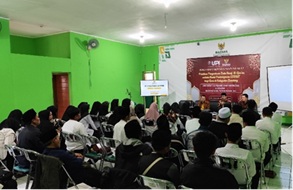
The Qur'anic Literacy Eradication Training through the LITERAT Learning Model aims to enhance the capacity of Islamic Education (PAI) teachers in systematically assessing and teaching Qur'anic literacy. The training involved 50 teachers in Bandung Regency and was conducted as an interactive workshop combining theoretical presentations, simulations, and hands-on practice. The LITERAT model—which consists of seven stages: Listening, Identification, Treatment, Explanation, Reading, Assessment, and Testing—equips participants with the ability to categorize students' Qur'anic reading skills into five levels: TPD1, TPD2, TD, TT, and TM. Before the training, most participants could only make general distinctions between "fluent" and "non-fluent" students in reading the Qur'an. After completing the training, participants reported the ability to apply classification indicators in a more measurable and structured manner. Pre-test results showed an average participant score of 61.5, which increased to 83.2 in the post-test. The majority of participants demonstrated improvement in the accuracy of student assessment classifications. Additionally, the majority of participants stated that the training was highly beneficial. The training strengthened participants' understanding of the LITERAT model and improved their pedagogical and evaluative competencies in Qur'anic instruction. This intervention significantly contributes to empowering teachers as objective, data-driven evaluators of religious literacy.
Downloads
Article Details

This work is licensed under a Creative Commons Attribution-ShareAlike 4.0 International License.
Authors who publish with this journal agree to the following terms:
- Any article on the copyright is retained by the author(s).
- Author grant the journal, right of first publication with the work simultaneously licensed under a Creative Commons Attribution License that allows others to share work with acknowledgment of the work authors and initial publications in this journal.
- Authors are able to enter into a separate, additional contractual arrangements for non-exclusive distribution of published articles of work (eg, post-institutional repository) or publish it in a book, with acknowledgment of its initial publication in this journal.
- Authors are permitted and encouraged to post their work online (e.g., in institutional repositories or on their websites) prior to and during the submission process, as can lead to productive exchanges, as well as earlier and greater citation of published work.
- The article and any associated published material is distributed under the Creative Commons Attribution-ShareAlike 4.0 International License
References
Alvito Budi Astoro, Suresman, E., & Faqihuddin, A. (2024). Strategi membangun literasi keagamaan melalui pendidikan agama Islam. Intizar, 30(2). https://doi.org/10.19109/intizar.v30i2.24808
Chand Dayal, H., & Alpana, R. (2020). Secondary pre-service teachers’ reflections on their microteaching: Feedback and self-evaluation. Waikato Journal of Education, 25(1), 73–83. https://doi.org/10.15663/wje.v25i0.686
Faqihuddin, A., Firmansyah, M. I., & Muflih, A. (2024). Multisensory approach in memorizing the Al-Quran for early childhood: Integration of the tradition of memorizing the Al-Quran with digital technology. Al-Ishlah: Jurnal Pendidikan, 16(2), 1289–1302. https://doi.org/10.35445/alishlah.v16i2.5326
Faqihuddin, A., Muflih, A., & Syarifudin, I. (2024). Vocational education and training (VET) in the field of learning media of digital-based Islamic religious education through the teaching practitioner program. Tarbawy: Indonesian Journal of Islamic Education, 11(1), 34–48. https://doi.org/10.17509/t.v11i1.69406
Faqihuddin, A., Muflih, A., Syarifudin, I., Romadhon, F., & Al-Ayyubi, S. (2024). The intervention of Islamic religious education teachers in puberty assistance: NVIVO analysis. Educative: Jurnal Ilmiah Pendidikan, 2(2), 87–97. https://doi.org/10.37985/educative.v2i2.491
Faqihuddin, A., Romadhon, F., & Muflih, A. (2024). Implementasi konsep spiritual pedagogik melalui program inpirasi dhuha. JIEP: Journal of Islamic Education Papua, 2(1), 1–17. http://dx.doi.org/10.58982/jiep.v2i1.25
Hyangsewu, P., Abdillah, H. T., Faqihuddin, A., Muflih, A., & Sari, I. (2024). IRE teachers’ efforts to improve digital literacy to strengthen religious interaction towards a good digital citizenship society. IJECA International Journal of Education & Curriculum Application, 7(3), 359–372. https://doi.org/10.31764/ijeca.v7i3.26737
Mohanakrishnan, J., & Brindha, G. (2016). Training needs and identification. International Journal of Pharmacy and Technology, 8(4), 23508–23511.
Mohseni, M. A. (2024). Mechanisms of obedience in the Holy Quran: A study based on cultural and ethnic semantics and Albert Bandura’s social cognitive theory. Quranica, 16(1, Special Issue), 1–25. https://doi.org/10.22452/quranica.vol16no1.1
Nurhayati, S. H. L., Islamy, M. R. F., & Faqihuddin, A. (2024). Exploring online preschool programs in children’s academic preparation for elementary school: A case study in Indonesia. Cogent Education, 11(1). https://doi.org/10.1080/2331186X.2024.2433818
Pathilaiya, H. L., Sinurat, J., Sarasati, B., Jumiati, S., Supriatna, A., Harto, B., Urhuhe, Siburian, D., Mahaza, Maesarini, I., & Hapsar, T. (2022). Pemberdayaan masyarakat. Jurnal Abdimas BSI, 5(2), 96–103. https://doi.org/10.31294/jabdimas.v5i2.12708
Pikiran Rakyat. (2017). Ironis, 54% Muslim Indonesia tak bisa baca Alquran. Pikiran Rakyat. https://www.pikiran-rakyat.com/nasional/pr-01290792/ironis-54-muslim-indonesia-tak-bisa-baca-alquran-415880
Pikiran Rakyat. (2024). Memprihatinkan! 80 persen siswa dan mahasiswa belum lancar baca Al Quran, Prof Udin: Dianggap tak penting. Pikiran Rakyat. https://soreang.pikiran-rakyat.com/kab-bandung/pr-3938563990/memprihatinkan-80-persen-siswa-dan-mahasiswa-belum-lancar-baca-al-quran-prof-udin-dianggap-tak-penting?page=all
Poerana, A. F., Hariyanto, F., Oxygentri, O., & Lubis, F. M. (2022). Peningkatan kapasitas pembelajaran santri melalui pelatihan pemanfaatan media sosial di Pondok Pesantren An-Nihayah Kabupaten Karawang. Transformasi: Jurnal Pengabdian Masyarakat, 18(2), 287–297. https://doi.org/10.20414/transformasi.v18i2.5052
Rahmawati, D. L., Handayani, O. W. K., & Indriyanti, D. R. (2022). Keefektivan metode penyuluhan keliling dan metode penyuluhan individu terhadap perilaku kepatuhan protokol kesehatan di Kelurahan Sekayu. Jurnal Sehat Mandiri, 17(1), 57–66. https://doi.org/10.33761/jsm.v17i1.599
Schumann Scheel, L., Kjaer, N. K., Marnie, C., & Peters, M. D. J. (2023). Reflection in the training of general practitioners in clinical practice settings: A scoping review protocol. JBI Evidence Synthesis, 21(7), 1501–1508. https://doi.org/10.11124/JBIES-22-00210
Scott, V. C., Chagnon, E., & Wandersman, A. (2024). The technical assistance (TA) effectiveness logic model: A tool for systematically planning, delivering, and evaluating TA. Evaluation & the Health Professions, 47(4), 369–385. https://doi.org/10.1177/01632787241285561
Sinta, D., Fahrudin, F., Faqihuddin, A., & Nurhuda, A. (2024). Membentuk karakter siswa melalui program-program sekolah: Studi kasus di SMA Islam Nurul Fikri Boarding School Lembang. Al-Mutharahah: Jurnal Penelitian dan Kajian Sosial Keagamaan, 21(1), 428–448. https://doi.org/10.46781/al-mutharahah.v21i01.854
Subakti, G. E., Faqihuddin, A., Ilyasa, F. F., & Muflih, A. (2024). Meningkatkan student engagement dalam pembelajaran sejarah pada mata pelajaran PAI melalui pesta topeng. Pendekar: Jurnal Pendidikan Berkarakter, 7(2), 121–130. https://doi.org/10.31764/pendekar.v7i2.23290
Supriadi, U., Faqihuddin, A., & Islamy, M. R. F. (2024). Integrasi nilai Islam dalam pendidikan: Studi kasus pelatihan guru mata pelajaran umum pada Madrasah Tsanawiyah Udin. ABDIMASY: Jurnal Pengabdian dan Pemberdayaan Masyarakat, 5(1), 74–87. https://doi.org/10.32696/abdimasya.v5i1.1332
Supriadi, U., Supriyadi, T., & Abdussalam, A. (2022). Al-Qur’an literacy: A strategy and learning steps in improving Al-Qur’an reading skills through action research. International Journal of Learning, Teaching and Educational Research, 21(1), 323–339. https://doi.org/10.26803/ijlter.21.1.18