Empowering Farmers through Fine Crumble Organic Fertilizer Innovation for Sustainable and Eco-Friendly Agriculture
Article Sidebar
Main Article Content
Abstract
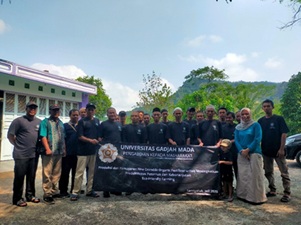
Munggang Wetan Hamlet, Sidoharjo Village, Samigaluh District, Kulon Progo, is in the Menoreh Highhills region, which has great goat farming potential. The KUBE Sejahtera X Binangun 005 farm group has been using goat manure as organic fertilizer; however, they continue to encounter challenges due to its rough texture and basic packaging. This community service activity aims to improve the quality of organic fertilizer products by applying Compost Maturation Technology and using a compost grinder to produce fine, crumbly organic fertilizer. The activity was conducted using a participatory approach that included outreach, training, technology application, and evaluation. The results of this community service activity showed a significant improvement in the physical quality of organic fertilizer that meets SNI standards, with characteristics such as a crumbly texture, blackish-brown color, a humus-like odor, and a temperature of 30–35°C, making it suitable for agricultural use. Additionally, the innovative packaging design has the potential to enhance the sales value of the partner group's organic fertilizer products. This activity not only supports local economic potential but also reinforces the principles of sustainable agriculture by utilizing livestock manure as a productive resource. This program is expected to become a model for rural community empowerment through appropriate, environmentally friendly technology.
Downloads
Article Details

This work is licensed under a Creative Commons Attribution-ShareAlike 4.0 International License.
Authors who publish with this journal agree to the following terms:
- Any article on the copyright is retained by the author(s).
- Author grant the journal, right of first publication with the work simultaneously licensed under a Creative Commons Attribution License that allows others to share work with acknowledgment of the work authors and initial publications in this journal.
- Authors are able to enter into a separate, additional contractual arrangements for non-exclusive distribution of published articles of work (eg, post-institutional repository) or publish it in a book, with acknowledgment of its initial publication in this journal.
- Authors are permitted and encouraged to post their work online (e.g., in institutional repositories or on their websites) prior to and during the submission process, as can lead to productive exchanges, as well as earlier and greater citation of published work.
- The article and any associated published material is distributed under the Creative Commons Attribution-ShareAlike 4.0 International License
References
Abdullah, A., Ali, H. M., Syamsu, J. A. 2015. Status Keberlajutan Adopsi Teknologi Pengolahan Limbah Ternak sebagai Pupuk Organik. MIMBAR, Jurnal Sosial Dan Pembangunan. 31(1):11–20. https://doi.org/10.29313/mimbar.v31i1.849
Badan Standardisasi Nasional (BSN). 2018. SNI 7763-2018: Pupuk Organik Padat, Pub. L. No. SNI 7763-2018, Jakarta: BSN
Badan Standardisasi Nasional (BSN). 2024. SNI 7763:2024 – Pupuk Organik Padat, Pub. L. No. SNI 7763:2024, Jakarta: BSN
EC. 2020. Circular Economy Action Plan: For a Cleaner and More Competitive Europe. In European Commission. European Union.
Fany, A., Novia, T., Hanimatus, D., Darianto, David, M., Lailyningsih, D. R. N. 2022. Pemanfaatan Limbah Kotoran Kambing menjadi Pupuk Organik sebagai Upaya Meningkatkan Ekonomi Petani Desa Banyuurip. Ahmad Dahlan Mengabdi. 1(1):17–19. https://doi.org/10.58906/abadi.v1i1.56
FAO. 2020. Digital Agriculture: Farmers in the Digital Age.
Ganti, N. W. S. L. S., Ginting, S., Leomo, S. 2023. Pengaruh Pemberian Pupuk Organik Terhadap Sifat Kimia Tanah Masam dan Hasil Tanaman Jagung (Zea mays L.). Berkala Penelitian Agronomi. 11(1):24–34. https://doi.org/10.33772/bpa.v11i1.400
Handiwirawan, E., Subandriyo. 2019. Pengembangan Ternak Kambing di Indonesia. Wartazoa. 29(2):69–78.
Hartatik, W., Widowati, L. R. 2010. Pupuk Organik dan Pupuk Hayati. Balai Penelitian Tanah.
Ife, J., Tesoriero, F. 2008. Community Development: Community-Based Alternatives in an Age of Globalisation (3rd ed.). Pearson Education Australia.
Kusuma, F. D., Hapsari, M. T. 2024. Peningkatan Kapasitas Masyarakat Urban dalam Pembuatan Pupuk Bokashi. ABDIKU: Jurnal Pengabdian Masyarakat Universitas Mulawarman. 3(1):29–32. https://doi.org/10.32522/abdiku.v3i1.1541
Mashudi, D., Imanudin, O., Falahudin, A. 2023. Karakteristik Pupuk Organik Dari Pengolahan Limbah Peternakan Sapi Potong Di Kelompok Ternak Banteng Tani Di Kecamatan Losarang Kabupaten Indramayu. Tropical Livestock Science Journal. 1(2):57–66. https://doi.org/10.31949/tlsj.v1i2.4783
Minkler, M., Wallerstein, N. 2011. Community-Based Participatory Research for Health: From Process to Outcomes (2nd ed.). Jossey-Bass.
Nenobesi, D., Mella, W., Soetedjo, P. 2017. Pemanfaatan Limbah Padat Kompos Kotoran Ternak dalam Meningkatkan Daya Dukung Lingkungan dan Biomassa Tanaman Kacang Hijau (Vigna radiata L.). Jurnal Pangan. 26:43–55. https://jurnalpangan.com/index.php/pangan/article/view/344
Prastowo, P., Nugraheni, Y. R., Ariyadi, B., Pastawan, V., Awaludin, A. 2023. Development of Alternative Feed Based on Silage Methods and Utilization of Goat Manure as Organic Fertilizer Using Simple Processing Methods in the KUBE Sejahtera X Binangun 005 Farmer Group, Sidoharjo Village, Samigaluh Sub-District, Kulon Progo District. Jurnal Pengabdian Masyarakat Peternakan. 8(2):17–34. http://dx.doi.org/10.35726/jpmp.v8i2.7180
Reza, M., Elystia, S., Sasmita, A., Priyambada, G., Andrio, D., Asmura, J. 2021. Sosialisasi dan Pelatihan Pengolahan Sampah Organik Rumah Tangga Menjadi Kompos dengan Teknologi Komposter terhadap Masyarakat RT 01 RW 03 Desa Rejosari Kecamatan Tenayan Raya. Jurnal Abdi Masyarakat Indonesia. 2(1):1–6. https://doi.org/10.54082/jamsi.140
Simatupang, R., Satmoko, S., Gayatri, S. 2019. Persepsi Petani Terhadap Penggunaan Pupuk Organik Pada Kelompok Tani Tranggulasi, Kecamatan Getasan, Kabupaten Semarang. Agrisaintifika: Jurnal Ilmu-Ilmu Pertanian. 3(1):59–72. https://doi.org/10.32585/ags.v3i1.557
Slamet, M. 2014. Pemberdayaan Masyarakat: Teori dan Praktek. IPB Press.
Sugito, Khoirin, L. 2024. Pemanfaatan Kotoran Kambing sebagai Pupuk Organik untuk Meningkatkan Kebersihan Lingkungan di Desa Mojosari. ABDIANDAYA: Jurnal Pengabdian Dan Pemberdayaan Masyarakat. 2(2):117–129. https://doi.org/10.56997/abdiandaya.v2i2.1597
Surya, A. A., Ramli, N. A. S., Saputri, P. I., Rahmatia, Yunus, S. R. 2021. Pembuatan Pupuk Organik Menggunakan Kotoran Kambing. Journal Lepa-Lepa Open. 1(1):103–106. https://ojs.unm.ac.id/JLLO/article/view/16802
Sutanto, R. 2002. Pertanian Organik: Menuju Pertanian Alternatif dan Berkelanjutan. Kanisius.
Syahri, L. A., Winarsih. 2022. Kualitas Kompos Sampah Daun Palem Raja (Roystonea regia) dengan Metode Lubang Resapan Biopori Jumbo. LenteraBio : Berkala Ilmiah Biologi. 11(1):1–7. https://doi.org/10.26740/lenterabio.v11n1.p1-7
Tilman, D., Balzer, C., Hill, J., Befort, B. L. 2011. Global Food Demand and the Sustainable Intensification of Agriculture. Proceedings of the National Academy of Sciences. 108(50):20260–20264. https://doi.org/10.1073/pnas.1116437108
Tri Pamungkas, S. S., Pamungkas, E. 2019. Pemanfaatan Limbah Kotoran Kambing sebagai Tambahan Pupuk Organik pada Pertumbuhan Bibit Kelapa Sawit (Elaeis guineensis Jacq.) di Pre-Nursery. MEDIAGRO. 15(01). https://doi.org/10.31942/md.v15i01.3071
Trivana, L., Pradhana, A. Y. 2017. Optimalisasi Waktu Pengomposan dan Kualitas Pupuk Kandang dari Kotoran Kambing dan Debu Sabut Kelapa dengan Bioaktivator PROMI dan Orgadec. Jurnal Sain Veteriner. 35(1):136–144. https://doi.org/10.22146/jsv.29301
UNESCO. 2017. Education for Sustainable Development Goals: Learning Objectives.
Widowati, L. R. 2009. Pupuk Organik: Jenis, Manfaat, dan Cara Pembuatan. Balai Penelitian Tanah.
Wijaya, M. B. R., Damayanti, A., Kurniawan, A., Wibowo, M. Y., Ar Rasyid, M. R., Salwa, D. F., Fitri, A. 2023. Penguatan Desain Kemasan Pupuk Kotoran Sapi dalam upaya Pemberdayaan Kelompok Tani Dewi Sri. PengabdianMu: Jurnal Ilmiah Pengabdian Kepada Masyarakat. 8(6):865–872. https://doi.org/10.33084/pengabdianmu.v8i6.5590