Transformasi Desa Banjar Rejo Menuju Desa Sadar Iklim Program Pengabdian Pemberdayaan Kemitraan Masyarakat Transforming Banjarrejo Village into a Climate-Awareness Village Empowerment Service Program Community Partnership
Article Sidebar
Main Article Content
Abstract
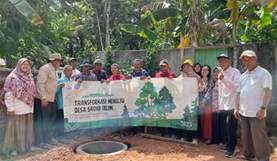
The Community Service Program (PKM) titled Transforming Banjarrejo Village into a Climate-Smart Village through Climate-Smart Agricultural Practices aims to address two primary challenges: reducing greenhouse gas (GHG) emissions and decreasing reliance on chemical inputs in conventional farming systems. Banjarrejo Village in East Lampung, with a population of 6,793 — 2,652 of whom are farmers, faces land degradation and low income due to unsustainable agricultural practices. The open burning of agricultural residues and household waste further exacerbates GHG emissions. The proposed solutions include: Integrated Waste Management and Environmental Conservation—the processing of household organic waste combined with environmental conservation through Lubang Multiguna (Lu-Mu) or multipurpose infiltration pits to enhance water infiltration and soil fertility; Organic Avocado Cultivation to increase farmers' income; and Climate-Smart Agricultural Practices to improve productivity while reducing GHG emissions. The PKM activities were conducted in Banjarrejo Village, Batanghari Subdistrict, East Lampung Regency, from September to December 2025. The program achieved success through collaboration among the Ministry of Education, Culture, Research, and Technology (Kemendikbudristek), Politeknik Negeri Lampung, and local farmer groups. The results demonstrated a 14% increase in community awareness of climate change issues, improved capacity for mitigation and adaptation, increased household income, and measurable contributions to national GHG reduction through tangible actions such as planting 250 organically managed avocado trees and constructing Lu-Mu infiltration pits for household waste management and groundwater conservation.
Downloads
Article Details

This work is licensed under a Creative Commons Attribution-ShareAlike 4.0 International License.
Authors who publish with this journal agree to the following terms:
- Any article on the copyright is retained by the author(s).
- Author grant the journal, right of first publication with the work simultaneously licensed under a Creative Commons Attribution License that allows others to share work with acknowledgment of the work authors and initial publications in this journal.
- Authors are able to enter into a separate, additional contractual arrangements for non-exclusive distribution of published articles of work (eg, post-institutional repository) or publish it in a book, with acknowledgment of its initial publication in this journal.
- Authors are permitted and encouraged to post their work online (e.g., in institutional repositories or on their websites) prior to and during the submission process, as can lead to productive exchanges, as well as earlier and greater citation of published work.
- The article and any associated published material is distributed under the Creative Commons Attribution-ShareAlike 4.0 International License
References
Adhikari S. (2018). Drought impact and adaptation strategies in the mid-hill farming system of western Nepal. Environments. 5(101). https://doi.org/10.3390/environments5090101
Adnan, A., Susilo, H., & Mardhiah, D. (2022). Effectiveness of farmer field schools in improving climate adaptation capacity. Journal of Agricultural Extension and Rural Development, 14(4), 145–154. https://doi.org/10.5897/JAERD2022.132
Andrieu N, Howland F, Acosta-Alba I, Le Coq J-F, Osorio-Garcia AM, & Martinez-Baron D, (2019). Co-designing climate-smart farming systems with local stakeholders: a methodological framework for achieving large-scale change. Front Sustain Food Syst. 3(37). https://doi.org/10.3389/fsufs.2019.00037
Aprilia R, Noerhayati E, & Rahmawati A. (2024) Analysis of waste generation characteristics as a reference for TPS 3R planning in community-based waste management efforts Civil Engineering Study Program, Faculty of Engineering, Universitas Islam Malang, Malang, East Java, 65144, Indonesia. https://doi.org/10.61511/phraj.v2i1.2024.828
Aryana, I. G. P. M., & Wangiyana, W. (2016). Perbandingan sistem budidaya padi konvensional dan berkelanjutan terhadap hasil dan efisiensi input di Indonesia. Jurnal Agroteknologi Tropika, 5(2), 81–89. https://www.peragi.org/wp-content/uploads/2021/09/PROSIDING-PERAGI-layout-6-Agustus-2021_CompressPdf.pdf
Aslamiah, I. D., Rahmawati, N., & Hadi, S. (2023). Evaluating participatory agricultural training for climate-smart villages in Indonesia. Sustainability, 15(12), 9876. https://doi.org/10.3390/su15129876.
Ayaz M, Ammad-Uddin M, Sharif Z, Mansour A, & Aggoune E-HM. (2019). Internet-of-Things (IoT)-based smart agriculture: Toward making the fields talk. IEEE Access (7) :129551–83. https://doi.org/10.1109/ACCESS.2019.2932609
Badan Pangan Nasional. (2024). Harga pangan nasional komoditas alpukat. Jakarta: Bapanas. Retrieved from https://panelharga.bapanas.go.id/
Hadi, S., Utami, E., & Wijayanti, R. (2022). Analisis produktivitas dan pendapatan petani alpukat varietas Miki di Kabupaten Malang. Jurnal Agribisnis Indonesia, 10(2), 123–130. https://doi.org/10.xxxx/jai.2022.10.2.123
Branca G, Arslan A, Paolantonio A, Grewer U, Cattaneo A, & Cavatassi R, ( 2021) Assessing the economic and mitigation benefits of climate-smart agriculture and its implications for political economy: A case study in Southern Africa. J Clean Prod (285) :125161. https://www.sciencedirect.com/science/article/abs/pii/S0959652620352057
Campbell BM, Thornton P, Zougmoré R, Van Asten P, & Lipper L. (2014). Sustainable intensification: What is its role in climate smart agriculture? Curr Opin Environ Sustain. (8) :39–43.
Crippa M, Solazzo E, Guizzardi D, Monforti-Ferrario F, Tubiello FN, & Leip A. (2021). Food systems are responsible for a third of global anthropogenic GHG emissions. Nat Food;2:198–209. https://doi.org/10.1038/s43016-021-00225-9
Dhokhikah, Y., Trihadiningrum, Y., & Sunaryo, S. (2015). Resources, Conservation and Recycling, 102, 153–162. https://www.sciencedirect.com/science/article/abs/pii/S092134491530032X
Dulbari D, Santosa E, Koesmaryono Y, Sulistyono E, Wahyudi A, Agusta H (2020). Local Adaptation to Extreme Weather and It’s Implication on Sustainable Rice Production in Lampung, Indonesia. AGRIVITA, Journal of Agricultural Science (43) :125–36. https://doi.org/10.17503/agrivita.v43i1.2338
Dulbari D, Santosa E, Koesmaryono Y, & Sulistyono E. (2018). Pendugaan kehilangan hasil pada tanaman padi rebah akibat terpaan angin kencang dan curah hujan tinggi. Indonesian Journal of Agronomy (46) :17–23. https://doi.org/10.24831/jai.v46i1.14376
Dulbari D, Santosa E, Sulistyono E, Agusta H, Guntoro D, & Zaman S. (2018). Produksi dan Kualitas Beras Dua Varietas Padi Akibat Rebah dan Terendam. Jurnal Ilmu Pertanian Indonesia (23) :74–80. https://doi.org/10.18343/jipi.23.1.74
Gram, G., Roobroeck, D., Pypers, P., Six, J., Merckx, R., & Vanlauwe, B. (2020). Combining organic and mineral fertilizers as a climate-smart integrated soil fertility management practice in sub-Saharan Africa: A meta-analysis. PLoS ONE, 15(9), e0239552. https://doi.org/10.1371/journal.pone.0239552
Hairiah, K., & Rahayu, S. (2007). Pengukuran karbon tersimpan di berbagai macam penggunaan lahan. Bogor: World Agroforestry Centre (ICRAF). Retrieved from https://www.worldagroforestry.org/publication/pengukuran-karbon-tersimpan
Hanuf, A. A., Prijono, S., & Soemarno. (2021). Improvement of soil available water capacity using biopore infiltration hole with compost in a coffee plantation. Journal of Degraded and Mining Lands Management. 8 (3) : 2791–2799. https://doi.org/10.15243/jdmlm.2021.083.2791
Hellin J, & Fisher E. (2019) Climate-smart agriculture and non-agricultural livelihood transformation. Climate. 7(48).
Intergovernmental Panel on Climate Change (IPCC). (2006). IPCC guidelines for national greenhouse gas inventories: Vol. 4. Agriculture, forestry and other land use. Geneva: IPCC. Retrieved from https://www.ipcc-nggip.iges.or.jp/public/2006gl/vol4.html
IPCC. (2018). Global warming of 1.5° C: An IPCC special report on the impacts of global warming of 1.5° C above pre-industrial levels and related global greenhouse gas emission pathways, in the context of strengthening the global response to the threat of climate change, sustainable development, and efforts to eradicate poverty. Intergovernmental Panel on Climate Change. https://doi.org/10.1017/9781009157940
Kementerian Lingkungan Hidup dan Kehutanan (KLHK). (2024). Sistem Informasi Pengelolaan Sampah Nasional (SIPSN). https://portal-sipsn.kemenlh.go.id/
Kottegoda, N., Fernando, N., de Silva, M., Munaweera, I., & Kottegoda, N. (2023). Climate Smart Agriculture: The role of fertilizer innovations and efficient plant nutrient management. Sri Jayewardenepura Journal of Science, 31(1), 1–15. https://journals.sjp.ac.lk/index.php/vjs/article/view/6709/4776
Mango N, Makate C, Tamene L, Mponela P, & Ndengu G. (2018). Adoption of small-scale irrigation farming as a climate-smart agriculture practice and its influence on household income in the Chinyanja Triangle, Southern Africa. Land (Basel) 7(49). https://doi.org/10.3390/land7020049
Meybeck A, Gitz V. Climate-Smart Agriculture: Policies, Practices and Financing for Food Security, Adaptation and Mitigation. 2010. https://www.researchgate.net/publication/328569762_Climate-Smart_Agriculture_Policies_Practices_and_Financing_for_Food_Security_Adaptation_and_Mitigation
Mizik T. (2021). Climate-smart agriculture on small-scale farms: A systematic literature review. Agronomy 11(1096). https://doi.org/10.3390/agronomy11061096
Mohd, M. H., Aziz, N. A. A., Yusoff, M. K., & Wahid, N. (2020). Estimation of aboveground biomass and carbon stock in avocado (Persea americana) plantation. Journal of Tropical Agriculture and Food Science, 48(2), 45–53. Retrieved from https://www.researchgate.net/publication/347892210
Murray U, Gebremedhin Z, Brychkova G, & Spillane C. (2016). Smallholder farmers and climate smart agriculture: Technology and labor-productivity constraints amongst women smallholders in Malawi. Gend Technol Dev (20) :117–48. https://doi.org/10.1177/0971852416640639
Nyasimi M, Kimeli P, Sayula G, Radeny M, Kinyangi J, & Mungai C. (2017). Adoption and dissemination pathways for climate-smart agriculture technologies and practices for climate-resilient livelihoods in Lushoto, Northeast Tanzania. Climate 5(63). https://doi.org/10.3390/cli5030063
Salassi ME, Deliberto MA, Linscombe SD, Wilson Jr CE, Walker TW, & McCauley GN. (2013) Impact of harvest lodging on rough rice milling yield and market price. Agron J (105) :1860–7. https://doi.org/10.2134/agronj2013.0238
Setiawan, A., Nugroho, P., & Sari, M. (2023). Pertumbuhan dan hasil alpukat (Miki variety) pada berbagai ketinggian tempat. Jurnal Hortikultura Indonesia, 14(1), 45–54. https://doi.org/10.xxxx/jhi.2023.14.1.45
Siedenburg J, Martin A, & McGuire S. (2012). The power of “farmer friendly” financial incentives to deliver climate smart agriculture: a critical data gap. Journal of Integrative Environmental Sciences (9) :201–17. https://doi.org/10.1080/1943815x.2012.748304