Membangun Desa Berkelanjutan: Pendampingan Pengelolaan Database Terintegrasi Building Sustainable Villages: Integrated Database Management Assistance
Article Sidebar
Main Article Content
Abstract
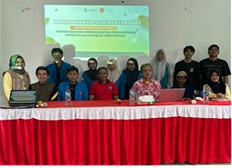
Integrated database management is a fundamental prerequisite for promoting sustainable, transparent, and evidence-based village development. However, Sidondo IV Village faces significant challenges due to limited digital literacy and insufficient capacity among village officials and community members in utilizing data for development planning. This community service program aims to strengthen local capacity through workshops and hands-on assistance in managing integrated village databases using Microsoft Office–based spreadsheet applications. A participatory approach was employed, consisting of workshops on sustainable village development, technical training in data processing, and guided preparation of data collection instruments. Program effectiveness was evaluated using pre-test and post-test assessments administered to training participants. The results indicate a substantial improvement in participants’ digital literacy and data management skills, with average scores increasing from 47.37 to 82.50, representing a 74.16 percent improvement. The program successfully produced an integrated village database system to support the planning, implementation, and evaluation of village development programs. Overall, this initiative contributes to strengthening participatory, transparent, and sustainable village governance through data-driven decision-making.
Downloads
Article Details

This work is licensed under a Creative Commons Attribution-ShareAlike 4.0 International License.
Authors who publish with this journal agree to the following terms:
- Any article on the copyright is retained by the author(s).
- Author grant the journal, right of first publication with the work simultaneously licensed under a Creative Commons Attribution License that allows others to share work with acknowledgment of the work authors and initial publications in this journal.
- Authors are able to enter into a separate, additional contractual arrangements for non-exclusive distribution of published articles of work (eg, post-institutional repository) or publish it in a book, with acknowledgment of its initial publication in this journal.
- Authors are permitted and encouraged to post their work online (e.g., in institutional repositories or on their websites) prior to and during the submission process, as can lead to productive exchanges, as well as earlier and greater citation of published work.
- The article and any associated published material is distributed under the Creative Commons Attribution-ShareAlike 4.0 International License
References
Agustina, N., Esa, & Yusuf, M. (2024). Model Kelembagaan Pemerintahan Desa. TUTURAN: Jurnal Ilmu Komunikasi, Sosial Dan Humaniora, 2(1), 201–209. https://doi.org/https://doi.org/10.47861/tuturan.v1i4.775
Andriani, N., Hasanuddin, B., Mahardiana, L., & Buntuang, P. C. D. (2024). Edukasi Pentingnya Ketersediaan Database Terhadap Efektivitas Kinerja Kelurahan Tatura Selatan. Sasambo: Jurnal Abdimas (Journal of Community Service), 6(3), 627–637. https://doi.org/10.36312/sasambo.v6i3.2059
Bian, L., & Liu, Z. (2024). Sustainable rural economy and food security: An integrated approach to the circular agricultural model. Quality Assurance and Safety of Crops & Foods, 16(2), 65–80. https://doi.org/10.15586/qas.v16i2.1450
Fahrudin, & Kusnadi. (2020). Analisis Potensi Ekonomi Desa dan Prospek Pengembangannya. Keadaban: Jurnal Sosial Dan Humaniora, 1(2), 1–18. https://doi.org/10.33650/adab.v1i2.2224
Food and Agriculture Organization of the United Nations. (2005). Improving information flows to the rural community. In Agricultural Management, Marketing and Finance Service. FAO (Agricultural Management, Marketing and Finance Service). ftp://ftp.fao.org/docrep/fao/009/a0287e/a0287e00.pdf
Kamakaula, Y. (2024). Sustainable Agriculture Practices: Economic, Ecological, and Social Approaches to Enhance Farmer Welfare and Environmental Sustainability. West Science Nature and Technology, 2(02), 47–54. https://doi.org/10.58812/wsnt.v2i02.964
Keller, S., Shipp, S., Korkmaz, G., Molfino, E., Goldstein, J., Lancaster, V., Pires, B., Higdon, D., Chen, D., & Schroeder, A. (2018). Harnessing the power of data to support community‐based research. WIREs Computational Statistics, 10(3). https://doi.org/10.1002/wics.1426
Lusiana, R., Murtafiah, W., Suprapto, E., Apriandi, D., Krisdiana, I., & Setyansah, R. K. (2024). Pelatihan Pengolahan Administrasi Data Desa untuk Mewujudkan CANTIK (Cinta Statistika) bagi Perangkat Desa di Kantor Desa Kerik Kecamatan Takeran. Jurnal PKM Manajemen Bisnis, 4(1), 31–39. https://doi.org/DOI 10.37481
Nasfi, N. (2020). Pengembangan Ekonomi Pedesaan Dalam Rangka Mengentas Kemiskinan Di Pedesaan. Jurnal EL-RIYASAH, 11(1), 54. https://doi.org/10.24014/jel.v11i1.8818
Nasution, M. S., Rusli, Z., Heriyanto, M., Syahza, A., Zulkarnaini, M., Mayarni, Mashur, D., & Ananda, F. (2025). Bibliometric Analysis of Rural Economic Development: Convergence between Sustainable Agriculture, Digital Technology, and Community Engagement for Village Self-Reliance. International Journal of Sustainable Development and Planning, 20(1), 245–262. https://doi.org/10.18280/ijsdp.200123
Sari, S. U. R., Mukti, T. S., & Safitri, P. M. N. (2024). Pelatihan dan Pendampingan Pengelolaan Data-Data Berbasis Teknologi Menuju Desa Mandiri Data. Nawadeepa: Jurnal Pengabdian Masyarakat, 3(3), 94–100. https://doi.org/10.58835/nawadeepa.v3i3.381
Sasongko, R. W. (2022). Strategi Penguatan Ekonomi Pedesaan di Indonesia (Riyanto (ed.); Edisi Pert). CV. Cendekia Press. Anggota IKAPI No. 328/JBA/2018. http://eprints2.ipdn.ac.id/id/eprint/1285/
Sehgal, S., & Batool, I. (2024). Economic Development: A Study of the Holistic Examination of Sustainable Agriculture’s Substantial Impact on Developing Nations. South Asian Journal of Social Studies and Economics, 21(7), 241–248. https://doi.org/10.9734/sajsse/2024/v21i7858
Sukidjo. (1995). Upaya Pengembangan Ekonomi Pedesaan. Jurnal Cakrawala Pendidikan, 2(2), 57–68. https://doi.org/10.21831/cp.v2i2.9178