Pengenalan Metode Pembelajaran Kimia Menyenangkan melalui Kit Detektif Kimia bagi Siswa SMA Negeri 1 Kota Bangun Introduction to a Fun Chemistry Learning Method through Chemistry Detective Kits for Students at SMA Negeri 1, Kota Bangun
Article Sidebar
Main Article Content
Abstract
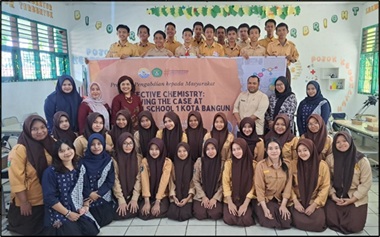
Chemistry is one of the elective subjects at the secondary education level that some students find difficult because it involves abstract concepts and is full of symbols. This condition necessitates learning innovation that offers a fun chemistry learning experience for students. This community service activity, conducted by the Chemistry Department, Faculty of Mathematics and Natural Sciences, Mulawarman University, aimed to introduce 11th-grade students at SMA Negeri 1 Kota Bangun to a fun chemistry learning method using the Chemistry Detective Kit. This kit was developed as a learning media innovation using a case-solving approach, where students were invited to analyze cases through a series of simple chemistry experiments, mimicking the work of a detective. The activity included group practical work, followed by a discussion of the chemistry concepts underlying each experiment. The results of the activity's evaluation through questionnaires and interviews indicated that participants responded very positively to the activity, both in terms of the materials and the activity's execution, and in its improvement in students' understanding of chemistry. The majority of students felt that each chemistry detective case provided a fun learning experience (71.9% Strongly Agree, 25.0% Agree). The evaluation results also showed that the learning activities in the form of investigative games helped students understand chemistry concepts and motivated them to learn more about chemistry.
Downloads
Article Details

This work is licensed under a Creative Commons Attribution-ShareAlike 4.0 International License.
Authors who publish with this journal agree to the following terms:
- Any article on the copyright is retained by the author(s).
- Author grant the journal, right of first publication with the work simultaneously licensed under a Creative Commons Attribution License that allows others to share work with acknowledgment of the work authors and initial publications in this journal.
- Authors are able to enter into a separate, additional contractual arrangements for non-exclusive distribution of published articles of work (eg, post-institutional repository) or publish it in a book, with acknowledgment of its initial publication in this journal.
- Authors are permitted and encouraged to post their work online (e.g., in institutional repositories or on their websites) prior to and during the submission process, as can lead to productive exchanges, as well as earlier and greater citation of published work.
- The article and any associated published material is distributed under the Creative Commons Attribution-ShareAlike 4.0 International License
References
Byusa, E., Kampire, E., & Mwesigye, A. R. (2022). Game-based learning approach on students motivation and understanding of chemistry concepts: A systematic review of literature. Heliyon, 8(5), e09541. https://doi.org/10.1016/j.heliyon.2022.e09541
Childs, P. E., & Sheehan, M. (2009). What's difficult about chemistry? An Irish perspective. Chemistry Education Research and Practice, 10(3), 204-218. http://dx.doi.org/10.1039/B914499B
Elmali, S., Freund, L., & Tiemann, R. (2025). A systematic literature review of game-based approaches in chemistry education (2014–2024). Chemistry Education Research and Practice. http://dx.doi.org/10.1039/D5RP00248F
Franco-Mariscal, A. J., Oliva-Martínez, J. M., & Almoraima Gil, M. L. (2015). Students’ Perceptions about the Use of Educational Games as a Tool for Teaching the Periodic Table of Elements at the High School Level. Journal of Chemical Education, 92(2), 278-285. https://doi.org/10.1021/ed4003578
Gupta, T. (2019). Game-Based Learning in Chemistry: A Game for Chemical Nomenclature. In Technology Integration in Chemistry Education and Research (TICER) (Vol. 1318, pp. 65-79): American Chemical Society. https://doi.org/10.1021/bk-2019-1318.ch005
Jegstad, K. M. (2024). Inquiry-based chemistry education: a systematic review. Studies in Science Education, 60(2), 251-313. https://doi.org/10.1080/03057267.2023.2248436
Jundu, R., Jehadus, E., Nendi, F., Kurniawan, Y., & Men, F. E. (2019). Optimalisasi Media Pembelajaran Interaktif dalam Meningkatkan Kemampuan Matematis Anak di Desa Popo Kabupaten Manggarai. E-DIMAS: Jurnal Pengabdian kepada Masyarakat, 10(2), 221-225. https://doi.org/10.26877/e-dimas.v10i2.3353
Laila, E., Festiyed, & Yerimadesi. (2024). Problem-Based Learning: A Systematic Literature Review of Chemistry Education Research in Indonesia. Sustainability Education, 1(1), 261-270. Retrieved from https://sustainabilityeducation.id/index.php/susedu/article/view/24
Moju, M., Taylor, L., & Iweuno, B. (2025). Tackling the challenge of chemical representations through sensemaking practices in chemistry education. Discover Education, 4(1), 352. https://doi.org/10.1007/s44217-025-00703-3
Muhson, A. (2010). Pengembangan Media Pembelajaran Berbasis Teknologi Informasi. Jurnal Pendidikan Akuntansi Indonesi, 8(2), 1-10. https://doi.org/10.21831/jpai.v8i2.949
Sirhan, G. (2007). Learning Difficulties in Chemistry: An Overview Journal of Turkish Science Education 4(2), 1-20. https://www.tused.org/index.php/tused/article/view/664
Subagyono, R. D., Allo, V., Syaima, H., Arif, M., Hiyahara, I., Widodo, N. and Gunawan, R. (2023). Pelatihan Penggunaan Kit Detektif Kimia dalam Pembelajaran Kimia Bagi Guru-Guru SMA, MA dan SMK di Kalimantan Timur. AKM: Aksi Kepada Masyarakat, 4(2), 353-362. https://doi.org/10.36908/akm.v4i2.977
Susilana, R., & Riyana, C. (2009). MEDIA PEMBELAJARAN: Hakikat, Pengembangan, Pemanfaatan, dan Penilaian. Bandung: CV Wacana Prima. https://books.google.co.id/books?id=-yqHAwAAQBAJ&printsec=frontcover&hl=id#v=onepage&q&f=false