Pengembangan Smart Farming Berbasis Agritourism sebagai Edukasi Teknologi Pertanian di Kabupaten Buleleng Development of Agritourism-Based Smart Farming as Agricultural Technology Education in Buleleng Regency
Article Sidebar
Main Article Content
Abstract
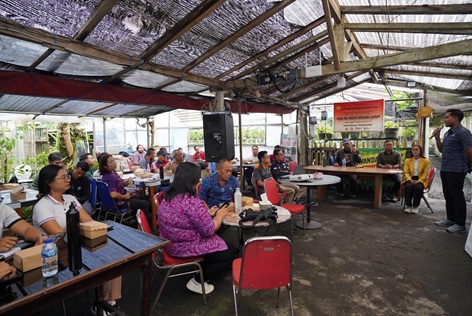
The development of agricultural technology is an important need to address the challenges of food sustainability, the low interest among the younger generation, and farmers' skepticism towards technological innovation. This community service activity was carried out in Buleleng Regency by developing agritourism-based smart farming as a means of agricultural technology education through the Wiwanda Agrow Independent Agriculture and Rural Training Center. The activity was carried out using a participatory approach, which included identifying partner needs, installing and integrating Internet of Things-based smart farming systems, functional testing and calibration, development of educational facilities and materials, training and assistance for farmers, and the implementation of educational tours for the community and students. The results of the activity show that the implemented smart farming system functions optimally in supporting monitoring and cultivation management, increases farmers' understanding and trust in technology, and serves as an effective learning medium for the younger generation. The integration of agritourism allows agricultural technology to be used not only for production but also as a vehicle for education and dissemination of innovation in a sustainable manner. Overall, this activity proves that the agritourism-based smart farming model can be an effective approach to encourage the adoption of agricultural technology, strengthen farmer regeneration, and support food security in the future, while creating sustainable partnerships between universities and communities, permitted to use abbreviations except for units of a quantity and use them to a minimum.
Downloads
Article Details

This work is licensed under a Creative Commons Attribution-ShareAlike 4.0 International License.
Authors who publish with this journal agree to the following terms:
- Any article on the copyright is retained by the author(s).
- Author grant the journal, right of first publication with the work simultaneously licensed under a Creative Commons Attribution License that allows others to share work with acknowledgment of the work authors and initial publications in this journal.
- Authors are able to enter into a separate, additional contractual arrangements for non-exclusive distribution of published articles of work (eg, post-institutional repository) or publish it in a book, with acknowledgment of its initial publication in this journal.
- Authors are permitted and encouraged to post their work online (e.g., in institutional repositories or on their websites) prior to and during the submission process, as can lead to productive exchanges, as well as earlier and greater citation of published work.
- The article and any associated published material is distributed under the Creative Commons Attribution-ShareAlike 4.0 International License
References
Aubert, B. A., Schroeder, A., & Grimaudo, J. (2012). IT as enabler of sustainable farming: An empirical analysis of farmers adoption decision of precision agriculture technology. Decision Support Systems, 54(1), 510–520. https://doi.org/10.1016/j.dss.2012.07.002
Barbieri, C., & Mahoney, E. (2009). Why is diversification an attractive farm adjustment strategy? Insights from Texas farmers and ranchers. Journal of Rural Studies, 25(1), 58–66. https://doi.org/10.1016/j.jrurstud.2008.06.001
Eastwood, C., Klerkx, L., & Nettle, R. (2017). Dynamics and distribution of public and private research and extension roles for technological innovation and diffusion. Journal of Rural Studies, 49, 1–12. https://www.sciencedirect.com/science/article/pii/S0743016716305903
Food and Agriculture Organization of the United Nations. (2017). The future of food and agriculture – Trends and challenges. Rome: FAO. https://openknowledge.fao.org/items/ede32306-aeec-4891-9fe6-7e4f2fd93143
Ingram, J., Maye, D., Kirwan, J., Curry, N., & Kubinakova, K. (2015). Interactions between niche and regime: An analysis of learning and innovation networks for sustainable agriculture across Europe. Journal of Agricultural Education and Extension, 21(1), 55–71. https://doi.org/10.1080/1389224X.2014.991114
Klerkx, L., Jakku, E., & Labarthe, P. (2019). A review of social science on digital agriculture, smart farming and agriculture 4.0. NJAS – Wageningen Journal of Life Sciences, 90–91, 100315. https://doi.org/10.1016/j.njas.2019.100315
Kolb, D. A. (2015). Experiential learning: Experience as the source of learning and development (2nd ed.). New Jersey, NJ: Pearson Education. https://www.researchgate.net/publication/315793484_Experiential_Learning_Experience_as_the_source_of_Learning_and_Development_Second_Edition
Leeuwis, C., & Aarts, N. (2011). Rethinking communication in innovation processes: Creating space for change in complex systems. Journal of Agricultural Education and Extension, 17(1), 21–36. https://doi.org/10.1080/1389224X.2011.536344
Lipper, L., Thornton, P., Campbell, B. M., Baedeker, T., Braimoh, A., Bwalya, M., … Torquebiau, E. F. (2014). Climate-smart agriculture for food security. Nature Climate Change, 4(12), 1068–1072. https://doi.org/10.1038/nclimate2437
Parr, D. M., & Trexler, C. J. (2011). Students’ experiential learning and use of student farms in sustainable agriculture education. Journal of Natural Resources & Life Sciences Education, 40(1), 172–180. https://doi.org/10.4195/jnrlse.2009.0047u
Rogers, E. M. (2003). Diffusion of innovations (5th ed.). New York, NY: Free Press.
Rose, D. C., Sutherland, W. J., Parker, C., Lobley, M., Winter, M., Morris, C., … Dicks, L. V. (2021). Decision support tools for agriculture: Towards effective design and delivery. Agricultural Systems, 149, 165–174. https://doi.org/10.1016/j.agsy.2016.09.009
Setiawan, W., Putra, H. P., & Wibowo, A. A. (2026). Pengembangan Teknologi Tepat Guna Pengolahan Sampah untuk Mendukung Desa Mandiri Budaya Berkelanjutan di Panggungharjo: Development of Waste Processing Technology to Support a Sustainable Independent Cultural Village in Panggungharjo. PengabdianMu: Jurnal Ilmiah Pengabdian Kepada Masyarakat, 11(Suppl-1). https://doi.org/10.33084/pengabdianmu.v11iSuppl-1.10790
Spielmaker, D. M., & Leising, J. G. (2013). Students perceptions of agriculture and natural resources careers. Journal of Agricultural Education, 54(2), 1–15. https://doi.org/10.4195/nse2016.07.0019
Tal, T., & Morag, O. (2009). Reflective practice as a means for preparing pre‐service teachers for outdoor education. Teaching and Teacher Education, 25(2), 245–255. https://doi.org/10.1007/s10972-009-9131-1
White, B. (2012). Agriculture and the generation problem: Rural youth, employment and the future of farming. IDS Bulletin, 43(6), 9–19. https://doi.org/10.1111/j.1759-5436.2012.00375.x
Wolfert, S., Ge, L., Verdouw, C., & Bogaardt, M. J. (2017). Big data in smart farming – A review. Agricultural Systems, 153, 69–80. https://www.sciencedirect.com/science/article/pii/S0308521X16303754