Optimalisasi Pelayanan Kesehatan Remaja Putri Melalui Pemeriksaan dan Edukasi tentang Kesehatan Reproduksi Remaja Optimizing Health Services for Adolescent Girls Through Screening and Reproductive Health Education
Article Sidebar
Main Article Content
Abstract
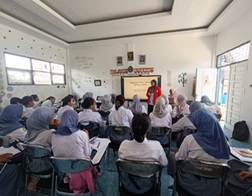
One of the most prominent issues among adolescents is reproductive health. This is closely related to biological changes and the maturation of reproductive organs, as well as preparing adolescents for the next stage of development, namely reproduction. One strategy with the potential to have a significant impact is the promotion of health among adolescent girls, which includes health education and health screening. This community service activity was implemented using a persuasive and educational approach, including reproductive health education through booklet media, peer group discussions, and health examinations involving 30 adolescent girls. The results showed an increase in knowledge among adolescent girls, as indicated by an improvement in the average knowledge score from 56.33 before the intervention to 88.67 after the intervention. This finding indicates that reproductive health education delivered through booklet media and peer group discussions is effective in improving adolescent girls’ understanding of adolescent reproductive health. Furthermore, the results of the health examination revealed that although most participants were not anemic and had normal nutritional status, some still experienced mild to moderate anemia. In addition, variations in body mass index were identified, including underweight, overweight, and obesity, as well as a risk of chronic energy deficiency (CED) among some participants. These findings indicate that nutritional problems and anemia among adolescent girls remain a concern and require continuous prevention and management efforts. Therefore, integrating health education and adolescent health services in schools is expected to be an effective, sustainable intervention model for improving the health status of adolescent girls.
Downloads
Article Details

This work is licensed under a Creative Commons Attribution-ShareAlike 4.0 International License.
Authors who publish with this journal agree to the following terms:
- Any article on the copyright is retained by the author(s).
- Author grant the journal, right of first publication with the work simultaneously licensed under a Creative Commons Attribution License that allows others to share work with acknowledgment of the work authors and initial publications in this journal.
- Authors are able to enter into a separate, additional contractual arrangements for non-exclusive distribution of published articles of work (eg, post-institutional repository) or publish it in a book, with acknowledgment of its initial publication in this journal.
- Authors are permitted and encouraged to post their work online (e.g., in institutional repositories or on their websites) prior to and during the submission process, as can lead to productive exchanges, as well as earlier and greater citation of published work.
- The article and any associated published material is distributed under the Creative Commons Attribution-ShareAlike 4.0 International License
References
Amalia Utami, E., Eni Lestari, N., & Herliana, I. (2024). Pengaruh Kombinasi Metode Ceramah Dan Diskusi Peer Group Terhadap Pengetahuan Dan Sikap Tentang Personal Hygiene Saat Menstruasi Dalam Pencegahan Pruritus Vulvae Pada Remaja Putri. Jurnal Kesehatan Dan Kedokteran, 1(2), 12–26. https://doi.org/10.62383/vimed.v1i2.68
Arisani, G., & Wahyuni, S. (2022). Pendidikan Kesehatan Remaja : Pertumbuhan dan Perkembangan Remaja. Poltekkes Kemenkes Palangka Raya. http://repo.polkesraya.ac.id/2628/
Başar, F., Yavuz, B., & Sağlam, H. Y. (2021). Evaluation of the effectiveness of reproductive health education program given to adolescents. Journal of Pediatric Research, 8(4), 469–478. https://doi.org/10.4274/jpr.galenos.2021.99266
BKKBN. (2013). Bimbingan Teknis Kesehatan Reproduksi dan Seksual yang Komprehensif. In UNESCO Office (pp. 1–62). https://unesdoc.unesco.org/ark:/48223/pf0000229599
Direktorat Bina Kesehatan Anak, K. R. (2016). Modul Pelatihan PKPR Bagi Konselor Sebaya. Direktorat Bina Kesehatan Anak Kemenkes RI.
Fitraniar, I. (2025). The effectiveness of educational media in preventing anemia among adolescent girls. In Science Midwifery (Vol. 13, Number 2). Online. www.midwifery.iocspublisher.orgJournalhomepage:www.midwifery.iocspublisher.org
Irawati, H., Kartini, A., Achadi Nugraheni, S., Dinas Kesehatan Provinsi Jawa Tengah, S., & Kesehatan Masyarakat, F. (2019). Pengaruh Booklet terhadap Pengetahuan dan Sikap Kesehatan Reproduksi Calon Pengantin terkait Pencegahan Risiko Kehamilan di Kabupaten Pemalang. Manajemen Kesehatan Indonesia, 7. https://ejournal.undip.ac.id/index.php/jmki/article/view/21816/15725
Kemenkes. (2018). Petunjuk Teknis Promosi Kesehatan di Fasilitas Pelayanan Kesehatan . Direktorat Promosi Kesehatan dan Pemberdayaan Masyarakat. https://peraturan.bpk.go.id/Download/131015/Permenkes%20Nomor%2044%20Tahun%202018.pdf
Kemenkes RI. (2015). Infodatin : Situasi Kesehatan Reproduksi Remaja. https://pusdatin.kemkes.go.id/article/view/15090700003/situasi-kesehatan-reproduksi-remaja.html
Kemenkes RI. (2018). Survei Demografi dan Kesehatan Indonesia: Kesehatan Reproduksi Remaja.
Kemenkes RI. (2021). Modul Kesehatan Reproduksi Remaja Luar Sekolah. Direktorat Jenderal Kesehatan Masyarakat Kementerian Kesehatan. https://repository.kemkes.go.id/book/877
Landry, M., Turner, M., Vyas, A., & Wood, S. (2017). Social media and sexual behavior among adolescents: Is there a link? JMIR Public Health and Surveillance, 3(2). https://doi.org/10.2196/publichealth.7149
Meilani, N., Hariadi, S. S., & Haryadi, F. T. (2025). Adolescent Reproductive Health Promotion for Senior High School Students. Kesmas: Jurnal Kesehatan Masyarakat Nasional, 20(1). https://doi.org/10.7454/kesmas.v20i1.2007
Mumtaz Anjaya, A., Dwi Alyani, A., Nugrahani, N., Athalia Fakhrunnisa, R., Kharin Herbawani Program Studi Kesehatan Masyarakat Program Sarjana, C., Ilmu Kesehatan, F., & Pembangunan Nasional Veteran Jakarta, U. (2024). Efektivitas Metode Pendidikan Kesehatan terhadap Kesadaran dan Kepatuhan Konsumsi Tablet Tambah Darah pada Remaja Putri Effectiveness of Health Education Methods on Awareness and Compliance of Iron Tablet Consumption in Adolescent Girls. Miracle Journal of Public Health (MJPH), 7(2). https://doi.org/10.36566/mjph/Vol7.Iss2/371
Nurmadinisia, R., & Susilawati. (2025). Effectiveness of the Peer Educator Model in Improving Hemoglobin Level among Adolescent Girls in Depok City. Jurnal Kesehatan Reproduksi, 16(1), 56–64. https://doi.org/10.58185/jkr.v16i1.390
Nutbeam, D., & Lloyd, J. E. (2021). Understanding and Responding to Health Literacy as a Social Determinant of Health. Annu. Rev. Public Health, 42, 2020. https://doi.org/10.1146/annurev-publhealth
Paladine, H. L., Ekanadham, H., & Diaz, D. C. (2021). Health Maintenance for Women of Reproductive Age (Vol. 103, Number 4). www.aafp.org/afpAdditionalcontentathttps://www.aafp.org/afp/2021/0215/p209.html.
Pane, D. N., Fikri, M. EL, & Ritonga, H. M. (2018). Psikologi Remaja dan Permasalahannya. Journal of Chemical Information and Modeling, 53(9), 1689–1699. https://doi.org/10.33853/istighna.v1i1.20
Weobong, B., Glozah, F. N., Taylor-Abdulai, H. B., Koka, E., Addae, N., Alor, S., Kohl, K., Banati, P., Adongo, P. B., & Ross, D. A. (2024). Reaching adolescents with health services: Systematic development of an adolescent health check-ups and wellbeing programme in Ghana (Y-Check, Ghana). PLoS ONE, 19(8). https://doi.org/10.1371/journal.pone.0304465
WHO. (2023). Sexual Reproductive Health. https://www.who.int/southeastasia/activities/adolescent-sexual-reproduc
WHO. (2025). Adolescent Health. https://www.who.int/health-topics/adolescent-health#tab=tab_1
Wierenga, L. M., Bos, M. G. N., Schreuders, E., vd Kamp, F., Peper, J. S., Tamnes, C. K., & Crone, E. A. (2018). Unraveling age, puberty and testosterone effects on subcortical brain development across adolescence. Psychoneuroendocrinology, 91, 105–114. https://doi.org/10.1016/j.psyneuen.2018.02.034