Pelatihan Keselamatan dan Kesehatan Kerja Pekerja Konstruksi di Kabupaten Tapin Occupational Safety and Health Training for Construction Workers in Tapin Regency
Article Sidebar
Main Article Content
Abstract
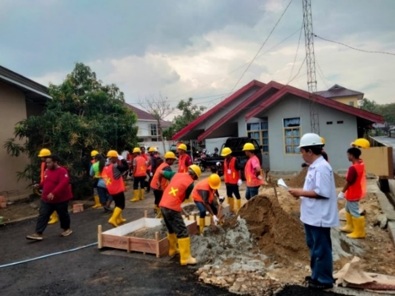
The construction sector has a high risk of workplace accidents, particularly on small- and medium-scale projects in the regions, due to workers' low understanding of Occupational Safety and Health (OHS) and minimal use of personal protective equipment. This situation also occurs in Tapin Regency, where the majority of construction workers have never received formal training, potentially increasing the number of workplace accidents. This activity aims to improve workers' knowledge, skills, and awareness of applying OHS principles through a structured, practical training program. The implementation method uses an educational, participatory, and applicable approach, consisting of preparation, implementation, and evaluation stages. The activity includes counseling on basic OHS material, practical use of personal protective equipment, and work safety simulations. Pre- and post-tests are used to evaluate participants' skill improvement. The results of the activity show a significant increase in participants' abilities, with the skilled category increasing from 12.5% to 67.5%, while the unskilled category decreased from 62.5% to 10%. Furthermore, changes in attitudes and behaviors have occurred, including increased awareness of PPE use, increased work caution, and the development of a culture of mutual reminders among workers. This program has proven effective in improving construction workers' competence and reducing the risk of workplace accidents. Therefore, practice-based OHS training can serve as a sustainable model for community empowerment and can be replicated in other areas to support the creation of a safe and productive construction work environment.
Downloads
Article Details

This work is licensed under a Creative Commons Attribution-ShareAlike 4.0 International License.
Authors who publish with this journal agree to the following terms:
- Any article on the copyright is retained by the author(s).
- Author grant the journal, right of first publication with the work simultaneously licensed under a Creative Commons Attribution License that allows others to share work with acknowledgment of the work authors and initial publications in this journal.
- Authors are able to enter into a separate, additional contractual arrangements for non-exclusive distribution of published articles of work (eg, post-institutional repository) or publish it in a book, with acknowledgment of its initial publication in this journal.
- Authors are permitted and encouraged to post their work online (e.g., in institutional repositories or on their websites) prior to and during the submission process, as can lead to productive exchanges, as well as earlier and greater citation of published work.
- The article and any associated published material is distributed under the Creative Commons Attribution-ShareAlike 4.0 International License
References
Daeli, B., Rahman, D. F., Fatimah, Z. N., & Rahmat, H. K. (2025). Kecelakaan kerja dan urgensi kesehatan dan keselamatan kerja dalam dunia industri: Sebuah tinjauan teoritis. Widya Bhakti: Jurnal Penelitian dan Pemberdayaan Masyarakat, 1(1), 29–40. journals.hakhara-institute.com
Edigan, F., Sari, L. R. P., & Amalia, R. (2019). Hubungan antara perilaku keselamatan kerja terhadap penggunaan alat pelindung diri (APD) pada karyawan PT Surya Agrolika Reksa di Sei Basau. Jurnal Saintis, 19(2), 61–70. https://doi.org/10.25299/saintis.2019.vol19(02).3741 journal.uir.ac.id
Julia, D., Martini, D., Alwan, Herdiani, N., & Wardani, D. P. (2026). Edukasi partisipatif K3 pada pabrik kerupuk di Tasikmalaya untuk meningkatkan pengetahuan dan praktik keselamatan kerja. Catimore: Jurnal Pengabdian kepada Masyarakat, 5(1), 91–103. https://doi.org/10.56921/cpkm.v5i1.379 Catimore: Jurnal Pengabdian Kepada Masyarakat
Lubab, L., & Nurdiana, I. M. (2026). Keselamatan kesehatan kerja (K3) pada konstruksi: Teori, analisis risiko, toksikologi, dan implementasi sistem pengendalian. Tren Digital Publishing.
Malaiholo, D., Prihartanto, R., Puruhita, H. W., & Wicaksono, R. (2023). Sosialisasi pengetahuan keselamatan dan kesehatan kerja (K3) prasarana perkeretaapian kepada siswa SMK Negeri 1 Kota Madiun. Jurnal Pengabdian Multidisiplin, 3(2), Article 2. https://doi.org/10.51214/japamul.v3i2.614
Panjili, M. R., Arrasul, A. R., Pratiwi, N. I., Molumu, R., Yambon, M. R., & Aminullah, M. A. (2026). Edukasi keselamatan dan kesehatan kerja (K3) bagi masyarakat Desa Tombang dalam meningkatkan kesadaran kerja aman. JESASI (Jurnal Edukasi, Sains, dan Inovasi), 3(1), 21–27. https://doi.org/10.66225/jesasi.v3i1.32 JESASI (JURNAL EDUKASI, SAINS, DAN INOVASI)
Sari, I. Y. (2024). Analisis penyebab kecelakaan kerja pada pekerja konstruksi. Journal of Industrial Hygiene and Occupational Health, 9(1), 22–30. https://doi.org/10.21111/jihoh.v9i1.11185 Garba Rujukan Digital
Subekti, A. T., Rudyarti, E., & Atmoko, D. (2025). Keselamatan dan kesehatan kerja pada UMKM sektor konstruksi. CV Eureka Media Aksara. sinta.kemdiktisaintek.go.id
Surur, H., & Suprihatin, H. (2025). Faktor yang memengaruhi terjadinya kecelakaan kerja pada proyek konstruksi: Klasifikasi faktor penyebab (framework 3M). J-Sipil: Jurnal Teknologi dan Ilmiah Teknik Sipil dan Sains, 2(2), 1–8. https://journal.univgresik.ac.id/index.php/j-sipil/article/view/472 journal.univgresik.ac.id
Yani, A. (2025). Efektivitas pelatihan keselamatan kerja di konstruksi dan peran manajemen dalam meningkatkan kepatuhan K3: Literatur review. Jurnal Ilmiah Ekonomi Manajemen & Bisnis, 3(1), 8–17. https://doi.org/10.60023/w9xcbn62 Jurnal Ilmiah Ekonomi Manajemen & Bisnis