Penguatan Pengetahun Gizi Ibu melalui Edukasi MP-ASI pada 1000 Hari Pertama Kehidupan Improving Maternal Nutrition Knowledge through MP-ASI Education in the First 1,000 Days of Life
Article Sidebar
Main Article Content
Abstract
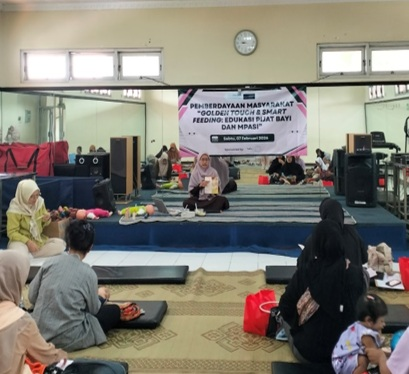
Stunting remains a major public health problem affecting human resource quality, one of the causes of which is suboptimal complementary feeding practices. This community empowerment activity aimed to improve the knowledge of mothers of infants aged 0–12 months regarding complementary feeding as an effort to prevent stunting. The method used was health education through interactive lectures, distribution of leaflets, and food texture demonstration tools, accompanied by pretest and posttest evaluation. The activity involved 20 mothers who had been previously registered. The results showed an increase in the average knowledge score from 7.6 in the pretest to 8.8 in the posttest. This improvement indicates that the education provided effectively enhanced mothers' understanding, particularly regarding the timing of feeding, age-appropriate food texture, and nutritional adequacy. Overall, this community empowerment activity contributed to improving maternal knowledge and has the potential to support appropriate feeding practices to prevent stunting sustainably. It is recommended that community empowerment activities be conducted in a sustainable, integrated manner to expand the reach of complementary feeding (MP-ASI) education to a broader population of mothers of young children.
Downloads
Article Details

This work is licensed under a Creative Commons Attribution-ShareAlike 4.0 International License.
Authors who publish with this journal agree to the following terms:
- Any article on the copyright is retained by the author(s).
- Author grant the journal, right of first publication with the work simultaneously licensed under a Creative Commons Attribution License that allows others to share work with acknowledgment of the work authors and initial publications in this journal.
- Authors are able to enter into a separate, additional contractual arrangements for non-exclusive distribution of published articles of work (eg, post-institutional repository) or publish it in a book, with acknowledgment of its initial publication in this journal.
- Authors are permitted and encouraged to post their work online (e.g., in institutional repositories or on their websites) prior to and during the submission process, as can lead to productive exchanges, as well as earlier and greater citation of published work.
- The article and any associated published material is distributed under the Creative Commons Attribution-ShareAlike 4.0 International License
References
Alliyah, P. A., Rizqiya, F., Hanifah, H., Zafirah, N., Hayati, R., & Fida, Z. S. (2024). Edukasi makanan pendamping ASI tepat untuk cegah stunting pada balita. Jurnal Abdimas Kedokteran dan Kesehatan, 2(1), 6–12. https://doi.org/10.24853/jaras.2.1.6-12
Angreni, W. O. N., Rahagia, R., Setyawati, A., Kamaruddin, M. I., & Suprapto, S. (2024). Partisipasi masyarakat dalam hidup bersih dan sehat sebagai upaya peningkatan kualitas kesehatan. Abdimas Polsaka, 3(1), 1–6. https://doi.org/10.35816/abdimaspolsaka.v3i1.60
Asmi, A. S., Tyarini, I. A., Saputra, M. K. F., Putra, J. A., & Son, H. K. (2024). Video media is more effective to improve balanced nutrition knowledge. Jurnal Ilmiah Kesehatan Sandi Husada, 13(2), 242–249. https://doi.org/10.35816/jiskh.v13i2.1210
Aurelia, Y. (2024). 1000 HPK kunci cegah stunting. Ayo Sehat Kementerian Kesehatan Republik Indonesia. https://ayosehat.kemkes.go.id/1000-hpk-kunci-cegah-stunting
Badan Kebijakan Pembangunan Kesehatan. (2024). Survei Kesehatan Indonesia (SKI) 2023 dalam angka. Kementerian Kesehatan Republik Indonesia. https://www.badankebijakan.kemkes.go.id/repositori/id/eprint/5539/
Das, S., Sanchez, J. J., Alam, A., Haque, M. A., Mahfuz, M., Ahmed, T., & Long, K. Z. (2020). Dietary magnesium, vitamin D, and animal protein intake and their association to the linear growth trajectory of children from birth to 24 months of age: Results from MAL-ED birth cohort study conducted in Dhaka, Bangladesh. Food and Nutrition Bulletin, 41(2), 200–210. https://doi.org/10.1177/0379572119892408
Kementerian Kesehatan Republik Indonesia. (2021). Buku saku hasil Studi Status Gizi Indonesia (SSGI) tahun 2021. https://www.badankebijakan.kemkes.go.id/buku-saku-hasil-studi-status-gizi-indonesia-ssgi-tahun-2021/
Kurniawan, E., Setiawan, A. B., Al-Hanif, E. T., Amidi, Mu’arifuddin, Sumardiana, B., Amin, S., & Yuwono, C. (2022). Buku panduan UNNES GIAT penanganan stunting. LPPM Universitas Negeri Semarang.
Laksono, A. D., Wulandari, R. D., & Amaliah, N. (2022). Stunting among children under two years in Indonesia: Does maternal education matter? PLOS ONE, 17(7), e0271509. https://doi.org/10.1371/journal.pone.0271509
Putri, M. E. M., Aprillia, N. A., Muzayyan, M. R., Gozali, I., & Hady, A. F. (2026). Pemberian MP-ASI pada usia dini menyebabkan risiko. [Nama jurnal belum dicantumkan], 4(1), 584–592.
Putri, N. R., Septiana, Y. C., Larasati, D., Dharmawan, C., & Amalia, R. (2024). Edukasi MPASI pada ibu bayi usia 0–1 tahun sebagai upaya persiapan dan peningkatan berat badan bayi sesuai dengan kurva pertumbuhan. JMM (Jurnal Masyarakat Mandiri), 8(1), 1124–1132. https://doi.org/10.31764/jmm.v8i1.20632
Thaifur, A. Y. B. R. (2024). Studi perubahan perilaku: Literature review. Jurnal Kolaboratif Sains, 7(1), 349–358. https://doi.org/10.56338/jks.v7i1.4878
Yadika, A. D. N., Berawi, K. N., & Nasution, S. H. (2019). Pengaruh stunting terhadap perkembangan kognitif dan prestasi belajar. Jurnal Majority, 8(2), 273–282.