Penguraian Sampah Organik di Bank Sampah Dharma Bakti melalui Budidaya Maggot Black Soldier Fly Decomposing Organic Waste at the Dharma Bakti Waste Bank through Cultivating Black Soldier Fly Maggots
Article Sidebar
Main Article Content
Abstract
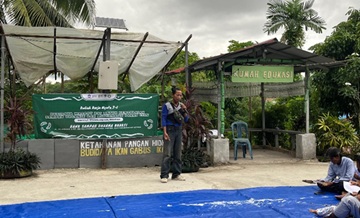
The Dharma Bakti Waste Bank in RT. 55, Muara Rapak Subdistrict, is one of the waste banks that remains active in managing community waste. However, the utilization of organic waste is still limited to compost production, while alternative management methods, such as Black Soldier Fly (BSF) maggot cultivation, have not been optimized. This community service program aims to enhance the utilization of organic waste through BSF maggot cultivation as an alternative feed for livestock, particularly catfish, which are already being farmed by residents. The method used in this program began with an awareness session on the benefits of maggot cultivation, followed by the construction of BSF fly cages, as well as hands-on training and practice on cultivation techniques for residents. The evaluation was conducted by measuring the increase in residents’ understanding before and after the training, along with a community satisfaction survey regarding the activities carried out. The results indicate a 17.98% increase in residents' understanding of BSF maggot cultivation, reflecting the effectiveness of the education and training provided. Additionally, the community satisfaction survey showed that 90% of residents were very satisfied, while the remaining 10% were satisfied. This initiative concludes that, in addition to providing valuable learning experiences for residents, it also empowers them in maggot cultivation through education and training, enabling better optimization of organic waste processing into economically valuable resources.
Downloads
Article Details

This work is licensed under a Creative Commons Attribution-ShareAlike 4.0 International License.
Authors who publish with this journal agree to the following terms:
- Any article on the copyright is retained by the author(s).
- Author grant the journal, right of first publication with the work simultaneously licensed under a Creative Commons Attribution License that allows others to share work with acknowledgment of the work authors and initial publications in this journal.
- Authors are able to enter into a separate, additional contractual arrangements for non-exclusive distribution of published articles of work (eg, post-institutional repository) or publish it in a book, with acknowledgment of its initial publication in this journal.
- Authors are permitted and encouraged to post their work online (e.g., in institutional repositories or on their websites) prior to and during the submission process, as can lead to productive exchanges, as well as earlier and greater citation of published work.
- The article and any associated published material is distributed under the Creative Commons Attribution-ShareAlike 4.0 International License
References
Kementerian Lingkungan Hidup dan Kehutanan. (2020). Siaran pers KLHK: Indonesia memasuki era baru pengelolaan sampah . Diakses dari https://ppid.menlhk.go.id/siaran_pers/browse/2329
Čičková, H., Newton, G. L., Lacy, R. C., & Kozánek, M. (2015). The use of fly larvae for organic waste treatment. Waste Management, 35, 68–80. https://doi.org/10.1016/j.wasman.2014.09.026
Fauzi, R. U. A., & Sari, E. R. N. (2018). Business analysis of maggot cultivation as a catfish feed alternative. Industria: Jurnal Teknologi dan Manajemen Agroindustri, 7(1), 39–46. https://doi.org/10.21776/ub.industria.2018.007.01.5
Gesriantuti, N., Elsie, E., Harahap, I., Herlina, N., & Badrun, Y. (2017). Pemanfaatan limbah organik rumah tangga dalam pembuatan pupuk bokashi di Kelurahan Tuah Karya, Kecamatan Tampan, Pekanbaru. Jurnal Pengabdian UntukMu NegeRI, 1(1), 72–77. https://doi.org/10.37859/jpumri.v1i1.39
Harlim, I., Ichsan, M. H. H., & Setiawan, E. (2022). Implementasi fuzzy logic Mamdani pada sistem monitoring dan kontrol kandang maggot BSF. Jurnal Pengembangan Teknologi Informasi dan Ilmu Komputer, 6(6), 2687–2695.
Makmur, M., Kusnoputranto, H., Moersidik, S. S., & Wisnubroto, D. S. (2012). Pengaruh limbah organik dan rasio N/P terhadap kelimpahan fitoplankton di kawasan budidaya kerang hijau Cilincing. Jurnal Teknologi Pengelolaan Limbah, 15(2), 51–64.
Masrufah, A., Afkar, K., Fawaid, A. S., Alvarizi, D. W., Khoiriyah, L., Khoiriyah, M., Kafi, M. A., Faradilla, R. S., Amsah, R., Hidayah, N. N., Salsabella, A., Nazwa, D. A. R., Fadila, S. N., Sari, U. E. K., Naim, F. I., Itsnaini, S. N. R., & Ramadhan, M. N. (2020). Budidaya maggot BSF (Black Soldier Fly) sebagai pakan alternatif ikan lele (Clarias batrachus) di Desa Candipari, Sidoarjo pada program holistik pembinaan dan pemberdayaan desa (PHP2D). Journal of Science and Social Development, 3(2), 10–16. https://doi.org/10.55732/jossd.v3i2.383
Ningrum, W. A., Khatimah, H., & Putra, P. (2022). Pengelolaan sampah organik menjadi pupuk kompos. An‑Nizam, 1(2), 20–28. https://doi.org/10.33558/an-nizam.v1i2.4167
Radhica, D. D., Aziz Rifa’i, A., Yasir Abdad, M., & Ulfatun Nisa, T. (2022). Budidaya maggot guna mengatasi permasalahan sampah organik dalam rangka peningkatan ekonomi produktif Dusun Gandekan melalui program holistik pembinaan dan pemberdayaan desa (PHP2D). MARTABE: Jurnal Pengabdian Masyarakat, 5(2), 726–732.
Wallady, A. A., Rahardja, B. S., & Kenconojati, H. (2022). Dietary combination of maggot and commercial feed enhance the growth rate and feed conversion ratio of snakehead fish (Channa striata). IOP Conference Series: Earth and Environmental Science, 1036(1), Article 012085. https://doi.org/10.1088/1755-1315/1036/1/012085