Peningkatan Produksi Olahan Daun Kelor Organik melalui Teknologi Budidaya Kelor secara organik di Kecamatan Kinovaro Kabupaten Sigi Sulawesi Tengah Increasing the Production of Organic Moringa Leaf Processes through Organic Moringa Cultivation Technology in Kinovaro District, Sigi Regency, Central Sulawesi
Article Sidebar
Main Article Content
Abstract
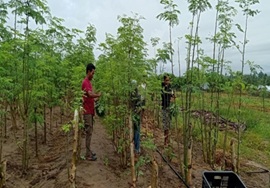
Moringa plants have high ethnobotanical value for the Kaili tribe in Porame village, Kinovaro district, Sigi Regency, Central Sulawesi. In this village, some MSMEs focus on producing organic moringa leaf products. However currently facing some problems, for example; the production of organic moringa leaves is still low both in terms of quality and quantity, and availability of raw materials for organic moringa leaves is still lacking due to the absence of moringa cultivation. Therefore, the empowerment program aims to find solutions to solve that problem. The approach method used in the form of education and training for partners by using counseling, training, and assistance methods in the form of technical guidance and community development in the production process of moringa leaves and their cultivation from seed to harvest, as well as the manufacture of organic fertilizers made from livestock manure. The results of the program that have been carried out are that there are organic moringa plantations covering an area of 0.5 Ha, products of organic moringa flour, etc, 20 sacks of organic fertilizers, and increasing in the knowledge and skills of farmer group members, especially in terms of organic moringa cultivation, post-harvest handling and diversification of its products.
Downloads
Article Details

This work is licensed under a Creative Commons Attribution-ShareAlike 4.0 International License.
Authors who publish with this journal agree to the following terms:
- Any article on the copyright is retained by the author(s).
- Author grant the journal, right of first publication with the work simultaneously licensed under a Creative Commons Attribution License that allows others to share work with acknowledgment of the work authors and initial publications in this journal.
- Authors are able to enter into a separate, additional contractual arrangements for non-exclusive distribution of published articles of work (eg, post-institutional repository) or publish it in a book, with acknowledgment of its initial publication in this journal.
- Authors are permitted and encouraged to post their work online (e.g., in institutional repositories or on their websites) prior to and during the submission process, as can lead to productive exchanges, as well as earlier and greater citation of published work.
- The article and any associated published material is distributed under the Creative Commons Attribution-ShareAlike 4.0 International License
References
Akbar, C. T., Suketi, K., & Kartika, J. G. (2019). Panen dan pascapanen kelor (Moringa oleifera Lam.) organik di kebun organik Kelorina, Blora, Jawa Tengah. Buletin Agrohorti, 7(3), 247–254. https://doi.org/10.29244/agrob.v7i3.30171
Angelina, C., Swasti, Y. R., & Pranata, F. S. (2021). Peningkatan nilai gizi produk pangan dengan penambahan bubuk daun kelor (Moringa oleifera): Review. Jurnal Agroteknologi, 15(1), 79–93. https://doi.org/10.19184/j-agt.v15i01.22089
Badan Pusat Statistik. (2019). Kecamatan Kinovaro dalam angka 2019. Badan Pusat Statistik Kabupaten Sigi.
Badan Pusat Statistik. (2021). Kecamatan Kinovaro dalam angka 2021. Badan Pusat Statistik Kabupaten Sigi.
Fitriah, A., Harmayani, R., Jamili, A., Mariani, Y., Kartika, N. M. A., & Isyaturriyadhah. (2021). Pengolahan limbah kotoran sapi menjadi pupuk organik di Desa Batu Kuta Lombok Barat. Jurnal Pengabdian KITA, 4(2), 22–28. https://doi.org/10.32938/jpk.v4i2.1637
Habibah, Wahdah, R., & Safitri, N. (2023). Pembinaan IKM Maju Bersama Desa Liang Anggang dalam meningkatkan variasi dan kualitas produk berbahan daun kelor. PengabdianMu: Jurnal Ilmiah Pengabdian kepada Masyarakat, 8(2), 239–247. https://doi.org/10.33084/pengabdianmu.v8i2.4318
Hubeis, A. V. S. (1996). Mendinamisasikan partisipasi kelompok tani nelayan dalam revitalisasi penyuluhan pertanian. Majalah Penyuluhan Pertanian Ekstensia, 4(3), 41–52.
Khasanah, V., & Astuti, P. (2019). Pengaruh penambahan ekstrak daun kelor (Moringa oleifera) terhadap kualitas inderawi dan kandungan protein mie basah substitusi tepung mocaf. Jurnal Kompetensi Teknik, 11(2), 15–21. https://doi.org/10.15294/jkomtek.v11i2.22499
Krisnadi, A. D. (2015). Kelor super nutrisi. Pusat Informasi dan Pengembangan Tanaman Kelor Indonesia & LSM Media Peduli Lingkungan (MEPELING).
Luthfiah, F. (2012). Potensi gizi daun kelor (Moringa oleifera) Nusa Tenggara Barat. Jurnal Media Bina Ilmiah, 6(2), 42–50.
Marhaeni, L. S. (2021). Daun kelor (Moringa oleifera) sebagai sumber pangan fungsional dan antioksidan. Jurnal Agrisia, 13(2), 40–53.
Pemerintah Desa Porame. (2016). Profil Desa Porame. Pemerintah Desa se-Kabupaten Sigi.
Purba, E. C. (2020). Kelor (Moringa oleifera Lam.): Pemanfaatan dan bioaktivitas. Jurnal Pro-Life, 7(1), 1–12. https://doi.org/10.33541/jpvol6Iss2pp102
Rani, K. C., Ekajayani, N. I., Darmasetyawan, N. K., & Dewi, A. D. R. (2019). Modul pelatihan kandungan nutrisi kelor (51 hal.). Fakultas Farmasi, Universitas Surabaya.
Sutrisno, E., & Priyambada, I. K. (2019). Pembuatan pupuk kompos padat limbah kotoran sapi dengan metode fermentasi menggunakan bioaktivator starbio di Desa Ujung-Ujung Kecamatan Pabelan Kabupaten Semarang. Jurnal Pasopati, 1(2), 76–79.
Trisnawati, Y., & Mutaqien, I. (2021). Berjuta manfaat kelor. Kementerian Pertanian Republik Indonesia, Pusat Perpustakaan dan Penyebaran Teknologi Pertanian.