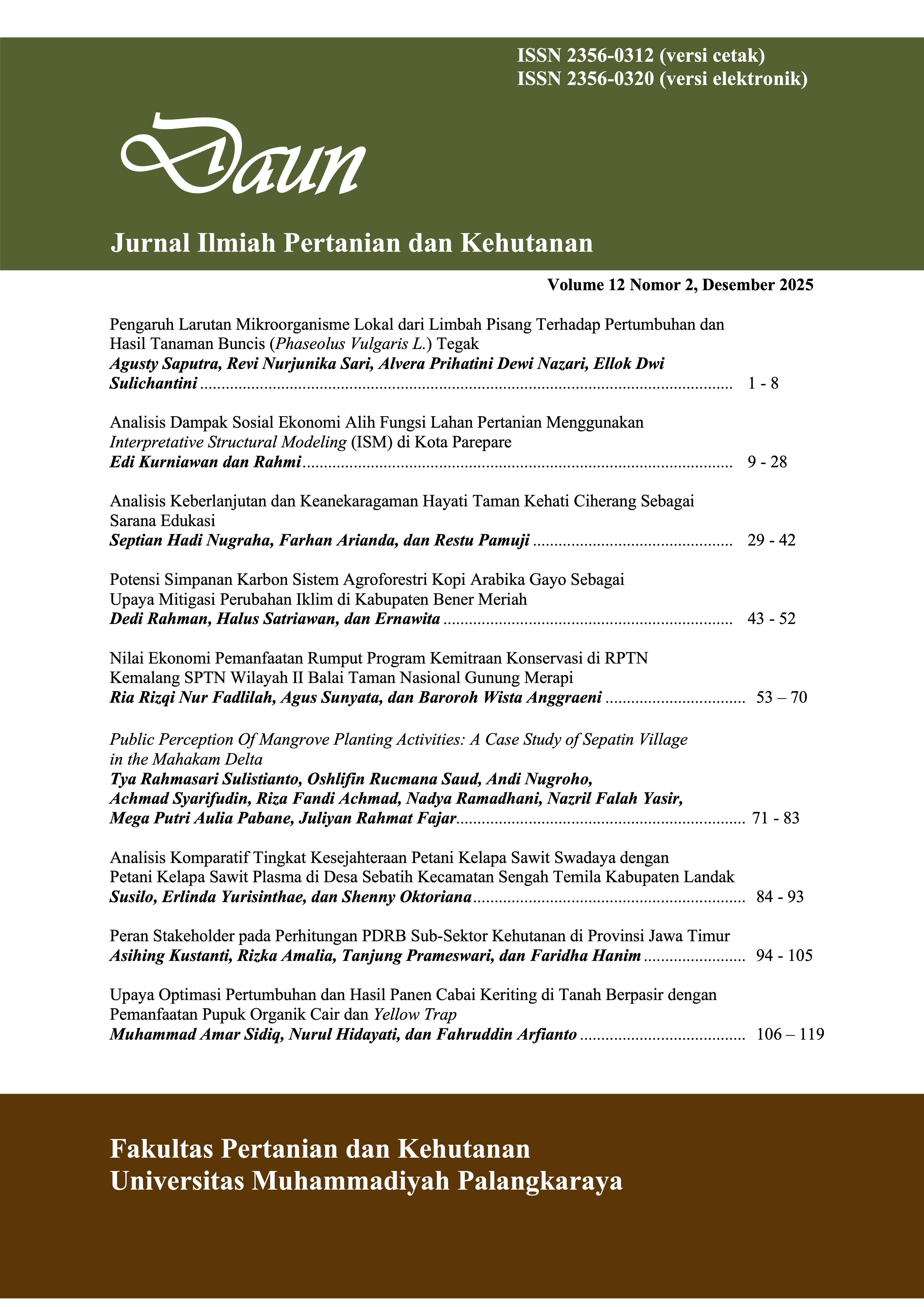
Analisis Dampak Sosial Ekonomi Alih Fungsi Lahan Pertanian Menggunakan Interpretative Structural Modeling (ISM) di Kota Parepare
Article Sidebar
Main Article Content
Abstract
The continuous conversion of agricultural land into non-agricultural uses in Parepare City has
substantially reduced productive farmland and generated various socio-economic impacts on local communities. This phenomenon is a critical issue as it threatens local food security, alters employment structures, and affects household welfare, particularly among farmers. This study aims to: (1) analyze land-use changes resulting from agricultural land conversion, (2) identify the economic impacts arising from the conversion, (3) examine its effects on the community’s economic structure, and (4) explain the social consequences that emerge as a result of these changes. A qualitative descriptive approach was employed, supported by Interpretative Structural Modeling (ISM) to map the relationships and levels of influence among the affected socio-economic factors. The findings indicate that the most influential factors driving socio-economic change are access to infrastructure, natural resources, and education. Economically, land conversion has led to shifts in livelihoods, changes in income levels, and a decline in household purchasing power among farmers. Socially, community cooperation has weakened, and changes in social structures have become evident. In conclusion, agricultural land conversion has significant implications for the socio-economic conditions of communities in Parepare City. This study highlights the need for sustainable spatial planning policies, improved non-agricultural skills development, and strengthened economic and educational literacy to support community adaptation to ongoing land-use changes. The continuous conversion of agricultural land into non-agricultural uses in Parepare City has substantially reduced productive farmland and generated various socio-economic impacts on local communities. This phenomenon is a critical issue as it threatens local food security, alters employment structures, and affects household welfare, particularly among farmers. This study aims to: (1) analyze land-use changes resulting from agricultural land conversion, (2) identify the economic impacts arising from the conversion, (3) examine its effects on the community’s economic structure, and (4) explain the social consequences that emerge as a result of these changes. A qualitative descriptive approach was employed, supported by Interpretative Structural Modeling (ISM) to map the relationships and levels of influence among the affected socio-economic factors. The findings indicate that the most influential factors driving socio-economic change are access to infrastructure, natural resources, and education. Economically, land conversion has led to shifts in livelihoods, changes in income levels, and a decline in household purchasing power among farmers. Socially, community cooperation has weakened, and changes in social structures have become evident. In conclusion, agricultural land conversion has significant implications for the socio-economic conditions of communities in Parepare City. This study highlights the need for sustainable spatial planning policies, improved non-agricultural skills development, and strengthened economic and educational literacy to support community adaptation to ongoing land-use changes.
Downloads
Article Details

This work is licensed under a Creative Commons Attribution-ShareAlike 4.0 International License.
All rights reserved. This publication may be reproduced, stored in a retrieval system, or transmitted in any form or by any means, electronic, mechanical, photocopying, recording.
References
Abd Rahim et al. (2024) ‘Dampak Alih Fungsi Lahan Pertanian di Kawasan Objek Wisata Latimojong Terhadap Pendapatan Petani’, Jurnal Galung Tropika, 13(1), pp. 98–106. Available at: https://doi.org/10.31850/jgt.v13i1.1147.
Ahmad, N. and Qahmash, A. (2021) ‘SmartISM: Implementation and Assessment of Interpretive Structural Modeling’, Sustainability, 13(16), p. 8801. Available at: https://doi.org/10.3390/su13168801.
Arnowo, H. (2025) ‘Pola Pemberdayaan Masyarakat Melalui Kampung Reforma Agraria di Desa Mekarsari, Kecamatan Panimbang, Kabupaten Pandeglang’, Tunas Agraria, 8(1), pp. 113–128. Available at: https://doi.org/10.31292/jta.v8i1.408.
Beni Akhmad et al. (2024) ‘Optimalisasi Partisipasi Masyarakat Dalam Kegiatan Musyawarah Pembangunan di Kelurahan Telum Dalam’, Jurnal Pengabdian Eksplorasi Humaniora, 2(1). Available at: https://doi.org/10.20527/ekshum.v2i1.17.
Dea, R.G. (2024) ‘Faktor Perubahan Alih Fungsi Lahan Pertanian Akibat Pembangunan Kawasan Aerotropolis Kulon Progo dan Dampaknya Terhadap Tata Guna Lahan LP2B, Pemukiman dan Pariwisata’, Local Engineering, 2(2), pp. 49–58. Available at: https://doi.org/10.59810/lejlace.v2i2.115.
Desmawan, D. et al. (2024) ‘Dampak Pengalihan Fungsi Lahan Pertanian Menjadi Lahan Permukiman dan Industri Di Kawasan Kabupaten Bekasi’, Bursa : Jurnal Ekonomi dan Bisnis, 3(3), pp. 115–121. Available at: https://doi.org/10.59086/jeb.v3i3.572.
Halim, E.C., Andi, A. and Rahardjo, J. (2021) ‘Aplikasi Interpretive Structural Modeling (Ism) Pada Faktor-Faktor Penyebab Keterlambatan Proyek Konstruksi Di Surabaya’, Dimensi Utama Teknik Sipil, 8(1), pp. 60–77. Available at: https://doi.org/10.9744/duts.8.1.60-77.
Isma, L., Deli, A. and Safrida, S. (2022) ‘Pengaruh Ekspor Pertanian, Luas Areal Pertanian, Dan Upah Pertanian Terhadap Penyerapan Tenaga Kerja Di Provinsi Aceh’, Jurnal Ilmiah Mahasiswa Pertanian, 7(4), pp. 367–376. Available at: https://doi.org/10.17969/jimfp.v7i4.21954.
Karolinoerita, V. and Annisa, W. (2020) ‘Salinisasi Lahan dan Permasalahannya di Indonesia’, Jurnal Sumberdaya Lahan, 14(2), p. 91. Available at: https://doi.org/10.21082/jsdl.v14n2.2020.91-99.
Mambang, M. et al. (2022) ‘E-Padi Berbasis Android Untuk Meningkatkan Minat Generasi Muda Pada Sektor Pertanian’, Jurnal Nasional Komputasi dan Teknologi Informasi (JNKTI), 5(1), pp. 93–98. Available at: https://doi.org/10.32672/jnkti.v5i1.3968.
Mulyani, S., Fathani, A.T. and Purnomo, E.P. (2020) ‘Perlindungan Lahan Sawah Dalam Pencapaian Ketahanan Pangan Nasional’, Rona Teknik Pertanian, 13(2), pp. 29–41. Available at: https://doi.org/10.17969/rtp.v13i2.17173.
Pratiwi MK, Andi Nuddin and Iradhatullah Rahim (2024) ‘Perubahan Mata Pencaharian Petani sebagai Dampak Alih Fungsi Lahan Pertanian’, JURNAL GALUNG TROPIKA, 13(1), pp. 35–44. Available at: https://doi.org/10.31850/jgt.v13i1.1140.
Putri, I.D., Martanto, R. and Junarto, R. (2024) ‘Pengaruh Alih Fungsi Lahan Terhadap Ketahanan Pangan, Lingkungan, dan Keberlanjutan Pertanian di Kabupaten Sleman’, Widya Bhumi, 4(2), pp. 192–211. Available at: https://doi.org/10.31292/wb.v4i2.108.
Rahmadewi, R. and Kurniati, E. (2025) ‘Dampak Alih Fungsi Lahan Terhadap Pembangunan Daerah: Studi Kasus Di Kabupaten Kendal Riska’, Jurnal Ilmu Ekonomi (JIE), 4(1), pp. 298–322.
Rahman, N.M. (2022) ‘Perlindungan Hukum Bagi Kelompok Tani Dalam Hal Terjadi Alih Fungsi Lahan Pertanian Menjadi Lahan Non Pertanian’, Jurnal Hukum dan Kenotariatan, 6(2), pp. 1020–1034. Available at: https://doi.org/10.33474/hukeno.v6i2.16469.
Sani, F.F. and Asyiawati, Y. (2022) ‘Kajian Alih Fungsi Lahan Sawah Menjadi Kawasan Terbangun’, Bandung Conference Series: Urban & Regional Planning, 2(2), pp. 424–428. Available at: https://doi.org/10.29313/bcsurp.v2i2.3469.
Suandi, S. and Delis, A. (2020) ‘Analisis Investasi Dan Kontribusi Sektor Pertanian Terhadap Perekonomian Kabupaten Merangin Provinsi Jambi Dengan Menggunakan Pendekatan Icor’, JSEP (Journal of Social and Agricultural Economics), 13(2), p. 112. Available at: https://doi.org/10.19184/jsep.v13i2.15545.
Sudarso, P., Makkawaru, Z. and Tira, A. (2023) ‘Alih Fungsi Tanah Pertanian Menjadi Kawasan Pembangunan Perumahan Dalam Rangka Penataan Ruang Wilayah Kabupaten Gowa’, Indonesian Journal of Legality of Law, 6(1), pp. 65–73. Available at: https://doi.org/10.35965/ijlf.v6i1.3838.
Sugiharto, F. and Agustin, N. (2023) ‘Pengaruh Perubahan Lahan Pertanian Menjadi Non Pertanian Terhadap Aspek Sosial Ekonomi Masyarakat’, Jurnal Perencanaan dan Pengembangan Kebijakan, 3(2), p. 129. Available at: https://doi.org/10.35472/jppk.v3i2.950.
Syahrial, S., Yenti, M.N. and Dermawan, A. (2024) ‘PERKEMBANGAN DAN POLA PERTUMBUHAN SEKTOR PERTANIAN KABUPATEN TANAH DATAR PROVINSI SUMATERA BARAT’, Agricore: Jurnal Agribisnis dan Sosial Ekonomi Pertanian Unpad, 9(1), pp. 1–9. Available at: https://doi.org/10.24198/agricore.v9i1.45663.
Zulha, I.Z.N.A. (2019) ‘PENERAPAN TEKNOLOGI TEPAT GUNA Untuk Peningkatan Pemberdayaan Masyarakat Dan Lingkungan’, JMM (Jurnal Masyarakat Mandiri), 2(2), p. 118. Available at: https://doi.org/10.31764/jmm.v0i0.1354.