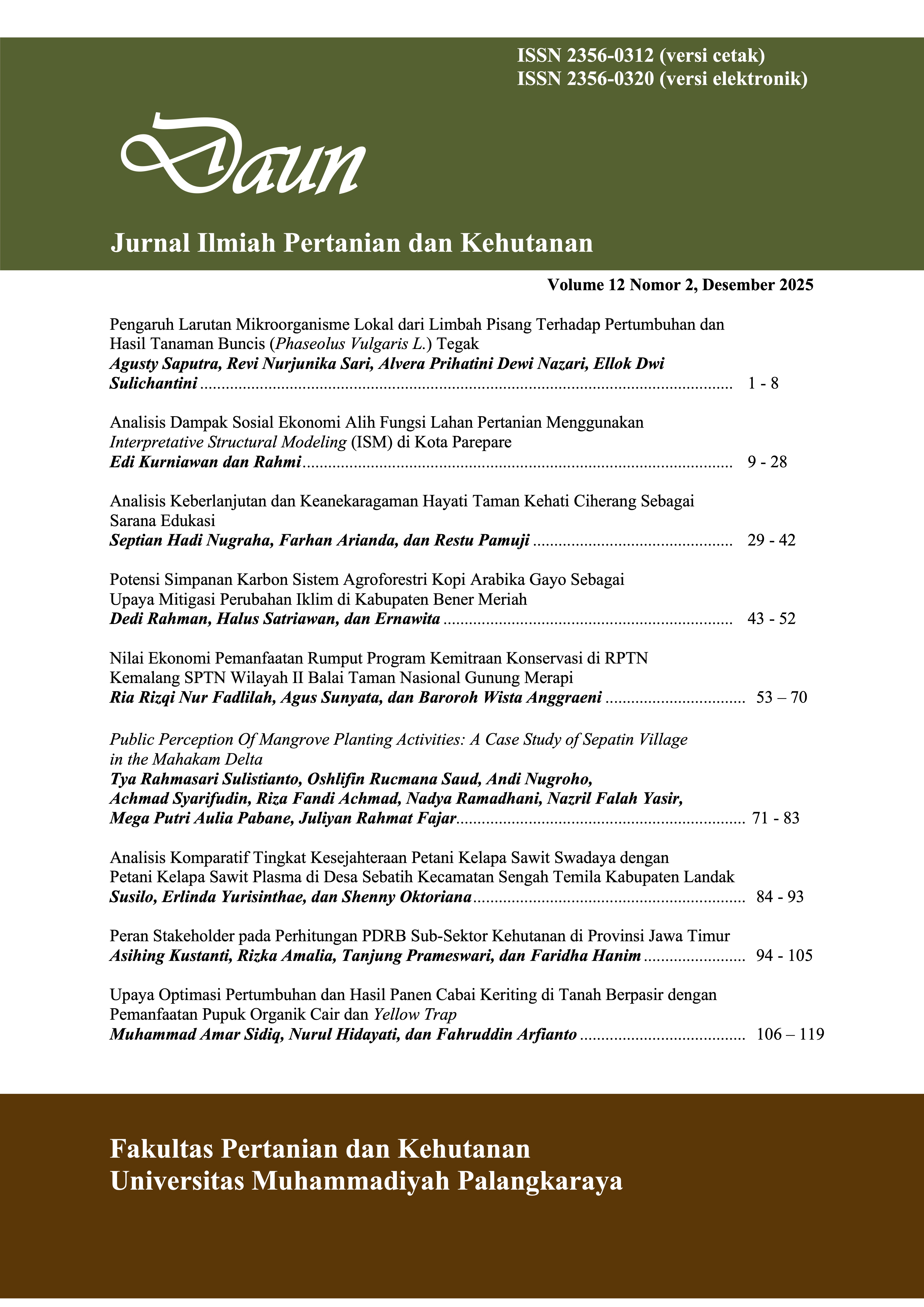
Potensi Simpanan Karbon Sistem Agroforestri Kopi Arabika Gayo Sebagai Upaya Mitigasi Perubahan Iklim di Kabupaten Bener Meriah
Article Sidebar
Main Article Content
Abstract
Climate change poses a growing threat to global coffee production, while agroforestry systems are increasingly recognized for their ecological and economic benefits, including their potential to enhance carbon sequestration. This study aimed to analyze the carbon stock of the Gayo coffee agroforestry system in Bener Meriah Regency. Field data were collected using a purposive sampling approach based on canopy density and accessibility, covering 16 plots measured between July and September 2024. Carbon estimation was conducted using the RaCSA method developed by ICRAF. The results show that Gayo coffee agroforestry represents a complex system with diverse plant species contributing to carbon storage. The highest carbon stock is recorded for Petai (Parkia speciosa) at 28.98 ton C/ha, while the lowest occurs in red chili (Capsicum annuum L.) at 0.034 ton C/ha. The total measured carbon stock reaches 2,115.072 ton C, with an average of 124.416 ton C/ha. These findings demonstrate that the Gayo coffee agroforestry system provides a substantial contribution to climate change mitigation through aboveground carbon storage. The study concludes that enhancing agroforestry-based coffee farming has ecological and economic benefits and strengthens opportunities for implementing low-carbon agricultural certification and social forestry programs. Future research may further explore belowground carbon and long-term carbon dynamics across different management intensities.
Downloads
Article Details

This work is licensed under a Creative Commons Attribution-ShareAlike 4.0 International License.
All rights reserved. This publication may be reproduced, stored in a retrieval system, or transmitted in any form or by any means, electronic, mechanical, photocopying, recording.
References
Adinugroho WC, Indrawan A, Supriyanto, Arifin HS. 2013. Kontribusi SistemAgroforestri terhadap Cadangan Karbon di Hulu DAS Kali Bekasi. Jurnal Hutan Tropis, 1(3): 242-249.
Avelino J, Cristancho M, Georgiou S, Imbach P, Aguilar L, Bornemann G, Läderach P, Anzueto F, Hruska AJ, Morales C. 2015. The coffee rust crises in Colombia and Central America (2008–2013): impacts, plausible causes and proposed solutions. Food Secur. 7(2). doi:10.1007/s12571-015-0446-9.
Birkenberg A, Birner R. 2018. The world’s first carbon neutral coffee: Lessons on certification and innovation from a pioneer case in Costa Rica. J. Clean.Prod. 189:485-501. doi: 10.1016/j.jclepro.2018.03.226.
Hameed, A., Hussain, S. A., & Suleria, H. A. R. 2020. “Coffee Bean-Related” agroecological factors affecting the coffee. Co-evolution of secondary metabolites, 641-705.
Hairiah K, Ekadinata A, Sari RR, Rahayu S. 2011. Pengukuran Cadangan Karbon: dari tingkat lahan ke bentang lahan. Petunjuk praktis. Edisi kedua. Bogor, World Agroforestry Centre, ICRAF SEA Regional Office, University of Brawijaya (UB), Malang, Indonesia
Hernandez-Aguilera, J. N., Conrad, J. M., Gómez, M. I., & Rodewald, A. D. 2019. The economics and ecology of shade-grown coffee: A model to incentivize shade and bird conservation. Ecological Economics, 159, 110-121.
[ICO]. International Coffee Organization. 2019. Coffee Development Report 2019. Report. London (UK): International Coffee Organization.
Jaramillo JA, Chabi-Olaye C, Kamonjo A, Jaramillo FE, Vega H-M, Poehling. Borgemeister C. 2009. Thermal tolerance of the coffee berry borer hypothenemus hampei: predictions of climate change impact on a tropical insect pest. PLoS One. 4(8): e6487.
Lestari, K. W., & Dewi, N. 2023. Potensi Simpanan Karbon pada Beberapa Tipe Agroforestri Berbasis Kopi Robusta di Desa Rowosari, Jember. Journal of Tropical Silviculture, 14(02), 150-157.
Ovalle-Rivera O, Läderach P, Bunn C, Obersteiner M, Schroth G. 2015. Projected shifts in Coffea arabica suitability among major global producing regions due to climate change. PLoS One. 10(4).
Pramulya, R., Bantacut, T., Noor, E., & Yani, M. 2019. Carbon Footprint Calculation for Gayo Arabica Coffee Primer Processing. Inter J Sci Techn Res, 8(12), 2934-2938.
Rega FV, Ferranti P. 2019. Life Cycle Assessment of Coffee Production in Time of Global Change. Encyclopedia of Food Security and Sustainability. Elsevier. hlm 497–502.
Yuniawati, Budiaman, & Elias. 2011. Estimasi Potensi Biomassa dan Massa Karbon Hutan Tanaman Acacia crassicarpa di Lahan Gambut (Studi Kasus di Areal HTI Kayu Serat di Pelalawan, Propinsi Riau). Jurnal Penelitian Hasil Hutan, 29(4). 343-355.
Yuniawati, Dulsalam, Andini S. 2022. Potensi Simpanan Karbon dan Emisi CO2 Akibat Penebangan di Hutan Alam Papua. Jurnal Penelitian Hasil Hutan, 40(2): 61-73.