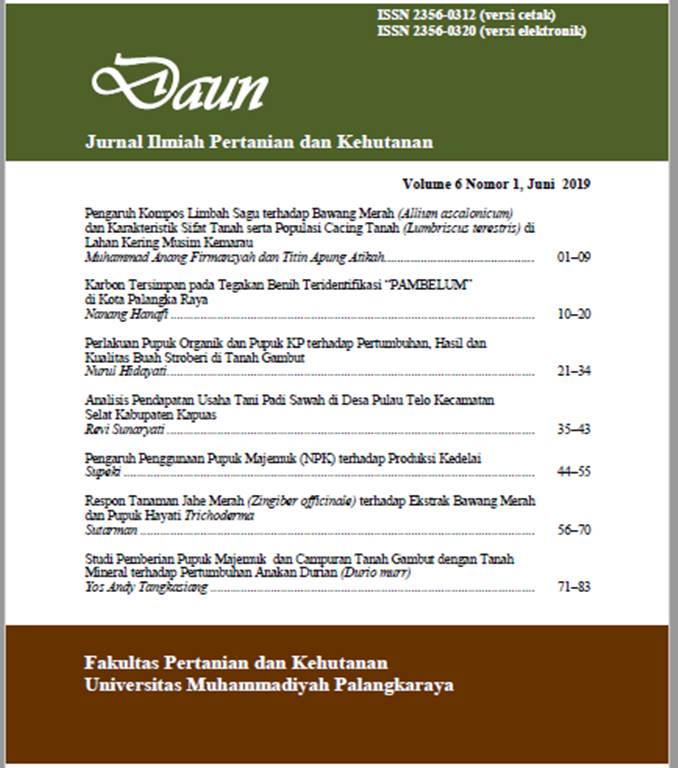
Pengaruh Kompos Limbah Sagu Terhadap Bawang Merah (Allium ascalonicum L.), dan Karakteristik Sifat Fisik Tanah Serta Populasi Cacing Tanah (Lumbriscus terestris) Dilahan Kering Musim Kemarau
DOI:
https://doi.org/10.33084/daun.v6i1.917Keywords:
Allium ascalonicumL, kompos, cacing tanah, lahan keringAbstract
The utilization of sago waste as a source of organic material, namely compost will provide positive values for both plants and soil productivity and reduce the cost of purchasing chicken manure which is increasingly expensive. Research conductedon dry land in the dry seasonat a land plot of header/ tajuk varieties red onionusing the treatment of sago waste compost dosage. The treatment of sago waste compost doses, among others KS 0 = control, KS 1 = 35 t/ha, KS 2 = 70 t/ha dan KS 3 = 105 t/ha. The results showed no significant differences between treatments on the growth parameters of red onion aged 2 MST and 4 MST. However, the dry production parameters show that KS treatment differs only with KS 0. Respectively 11,56 t/ha compared to 9,61 t/ha. The treatment of sago waste compost dosage also has a good effect on decreasing the value of soil bulk density, increasing soil water content and also soil porosity. It is associated with the increased dose of sago waste compost then further increase the number of earthworm populations at different depths in the soil. At a depth of 0-15 cm the highest population of earthworms at KS 3 reached 1,077/ 2m2while KS 0 is only 309/2m2.
Downloads
Downloads
Published
Issue
Section
License
All rights reserved. This publication may be reproduced, stored in a retrieval system, or transmitted in any form or by any means, electronic, mechanical, photocopying, recording.