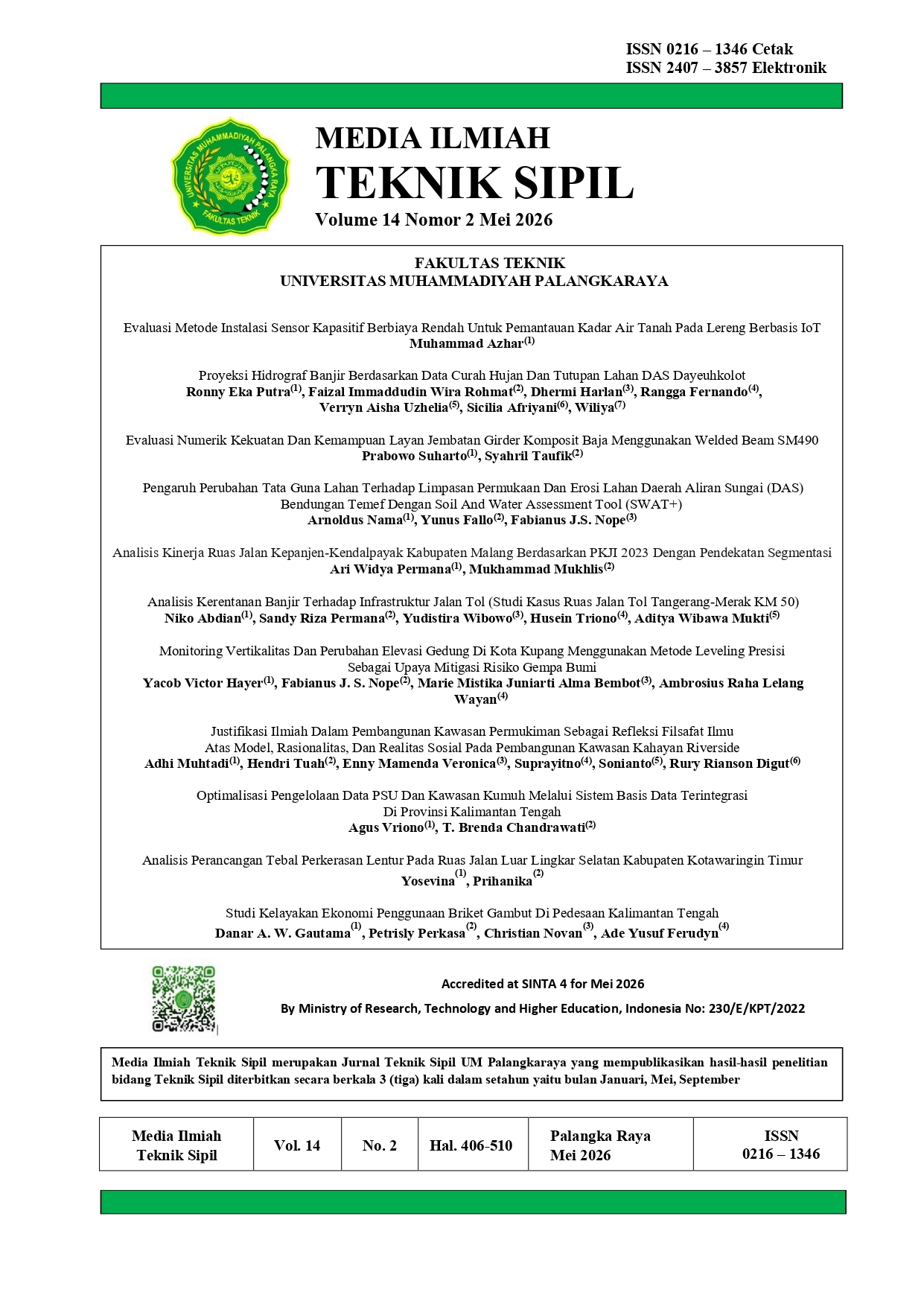
Evaluasi Metode Instalasi Sensor Kapasitif Berbiaya Rendah untuk Pemantauan Kadar Air Tanah pada Lereng Berbasis IoT Evaluation Of Low-Cost Capacitive Sensor Installation Methods For IoT-Based Soil Moisture Monitoring On Slopes
Article Sidebar
Main Article Content
Abstract
This study evaluates the effect of installation methods of low-cost capacitive soil moisture sensors on field measurement performance. Six sensors were tested using two installation methods, namely side mount and bottom mount, at three depth variations (0.2 m, 0.5 m, and 1 m). A monitoring system was developed using an ESP32 microcontroller integrated with the Firebase cloud platform for real-time data acquisition, powered by a solar panel. Field testing was conducted from March 10 to April 16, 2026, with GPM satellite rainfall data used as a supporting parameter. Calibration results showed a strong linear relationship between sensor output voltage and volumetric water content with R2>0.9 for all sensors. The bottom mount method produced valid readings from the beginning of the testing period with good response to rainfall events at all depths. In contrast, the side mount method experienced a delay in sensor–soil contact formation, resulting in invalid data during the early phase. The findings indicate that the quality of physical contact between the sensor and soil is a key factor in reading reliability, and the bottom mount method is more effective for long-term field soil moisture monitoring.
Downloads
Article Details

This work is licensed under a Creative Commons Attribution-ShareAlike 4.0 International License.
All rights reserved. This publication may be reproduced, stored in a retrieval system, or transmitted in any form or by any means, electronic, mechanical, photocopying, recording.
References
Abdelmoneim, A.A. et al. (2025) ‘Calibration of Low-Cost Capacitive Soil Moisture Sensors for Irrigation Management Applications’, Sensors, 25(2), p. 343.
Abdulraheem, M.I. et al. (2023) ‘Advancement of remote sensing for soil measurements and applications: A comprehensive review’, Sustainability, 15(21), p. 15444.
Adla, S. et al. (2020) ‘Laboratory calibration and performance evaluation of low-cost capacitive and very low-cost resistive soil moisture sensors’, Sensors, 20(2), p. 363.
Babić, D. et al. (2022) ‘An internet of things system for environmental monitoring based on ESP32 and Blynk’, in 2022 26th International Conference on Information Technology (IT). IEEE, pp. 1–5.
Bogaard, T.A. and Greco, R. (2016) ‘Landslide hydrology: from hydrology to pore pressure’, Wiley Interdisciplinary Reviews: Water, 3(3), pp. 439–459.
Deng, X. et al. (2020) ‘A method of electrical conductivity compensation in a low-cost soil moisture sensing measurement based on capacitance’, Measurement, 150, p. 107052. Available at: https://doi.org/https://doi.org/10.1016/j.measurement.2019.107052.
Filho, O.A. and Fernandes, M.A. (2019) ‘Landslide analysis of unsaturated soil slopes based on rainfall and matric suction data’, Bulletin of Engineering Geology and the Environment, 78(6), pp. 4167–4185.
Hercog, D. et al. (2023) ‘Design and Implementation of ESP32-Based IoT Devices’, Sensors, p. 6739. Available at: https://doi.org/10.3390/s23156739.
Hura, V. and Monastyrskii, L. (2023) ‘IOT-based solution for detection of air quality using ESP32’, Artificial Intelligence, 28(3), pp. 86–93.
Loconsole, D. et al. (2025) ‘Soil Moisture Sensing Technologies: Principles, Applications, and Challenges in Agriculture’, Agronomy, p. 2788. Available at: https://doi.org/10.3390/agronomy15122788.
Mane, S. et al. (2025) ‘Development of low-cost handheld soil moisture sensor for farmers and citizen scientists’, Frontiers in Environmental Science, 13, p. 1590662.
Muntohar, A.S. et al. (2022) ‘Rainfall infiltration-induced slope instability of the unsaturated volcanic residual soils during wet seasons in Indonesia’, Indonesian Journal on Geoscience, 9(1), pp. 71–85.
Nagahage, E.A., Nagahage, I.S. and Fujino, T. (2019) ‘Calibration and Validation of a Low-Cost Capacitive Moisture Sensor to Integrate the Automated Soil Moisture Monitoring System’, Agriculture, p. 141. Available at: https://doi.org/10.3390/agriculture9070141.
Patel, D., Koradia, K. and Sharma, P. (2025) ‘IoT-Based Water Quality Monitoring System using ESP32’, in 2025 7th International Conference on Energy, Power and Environment (ICEPE), pp. 1–5. Available at: https://doi.org/10.1109/ICEPE65965.2025.11139802.
Peranić, J., Čeh, N. and Arbanas, Ž. (2022) ‘The use of soil moisture and pore-water pressure sensors for the interpretation of landslide behavior in small-scale physical models’, Sensors, 22(19), p. 7337.
Pramono, N.A. et al. (2023) ‘Development a prototype of river water level monitoring system using ESP32 based on internet of things for flood mitigation’, in Journal of Physics: Conference Series. IOP Publishing, p. 12039.
Silalahi, F.E.S., Arifianti, Y. and Hidayat, F. (2019) ‘Landslide susceptibility assessment using frequency ratio model in Bogor, West Java, Indonesia’, Geoscience Letters, 6(1), p. 10.
Songara, J.C. and Patel, J.N. (2022) ‘Calibration and comparison of various sensors for soil moisture measurement’, Measurement, 197, p. 111301. Available at: https://doi.org/https://doi.org/10.1016/j.measurement.2022.111301.
Stangl, R., Buchan, G.D. and Loiskandl, W. (2009) ‘Field use and calibration of a TDR-based probe for monitoring water content in a high-clay landslide soil in Austria’, Geoderma, 150(1–2), pp. 23–31.
Suhaimi, A.F. et al. (2021) ‘IoT based smart agriculture monitoring, automation and intrusion detection system’, in Journal of Physics: Conference Series. IOP Publishing, p. 12016.
Vanapalli, S.K. et al. (1996) ‘Model for the prediction of shear strength with respect to soil suction’, Canadian Geotechnical Journal, 33(3), pp. 379–392. Available at: https://doi.org/10.1139/t96-060.
Yao, Y., Fan, J. and Li, J. (2025) ‘A review of advanced soil moisture monitoring techniques for slope stability assessment’, Water, 17(3), p. 390.
Zhang, Q. and Shen, D. (2024) ‘Rainfall-induced landslides: influencing, modelling and hazard assessment’, Water. MDPI, p. 3384.
Zhao, N., Lu, H. and Zhang, R. (2022) ‘The Coupling Effect of Pore Water Pressure and Pore Water Gravity in Unsaturated Soils under Rainfall Condition and Its Influence on Slope Stability’, Geofluids, 2022(1), p. 9492514. Available at: https://doi.org/https://doi.org/10.1155/2022/9492514.
Zhu, Y. et al. (2019) ‘Time-domain and frequency-domain reflectometry type soil moisture sensor performance and soil temperature effects in fine-and coarse-textured soils’, Applied Engineering in Agriculture, 35(2), pp. 117–134.