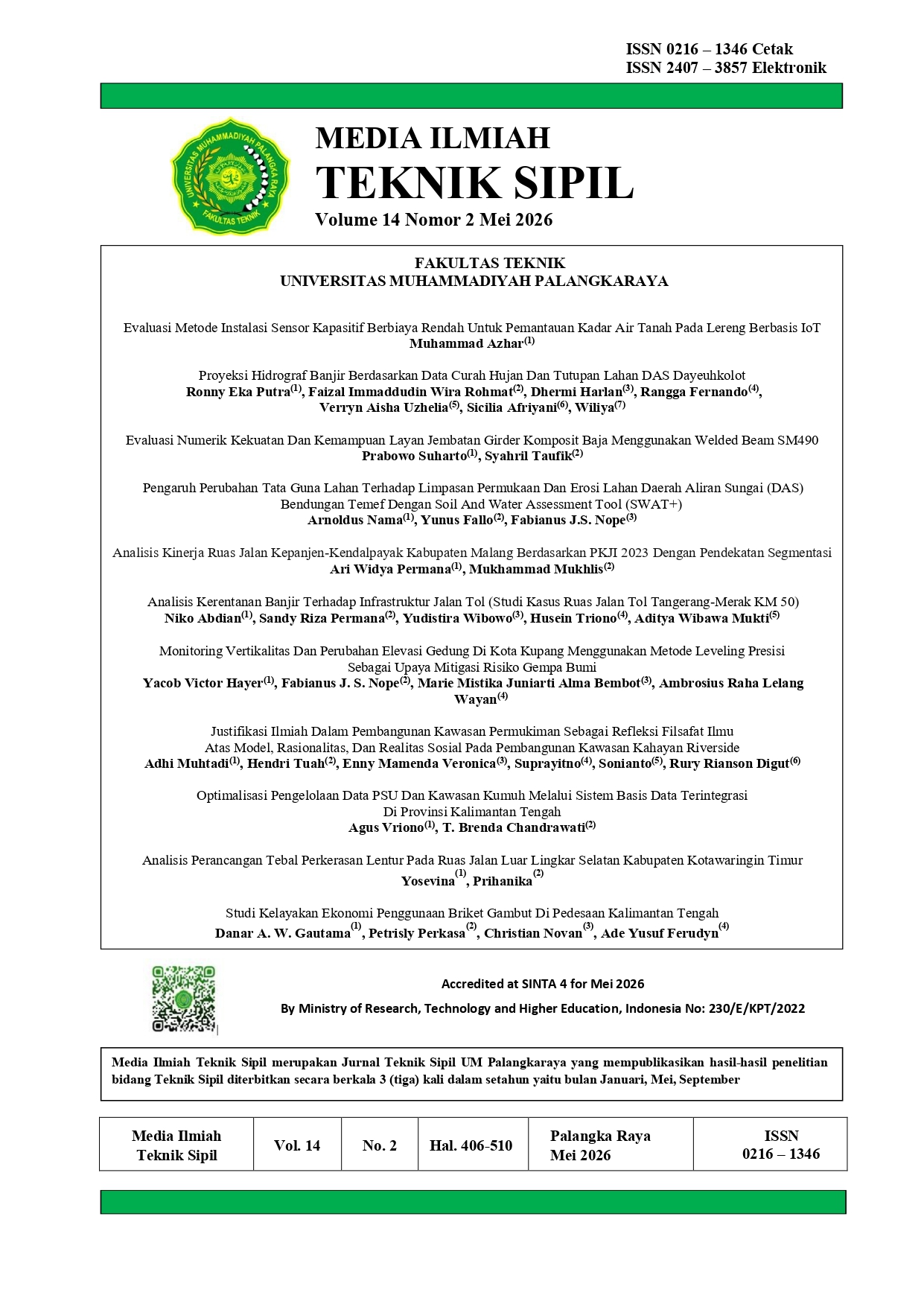
Studi Kelayakan Ekonomi Penggunaan Briket Gambut di Pedesaan Kalimantan Tengah
Economic Feasibility Study Of Peat Briquette Utilization In Rural Central Kalimantan
DOI:
https://doi.org/10.33084/mits.v14i2.12786Keywords:
Biomassa, Peat briquettes, Alternative energy, Economic feasibility, Rural Central Kalimantan, Biomass, Energy sustainabilityAbstract
This study aims to analyze the economic feasibility of utilizing peat-based briquettes as an alternative household energy source in rural Central Kalimantan. The research adopts a comparative literature review approach, examining previous studies on peat briquettes, rice husk briquettes, and bagasse briquettes. The analysis focuses on technical parameters (calorific value, moisture content, ash content, burning duration) and economic parameters (production cost, selling price, profit margin, and investment feasibility indicators). The findings indicate that peat briquettes have higher calorific values (5,800–6,200 kcal/g) and longer burning duration (±240 minutes) compared to other biomass fuels. Economically, peat briquettes demonstrate lower production costs (±Rp 3,500/kg), higher profit margins, and positive feasibility indicators, including a positive NPV, BCR of 1.8, and a payback period of approximately two years. Therefore, peat briquettes are economically feasible to be developed as a community-based alternative energy in rural Central Kalimantan, although environmental sustainability must be considered through biomass diversification and regulated peat utilization.Downloads
References
Bhattacharya, S. C., & Salam, P. A. (2002). Biomass-energy in Asia: A review of status and research. Energy for Sustainable Development, 6(3), 10–20.
FAO. (2019). Peatland management and sustainable energy. Food and Agriculture Organization of the United Nations.
IEA. (2021). Renewable energy for rural communities. International Energy Agency.
Miettinen, J., Hooijer, A., Shi, C., Tollenaar, D., Vernimmen, R., Liew, S. C., & Page, S. E. (2016). Subsidence and carbon loss in drained tropical peatlands. Environmental Research Letters, 11(9), 094014.
Page, S. E., Rieley, J. O., & Banks, C. J. (2011). Global and regional importance of the tropical peatland carbon pool. Global Change Biology, 17(2), 798–818.
Perkasa, P., Cassiophea, L., Layang, S., Sitinjak, T. A., Permanasuri, N. P. D. A., Gautama, D. A. W., Purnawan, E. I., & Ovany, R. (2024). Model 3D pondasi Kacapuri sebagai solusi berbasis kearifan lokal untuk pembangunan pada tanah gambut di Desa Gohong. Jurnal Teknik Sipil Indonesia, 18(2), 77–89.
Rahman, H. (2019). Comparative study of rice husk briquettes as household energy. Journal of Renewable Energy Studies, 12(2), 45–53.
Salehi Siahdashti, M., Talaeipoor, M., Khademieslam, H., & Bazyar, B. (2022). Investigation of physical and thermal properties of fuel briquettes made of bagasse. BioResources, 17(2), 2053–2073.
Suryani, A. (2020). The effect of peat-based briquettes on household energy efficiency. Indonesian Journal of Biomass Energy, 8(1), 33–41.
Yusuf, M. (2021). Bagasse briquettes as alternative energy for rural households. Energy and Environment Journal, 15(3), 122–130.
Downloads
Published
Issue
Section
License
Copyright (c) 2026 Danar Ariangga Windra Gautama, Petrisly Perkasa, Christian Novan, Ade Yusuf Ferudyn

This work is licensed under a Creative Commons Attribution-ShareAlike 4.0 International License.
All rights reserved. This publication may be reproduced, stored in a retrieval system, or transmitted in any form or by any means, electronic, mechanical, photocopying, recording.