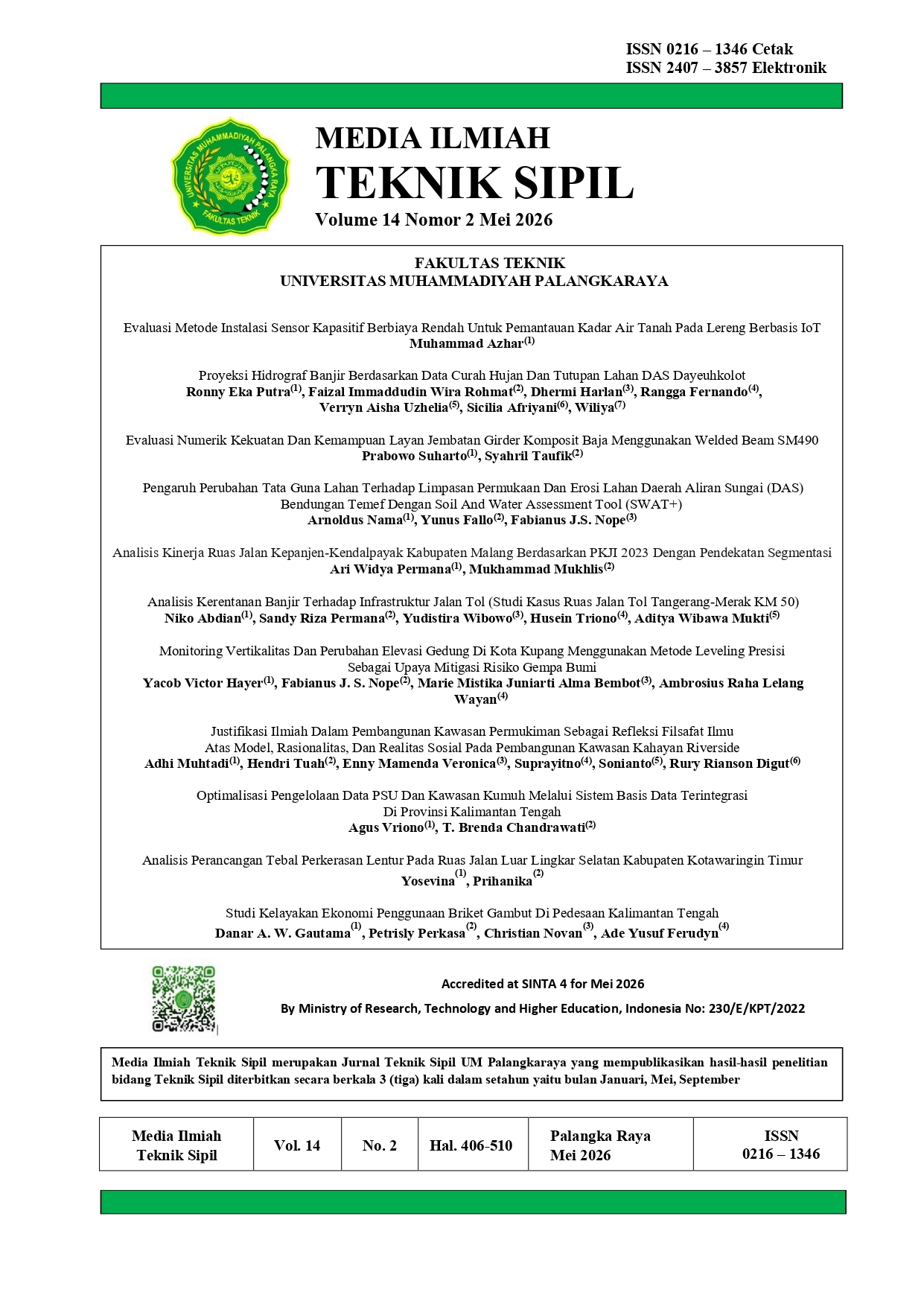
Analisis Kerentanan Banjir Terhadap Infrastruktur Jalan Tol (Studi Kasus Ruas Jalan Tol Tangerang-Merak KM 50) Analysis Of Flood Vulnerability In Toll Road Infrastructure (Case Study Of The Tangerang-Merak Toll Road At Km 50)
Article Sidebar
Main Article Content
Abstract
Flooding on the Tangerang-Merak Toll Road at KM 50+000–51+000, Cikande, in January 2026 disrupted the national logistics corridor. This study evaluates the macro-level causes of inundation through integrated hydrological analysis using a Geographic Information System (GIS) approach with scoring, overlay, and hydrological modeling techniques across 14,516 spatial units in the Cidurian Watershed. The evaluation covers spatial drainage capacity, Digital Elevation Model (DEM), flow accumulation, SWAT+ modeling, and its alignment with the Cikande Industrial Area Detailed Spatial Plan (RDTR). Analysis indicates that 96.2% of the study area has low drainage capacity, an average Curve Number of 94.2, and a surface runoff ratio of 0.83. The flooding mechanism is identified as compound flooding involving three simultaneous processes: local channel tailwater submergence driven by high Cidurian River levels, backwater accumulation in upstream toll road depressions, and overtopping across the road body. DEM analysis confirms Bakung Village as the flow pathway and Songgom Jaya Village as the final accumulation zone. The findings confirm that the flood stems from the interaction of main river overflow, loss of hydraulic gradient, and watershed capacity limits rather than local drainage constraints alone. Three technical mitigation scenarios are recommended: elevating the road, river normalization with embankments, and expanding cross-drain capacity integrated with collector drains and downstream normalization.
Downloads
Article Details

This work is licensed under a Creative Commons Attribution-ShareAlike 4.0 International License.
All rights reserved. This publication may be reproduced, stored in a retrieval system, or transmitted in any form or by any means, electronic, mechanical, photocopying, recording.
References
Amalia, E., Maryono, M., Muhammad, F., Soeprobowati, T. R., & Maas, P. (2024). Comparison of SWAT-based ecohydrological modeling in the Rawa Pening Catchment Area, Indonesia. Jurnal Pendidikan IPA Indonesia, 13(1), 45-58.
Arnold, J. G., Moriasi, D. N., Gassman, P. W., Abbaspour, K. C., White, M. J., Srinivasan, R., Santhi, C., Harmel, R. D., Van Griensven, A., Van Liew, M. W., Kannan, N., & Jha, M. K. (2012). SWAT: Model use, calibration, and validation. Transactions of the ASABE, 55(4), 1491-1508.
Bieger, K., Arnold, J. G., Rathjens, H., White, M. J., Bosch, D. D., Allen, P. M., Volk, M., & Srinivasan, R. (2017). Introduction to SWAT+, a completely restructured version of the Soil and Water Assessment Tool. Journal of the American Water Resources Association, 53(1), 115-130.
Johnston, I., Murphy, W., & Holden, J. (2021). A review of floodwater impacts on the stability of transportation embankments. Earth-Science Reviews, 215, 103553.
Danso, S. Y., Ma, Y., & Bam, S. (2020). Spatio-temporal distribution of flood occurrence in Ghana. Journal of Hydrology: Regional Studies, 32, 100756.
Fadlin, F., Widiyati, D. A., Sofyan, A. B., & Tahrir, M. (2024). Land use change and Soil Conservation Services Curve Number (SCS-CN) in Karangmumus Watershed Samarinda. International Journal of Engineering Trends and Technology, 72(10), 1-9.
Green, J., Haigh, I. D., Quinn, N., Neal, J., Wahl, T., Wood, M., Eilander, D., de Ruiter, M., Ward, P., & Camus, P. (2025). Review article: A comprehensive review of compound flooding literature with a focus on coastal and estuarine regions. Natural Hazards and Earth System Sciences, 25, 747-816.
Jafarzadegan, K., Moradkhani, H., Pappenberger, F., Moftakhari, H., Bates, P., Abbaszadeh, P., Marber, K., & Maruf, S. (2023). Recent advances and new frontiers in riverine and coastal flood modeling. Reviews of Geophysics, 61(2), e2022RG000788.
Kasmalkar, I. G., Serafin, K. A., Miao, Y., Bick, I. A., Ortolano, L., Ouyang, D., & Suckale, J. (2020). When floods hit the road: Resilience to flood-related traffic disruption in the San Francisco Bay Area and beyond. Science Advances, 6(32), eaba2423.
Kure, S., Farid, M., Fukutani, Y., Muhari, A., Bricker, J. D., Udo, K., & Mano, A. (2021). Flood inundation simulations based on GSMaP satellite rainfall data in Jakarta, Indonesia. Progress in Earth and Planetary Science, 8, 34.
Kusumo, P., & Nursari, E. (2016). Zonasi tingkat kerawanan banjir dengan Sistem Informasi Geografis pada DAS Cidurian Kab. Serang, Banten. STRING (Satuan Tulisan Riset dan Inovasi Teknologi), 1(1), 29-38.
Nageswara Rao, K. (2020). Analysis of surface runoff potential in ungauged basin using basin parameters and SCS-CN method. Applied Water Science, 10(1), 47.
Nastiti, E. U., Asih, A. S., & Hermawan, A. (2024). Pengaruh perubahan tata guna lahan terhadap debit banjir pada DAS Cibanten. 5th CEEDRIMS, 5(1), 10-20.
Nurcahyaningtyas, D., Suhartanto, E., & Harisuseno, D. (2024). Flood prone mapping based on surface runoff analysis using the SWAT model at the upstream side of Brantas. Jurnal Teknik Pengairan, 15(1), 37-49.
Ogato, G. S., Bantider, A., Abebe, K., & Geneletti, D. (2020). Geographic information system (GIS)-based multicriteria analysis of flooding hazard and risk in Ambo Town and its watershed, West Shoa Zone, Oromia Regional State, Ethiopia. Journal of Hydrology: Regional Studies, 27, 100659.
Peraturan Menteri Pekerjaan Umum dan Perumahan Rakyat Nomor 04/PRT/M/2015 tentang Kriteria dan Penetapan Wilayah Sungai.
Permatasari, R., Adityawan, M. B., Kuntoro, A. A., & Wigati, S. (2024). Projected Curve Number (CN) changes and surface runoff at the Citarum-Majalaya Watershed. International Journal of Design and Nature and Ecodynamics, 19(5), 1411-1422.
Pregnolato, M., Ford, A., Wilkinson, S. M., & Dawson, R. J. (2017). The impact of flooding on road transport: A depth-disruption function. Transportation Research Part D: Transport and Environment, 55, 67-81.
Rodrigue, J. P. (2020). The Geography of Transport Systems (5th ed.). Routledge.
Saleh, F., Ramaswamy, V., Georgas, N., Blumberg, A. F., & Pullen, J. (2020). Developing a modeling framework to simulate compound flooding: When storm surge interacts with riverine flow. Frontiers in Climate, 2, 609610.
Sebayang, I. S. (2022). Pemanfaatan Sistem Informasi Geografis (SIG) untuk analisis tingkat kerawanan banjir pada DAS Cisadane. Rekayasa Sipil, 11(1), 28-37.
Suharyanto, A. (2021). Estimating flood inundation depth along the arterial road based on the rainfall intensity. Civil and Environmental Engineering, 17(1), 66-81.
Triasary, K., Purwanto, M. Y. J., & Tarigan, S. D. (2021). Beberapa skenario penggunaan lahan untuk perbaikan kondisi hidrologi di Daerah Aliran Sungai Cidurian. Jurnal Penelitian Pengelolaan Daerah Aliran Sungai, 5(2), 121-140.
USDA-NRCS. (2004). National Engineering Handbook, Chapter 9 and 10: Estimation of Direct Runoff from Storm Rainfall, Part 630 Hydrology. USDA, Washington DC.
Wang, L., Cui, S., Li, Y., Huang, H., Manandhar, B., Nitivattananon, V., Fang, X., & Huang, W. (2022). A review of the flood management: From flood control to flood resilience. Heliyon, 8(11), e11763.
Zscheischler, J., Westra, S., van den Hurk, B. J. J. M., Seneviratne, S. I., Ward, P. J., Pitman, A., AghaKouchak, A., Bresch, D. N., Leonard, M., Wahl, T., & Zhang, X. (2018). Future climate risk from compound events. Nature Climate Change, 8, 469-477.