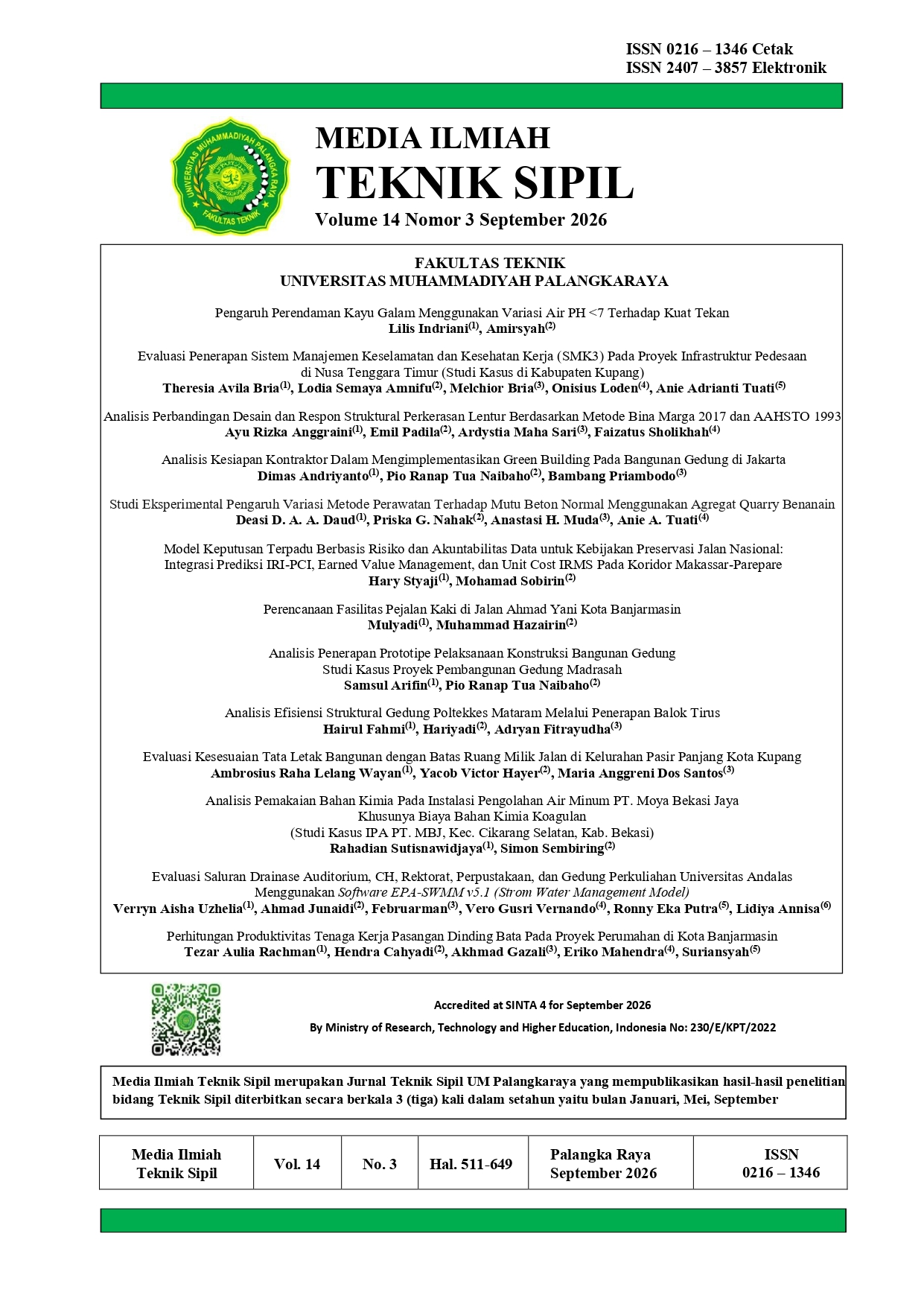
Pengaruh Perendaman Kayu Galam Menggunakan Variasi Air pH <7 Terhadap Kuat Tekan The Effect Of Soaking Galam Wood Using Variations Of Water With pH < 7 On Compressive Strength
Article Sidebar
Main Article Content
Abstract
Galam wood is a type of local wood widely used in construction, particularly in swampy areas and soft soil conditions. Wood durability is influenced by several factors, including wood species, wood condition, preservation method, and the preservative material used. Based on these considerations, this study applied a soaking method using variations of water pH, particularly water with pH < 7, to determine its effect on the mechanical properties of galam wood. This study aims to analyze the effect of soaking galam wood using variations of water pH on the compressive strength of wood parallel and perpendicular to the grain. In addition, this study examines the relationship between density and deflection of galam wood after the soaking process. The results showed that the compressive strength parallel to the grain under the condition of soaking in water with pH = 7 was 389.1 kg/cm², showing a decrease of 37.2% compared to other samples. Meanwhile, the compressive strength perpendicular to the grain under the condition of soaking in water with pH < 7 was 390 kg/cm², showing an increase of 36.00%. The highest density of wood soaked in water with pH < 7 was 2.476 kg/cm³ for the direction parallel to the grain and 2.576 kg/cm³ for the direction perpendicular to the grain. The highest deflection also occurred in wood soaked in water with pH < 7, reaching 5.00 cm parallel to the grain and 4.60 cm perpendicular to the grain. Therefore, soaking galam wood in water with pH < 7 affects the increase in compressive strength, density, and deflection of galam wood.
Downloads
Article Details

This work is licensed under a Creative Commons Attribution-ShareAlike 4.0 International License.
All rights reserved. This publication may be reproduced, stored in a retrieval system, or transmitted in any form or by any means, electronic, mechanical, photocopying, recording.
References
Adhijoso, J. (2014). Perkembangan dan prospek rekayasa struktur kayu di Indonesia. Program Magister Teknik Sipil, Universitas Kristen Petra.
Aini, N. (2009). Pengaruh pengawetan terhadap kekuatan dan keawetan produk laminasi bambu. Jurusan Teknik Sipil dan Lingkungan, Fakultas Teknik, Universitas Gadjah Mada.
Basuki, A. (2017). Sambungan batang tekan dan momen lentur laminated veneer lumber (LVL) kayu sengon (Paraserianthes falcataria) dengan alat pengencang baut. Jurnal Matriks Jurusan Teknik Sipil Universitas Sebelas Maret.
Firman, A. (2017). Teknologi pengawetan kayu bangunan dalam rangka menambah nilai ekonomi kayu. Jurnal Logika.
Irsan. (2014). Pengaruh asam sulfat (H₂SO₄) terhadap kuat tekan dan kuat tarik kayu kelapa. Jurusan Sipil, Fakultas Teknik, Universitas Hasanuddin Makassar.
Johar, D. (2017). Penerapan material kayu kelapa pada konstruksi resort Pantai Goa Cina. Jurusan Arsitektur, Fakultas Teknik, Universitas Brawijaya Malang.
Pangestuti, E. K. (2015). Pengawetan kayu sengon melalui rendaman dingin menggunakan bahan pengawet Enbor SP ditinjau terhadap sifat mekanik. Jurusan Teknik Sipil, Fakultas Teknik, Universitas Negeri Semarang.
Prasetyo, S. (2017). Efektivitas pengawetan kayu terhadap serangan rayap dengan menggunakan bahan pengawet ekstrak tembakau dan urea. Program Studi Teknik Sipil, Fakultas Teknik, Universitas Negeri Yogyakarta.
Rahayu, K. (2015). Sifat penyerapan bahan pengawet dan beberapa jenis kayu bangunan. Fakultas Kehutanan, Institut Pertanian Stiper Yogyakarta.
Suhaendah, E. (2014). Pengawetan kayu tisuk (Hibiscus macrophyllus) melalui rendaman dingin dengan bahan pengawet boric acid equivalent. Balai Penelitian Teknologi Agroforestry.
Yuliani, S. (2015). Pengaruh lama perendaman kayu albasia (Albizia falcataria L.) dalam minyak pirolisis sampah plastik terhadap serangan rayap tanah (Microtermes inspiratus Kemner). Fakultas Biologi, Universitas Jenderal Soedirman.