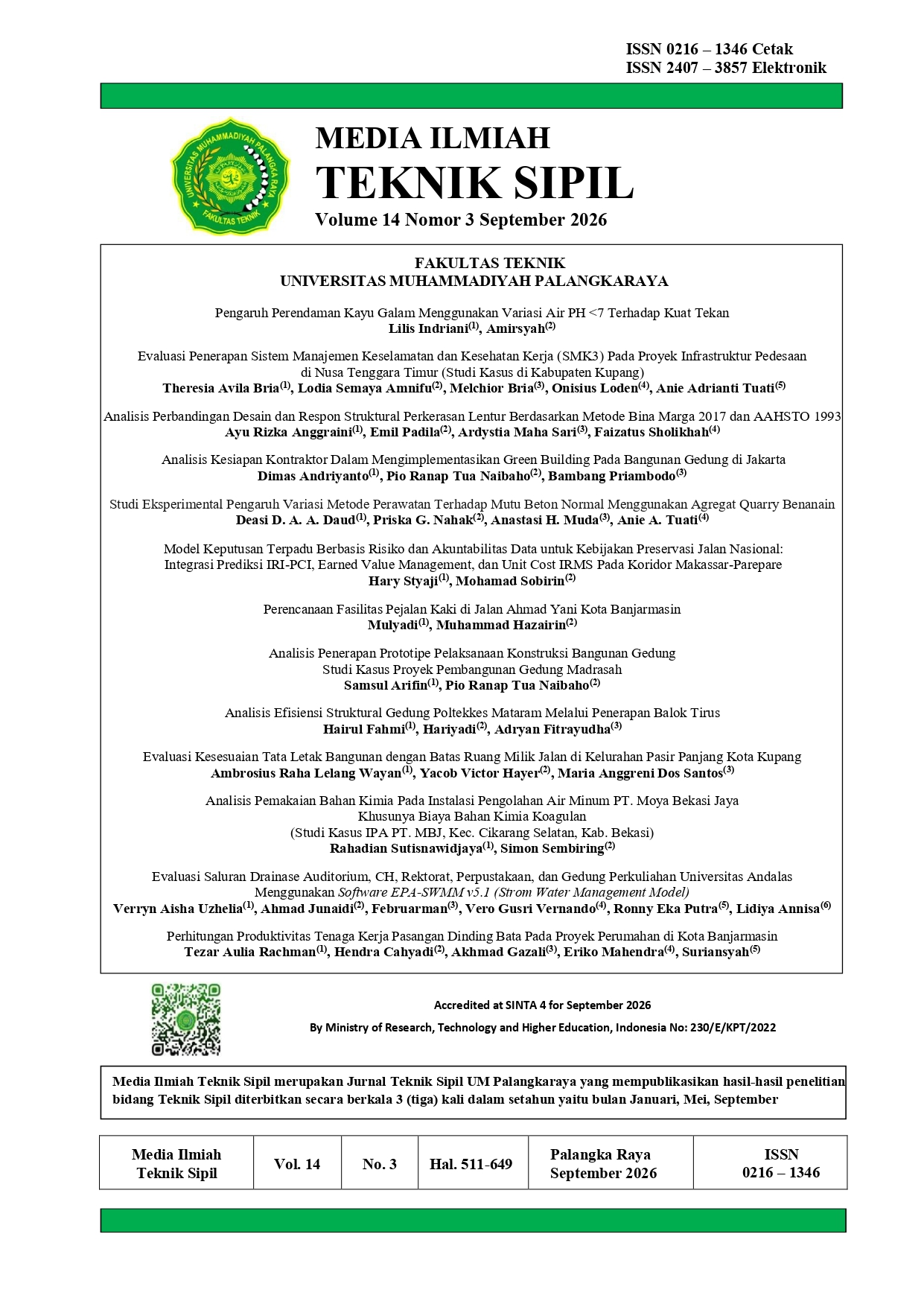
Analisis Pemakaian Bahan Kimia Pada Instalasi Pengolahan Air Minum PT. Moya Bekasi Jaya Khususnya Biaya Bahan Kimia Koagulan (Studi Kasus IPA PT. MBJ, Kec. Cikarang Selatan, Kab. Bekasi) Analysis Of Chemical Consumption at The PT. Moya Bekasi Jaya Drinking Water Treatment Plant: A Focus On Coagulant Costs (Case Study Of PT. MBJ WTP, South Cikarang District, Bekasi Regency)
Article Sidebar
Main Article Content
Abstract
Clean water is a basic necessity that plays a vital role in maintaining public health and supporting various life activities. To meet the demand for clean water in the Cikarang region and its surroundings, Perumda Tirta Bhagasasi collaborates with the private sector through the Water Treatment Plant (WTP) of PT Moya Bekasi Jaya (MBJ), which utilizes raw water from the Tarum Barat Canal. This study aims to evaluate the effectiveness of using Aluminum Sulfate (Alum) and Poly Aluminum Chloride (PAC) coagulants based on raw water quality, treatment results, and operational cost efficiency. The research methods include collecting primary and secondary data for the period of January–December 2025, analyzing laboratory test results (jar tests), evaluating the optimum coagulant dosage based on turbidity and pH parameters, and analyzing operational cost efficiency. The relationship between raw water turbidity and coagulant dosage was analyzed using linear regression. The results showed a strong correlation between raw water turbidity and the required coagulant dosage, with a coefficient of determination (R^2) of 0.9218 for Alum and 0.9507 for PAC. The jar test results indicated that PAC performed better than Alum when raw water turbidity exceeded 228.49 NTU. The efficiency of PAC usage became more evident at raw water turbidity levels above 300 NTU, with PAC being 4.7% more cost-effective, saving IDR 5.88/m³. Based on the research findings, PAC 8% is recommended as a more effective and efficient coagulant for high raw water turbidity conditions, while Alum 8% remains feasible for low to moderate turbidity levels to optimize water treatment operational costs.
Downloads
Article Details

This work is licensed under a Creative Commons Attribution-ShareAlike 4.0 International License.
All rights reserved. This publication may be reproduced, stored in a retrieval system, or transmitted in any form or by any means, electronic, mechanical, photocopying, recording.
References
Al-Ghamdi, A., dkk. (2021). "Economic Evaluation and Optimization of Coagulant Dosage in Water Treatment Plants." Journal of Water Process Engineering, Vol. 40, pp. 101-115.
A. Oktavianto and F. Rosariawari, "Evaluasi penggunaan bahan kimia pada instalasi pengolahan air minum," pp. 45–52, 2024.
Budiman, A., & Setiawan, H. (2023). "Analisis Efisiensi Biaya Operasional Bahan Kimia pada Pengolahan Air Bersih PDAM." Jurnal Teknik Lingkungan, Vol. 9(2), pp. 45-56.
F. R. Spellman, Handbook of Water and Wastewater Treatment Plant Operations. Boca Raton: CRC Press, 2004, pp. 341–345.
G. Tchobanoglous and F. Burton, Wastewater Engineering: Treatment and Reuse, 4th ed. New York: McGraw-Hill, 2003, pp. 120–124.
Hendrawan, D. (2020). "Optimasi Dosis Koagulan Poly Aluminum Chloride (PAC) untuk Menurunkan Biaya Produksi Air Minum." Jurnal Teknologi Air Bersih, Vol. 14(1), pp. 12-23.
Hidayat, R., & Shavitri, D. (2022). "Studi Komparasi Efisiensi Aluminium Sulfat dan Poly Aluminium Chloride (PAC) pada Pengolahan Air Bersih." Jurnal Teknik Lingkungan, 11(2), pp. 145–154.
Indonesia, Peraturan Pemerintah Republik Indonesia Nomor 122 Tahun 2015 tentang Sistem Penyediaan Air Minum, 2015.
J. Wilson, Water Clarification and Sedimentation Systems. Oxford: Elsevier Science, 2005, pp. 88–95.
Kementerian Kesehatan Republik Indonesia, Peraturan Menteri Kesehatan Republik Indonesia Nomor 2 Tahun 2023 tentang Persyaratan Kualitas Air Minum, 2023.
Kumar, R., & Bhardwaj, A. (2022). "Chemical Cost Minimization in Surface Water Treatment Using Quality Productivity Metrics." Water Resources Management, Vol. 36(5), pp. 1895-1910.
Lestari, S., dkk. (2024). "Penerapan Metode Metode Activity-Based Costing (ABC) dalam Menentukan Biaya Satuan Koagulan di Pengolahan Air." Jurnal Akuntansi dan Keuangan Industri, Vol. 5(1), pp. 77-89.
Prasetyo, B. (2022). "Evaluasi Kinerja Unit Koagulasi-Flokulasi: Hubungan Karakteristik Air Baku dengan Nilai Ekonomis Bahan Kimia." Jurnal Air Indonesia, Vol. 11(3), pp. 210-222.
Pratama, M. A., Siregar, A. H., & Hutagalung, R. (2021). "Analisis Pengaruh Fluktuasi Kekeruhan Air Baku Sungai Terhadap Dosis Koagulan di Instalasi Pengolahan Air." Jurnal Infrastruktur dan Lingkungan, 7(1), pp. 23–32.
Ramadhan, F., & Fitriani, N. (2021). "Studi Komparasi Efisiensi Biaya Koagulan Aluminium Sulfat dan Poly Aluminum Chloride pada WTP Industri." Jurnal Teknik Kimia dan Lingkungan, Vol. 5(2), pp. 134-143.
Ramadhani, S., & Warmadewanthi, I. (2020). "Optimasi Dosis Koagulan untuk Kekeruhan Tinggi Menggunakan Metode Jar Test dan Pemodelan Regresi." Jurnal Purifikasi, 18(2), pp. 89–98.
R. Smith and J. Scott, Water Treatment Principles and Design, 2nd ed. New York: John Wiley & Sons, Inc., 2005, pp. 210–218.
Santos, M., & Silva, C. (2023). "Statistical Process Control for Chemical Dosage Optimization in Water Treatment Plants." Control Engineering Practice, Vol. 121, pp. 105-118.
Sutapa, I. A. (2018). "Evaluasi Kinerja Unit Koagulasi-Flokulasi-Sedimentasi dalam Menurunkan Kekeruhan dan Zat Organik Air Permukaan." Jurnal Teknologi Lingkungan, 19(1), pp. 55–64.
Wahyudi, E., Lestari, S., & Nugroho, A. (2023). "Efisiensi Tekno-Ekonomi Penggunaan Poly Aluminium Chloride (PAC) dalam Pengolahan Air Minum pada Skala Industri." Jurnal Riset Teknologi Industri, 17(1), pp. 72–81
Wibowo, T. (2025). "Analisis Efisiensi Penggunaan Bahan Coagulant Aid untuk Menekan Biaya Koagulan Utama pada IPA Kapasitas Besar." Jurnal Infrastruktur dan Lingkungan, Vol. 7(1), pp. 33-45.
Zhang, Y., dkk. (2022). "Data-Driven Chemical Cost Optimization in Municipal Wastewater and Drinking Water Treatment." Water Research, Vol. 215, pp. 118-132.