
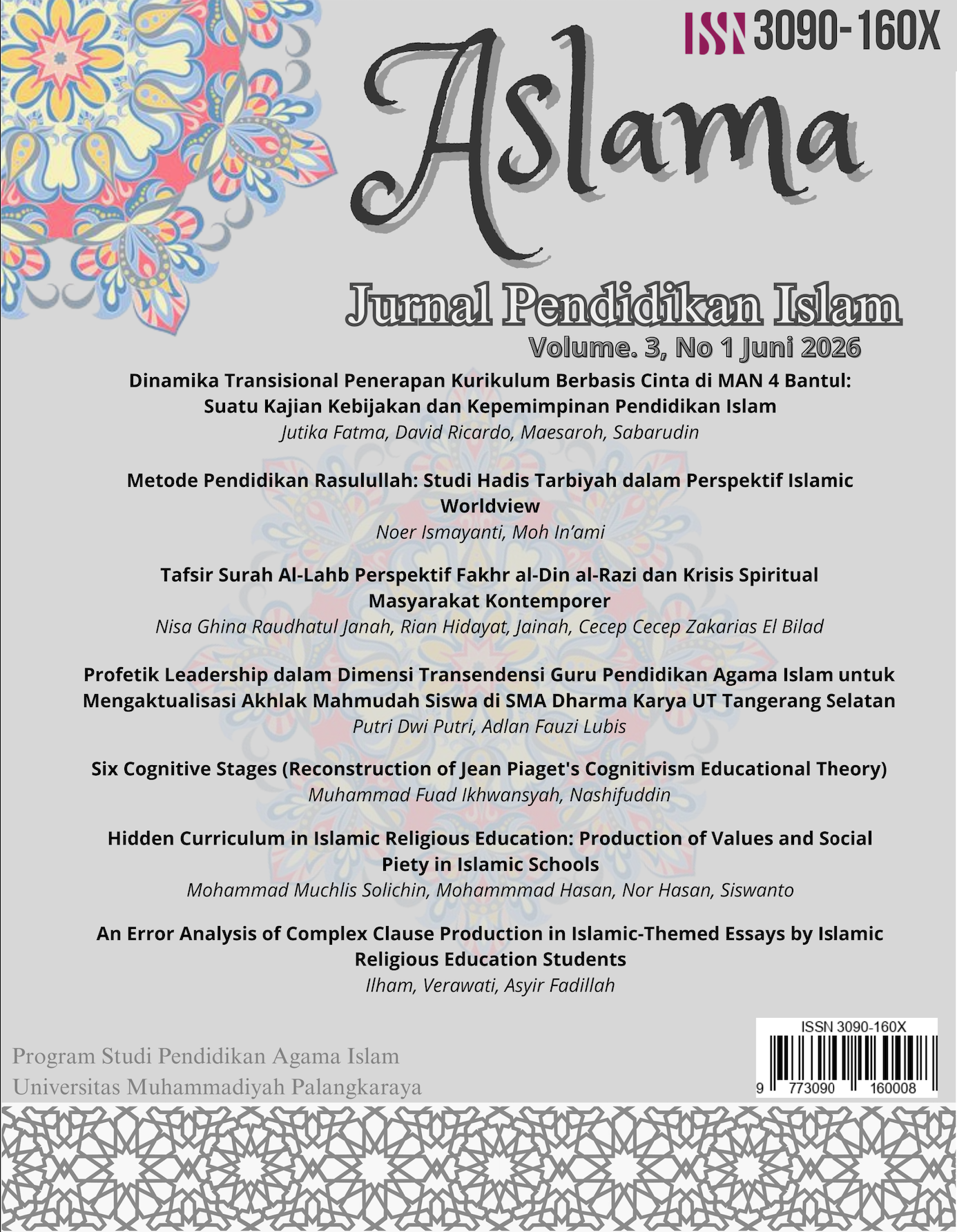
An Error Analysis of Complex Clause Production in Islamic-Themed Essays by Islamic Religious Education Students
Article Sidebar
Main Article Content
Abstract
The mastery of complex clauses is a critical prerequisite for academic writing in English, particularly for students of Islamic Religious Education who must integrate foreign grammatical structures with semantically dense Islamic terminology. This descriptive qualitative study, grounded in the Error Analysis framework, aims to identify error patterns in the production of noun clauses and adjective clauses in Islamic-themed essays and to interpret the underlying causal factors. Primary data were drawn from 15 Mid-Term Examination answer sheets produced by second-semester PAI students, while supporting data were collected through a Focus Group Discussion with six purposively selected students. Document analysis revealed that the most dominant errors occurred in spelling and mechanics, followed by misordering, omission, misformation, and subject-verb disagreement. A further notable finding was the emergence of avoidance strategy, whereby students consistently simplified their ideas into short, discrete sentences to circumvent the risk of errors in complex clause formation. FGD data indicated that students used Indonesian as a cognitive mediator prior to composing in English, while Islamic terminology compounded the cognitive load of the composition process. These findings point to a persistent gap between students' declarative grammatical knowledge and their productive competence in free writing. This study recommends an instructional approach that integrates pre-teaching of Islamic domain vocabulary, scaffolded complex clause production practice, and the reinforcement of students' linguistic self-efficacy.
Downloads
Article Details

This work is licensed under a Creative Commons Attribution-ShareAlike 4.0 International License.
References
AlMohaya, L. F. (2022). The impact of Telegram on syntactic complexity of the Saudi female EFL undergraduates’ argumentative, classification, and reaction essays (Master’s thesis, Al-Imam Muhammad Ibn Saud Islamic University). Arab World English Journal. https://doi.org/10.24093/awej/th.282
Bandura, A. (1997). Self-efficacy: The exercise of control. W. H. Freeman.
Biber, D., Johansson, S., Leech, G., Conrad, S., & Finegan, E. (1999). Longman grammar of spoken and written English. Longman.
Braun, V., & Clarke, V. (2006). Using thematic analysis in psychology. Qualitative Research in Psychology, 3(2), 77–101. https://doi.org/10.1191/1478088706qp063oa
Corder, S. P. (1967). The significance of learners’ errors. International Review of Applied Linguistics in Language Teaching, 5(1–4), 161–170. https://doi.org/10.1515/iral.1967.5.1-4.161
Creswell, J. W., & Poth, C. N. (2018). Qualitative inquiry and research design: Choosing among five approaches (4th ed.). SAGE Publications.
Daud, A., Firmansyah, & Octasary, M. (2024). An investigation of student’s performance in using compound-complex sentences in writing at EFL classroom. Jurnal Bilingual, 14(1), 8–12. https://doi.org/10.33387/j.bilingual.v14i1.8181
Denzin, N. K. (1978). The research act: A theoretical introduction to sociological methods. McGraw-Hill.
Dulay, H., Burt, M., & Krashen, S. (1982). Language two. Oxford University Press.
Flowerdew, J., & Peacock, M. (Eds.). (2001). Research perspectives on English for academic purposes. Cambridge University Press.
Gass, S. M., & Mackey, A. (2000). Stimulated recall methodology in second language research. Lawrence Erlbaum Associates.
Hyland, K. (2006). English for academic purposes: An advanced resource book. Routledge.
James, C. (1998). Errors in language learning and use: Exploring error analysis. Longman.
Kahneman, D. (1973). Attention and effort. Prentice-Hall.
Khan, A. (2022). The effect of writing exercises in classroom on the production of written sentences at undergraduate level by Saudi EFL learners: A case study of error analysis. Cogent Education, 9(1), 2122259. https://doi.org/10.1080/2331186X.2022.2122259
Kirkpatrick, A. (2010). The Routledge handbook of world Englishes. Routledge.
Patton, M. Q. (2002). Qualitative research and evaluation methods (3rd ed.). SAGE Publications.
Ramadhianti, A., Kurniasih, E., Somba, S., & Akmaliah, N. (2022). An error analysis in generating compound complex sentence on students’ writing. Journal of English Language Teaching and Literature, 5(2), 141–150. https://doi.org/10.47080/jeltl.v5i2.2131
Richards, J. C. (1971). A non-contrastive approach to error analysis. English Language Teaching, 25(3), 204–219. https://doi.org/10.1093/elt/XXV.3.204
Schachter, J. (1974). An error in error analysis. Language Learning, 24(2), 205–214. https://doi.org/10.1111/j.1467-1770.1974.tb00502.x
Selinker, L. (1972). Interlanguage. International Review of Applied Linguistics in Language Teaching, 10(1–4), 209–231. https://doi.org/10.1515/iral.1972.10.1-4.209
Suhono, Cahyono, B. Y., & Ndruru, F. (2025). An error analysis of writing products made by Indonesian Islamic university students. Jurnal Iqra’: Kajian Ilmu Pendidikan, 10(1), 228–248. https://doi.org/10.25217/ji.v10i1.5808
Sulistyaningsih, D. (2021). Grammatical errors in undergraduate thesis abstracts: An error analysis study. LingTera, 8(1), 34–45.
Swain, M. (1985). Communicative competence: Some roles of comprehensible input and comprehensible output in its development. In S. Gass & C. Madden (Eds.), Input in second language acquisition (pp. 235–253). Newbury House.
Sweller, J. (1988). Cognitive load during problem solving: Effects on learning. Cognitive Science, 12(2), 257–285. https://doi.org/10.1207/s15516709cog1202_4